

Moving to a new state or expanding your practice through telemedicine sounds exciting—until you hit the wall called state medical licensing.
Each U.S. state has its own rules, timelines, and paperwork labyrinth. But with the proper prep and strategy, you can turn this months-long headache into a smooth, predictable process.
Let’s explore how to get a state medical license in this step-by-step guide — from eligibility to final approval.
How to Get a New State Medical License
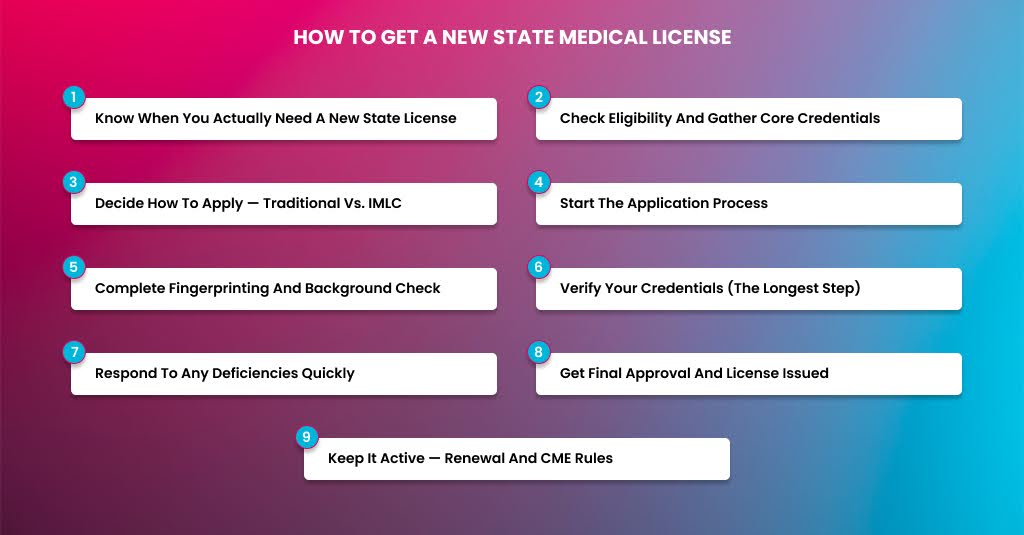
Applying for a new state medical license might sound complicated, but it’s really just a process — one you can handle easily if you know what to expect. Each step builds on the last, and with a bit of preparation, you can save weeks of waiting. Let’s break it down step by step and walk through exactly how to get your new state license without unnecessary delays.
Step 1: Know When You Actually Need a New State License
Before you start, make sure you really need a new license.
Here’s a quick rule of thumb:
- In-person practice: You need a state license that allows you to practice where the patient is physically located during the encounter.
- Telemedicine: The same rule applies—the patient’s location determines the required license.
- Locum Tenens or Travel Assignments: You must be licensed in each state where you’ll practice, even temporarily.
- Multi-state medical groups: Each physician needs a license in every state where they treat patients.
If you live in Texas but treat a patient virtually in Florida, you must have a Florida medical license — even if you never set foot there.
Step 2: Check Eligibility and Gather Core Credentials
Each state board has its own quirks, but most require similar baseline qualifications.
Common Requirements:
- MD or DO degree from an accredited U.S. or foreign medical school.
- Completed residency training (usually at least one year for U.S. graduates; up to three for international grads).
- Passed all required exams (USMLE or COMLEX).
- No disciplinary or malpractice red flags that could delay approval.
- U.S. citizenship or legal work status.
Key Documents to Collect Early:
You’ll need these for nearly every state board:
- Medical school diploma and transcripts
- Residency/fellowship verification
- Board certification (if applicable)
- USMLE/COMLEX score reports
- Employment history and references
- Malpractice claim history and NPDB self-query report
- Passport-style photo and valid ID
Start collecting your documents before you even start the application — delays often stem from waiting on verifications.
Step 3: Decide How to Apply — Traditional vs. IMLC
Here’s where you can save months of your life.
Option 1: Traditional State Application
You apply directly to the state medical board.
- Works if you’re not eligible for IMLC.
- It can take 3–6 months (in some states, even 9).
- Involves manually sending verifications to every state.
Option 2: Interstate Medical Licensure Compact (IMLC)
The IMLC is a shortcut that lets you obtain licenses in multiple states more quickly if your primary permit is in a “compact” state.
Eligibility:
- Your primary license is in an IMLC member state.
- You have no disciplinary actions or criminal record.
- You live in (or have a principal practice in) that state.
Once approved, you can apply for licenses in other member states in days instead of months.
IMLC covers 37 states + Guam and D.C. (as of 2025) — including big ones like Texas, Florida, Arizona, and Washington.
Visit imlcc.org to check if your state participates.
Step 4: Start the Application Process
Once you pick your path, the real paperwork begins.
To start the application process:
- Create an online account on the state medical board website.
- Complete the application form (be meticulous—minor errors can cause delays).
- Pay application fees (usually $400–$1,000 depending on the state).
- Send verifications to medical school, residencies, and previous employers.
- Submit fingerprint/background check.
- Provide malpractice history and NPDB self-query.
- Upload continuing medical education (CME) if required.
- Wait for the board to process and verify everything.
Processing Times:
- Fast states (e.g., Alaska, Michigan): ~4–6 weeks.
- Moderate (e.g., Texas, Georgia): 2–4 months.
- Slow (e.g., California, New York): 4–6+ months.
Step 5: Complete Fingerprinting and Background Check
Every state conducts criminal background checks through the FBI and state agencies.
You’ll either:
- Get fingerprinted at an approved local center, or
- Order a fingerprint card and mail it to the board.
Tip: Do this early.
Boards won’t move forward until your background check clears — and it often takes 2–3 weeks.
Step 6: Verify Your Credentials (The Longest Step)
Credential verification eats up the most time.
Here’s how it works:
- Your med school, residency, and licensing boards must directly send verification to the new state board.
- Many use the Federation Credentials Verification Service (FCVS) from FSMB.
FCVS (Federation Credentials Verification Service)
Think of FCVS as your digital credential vault.
It stores verified copies of your:
- Education
- Training
- Exam scores
- Identity
Once stored, any state that accepts FCVS (most do) can pull your file instantly.
Saves time if you plan to apply in multiple states.
Takes longer for first-time setup (3–6 weeks).
Step 7: Respond to Any Deficiencies Quickly
Boards often send “deficiency letters” if something’s missing or unclear — like a date mismatch or missing verification.
Don’t panic. Just fix the issue fast.
Every week you delay your response, the timeline extends.
Keep a spreadsheet of what each state has received, what is pending verification, and the communication logs. It’ll save you hours of guesswork.
Step 8: Get Final Approval and License Issued
Once all checks clear and documentation is complete, the board will:
- Approve your application
- Issue your license number
- Publish it on their public lookup site
You’ll usually get an email confirmation first, then a paper copy in the mail.
Congratulations — you’re now licensed in a new state!
Step 9: Keep It Active — Renewal and CME Rules
Every state has its own renewal cycle (usually 1–2 years).
Expect to:
- Pay a renewal fee ($100–$600).
- Submit proof of CME hours.
- Update malpractice and disciplinary disclosures.
Set reminders 90 days before renewal deadlines.
Letting a license lapse means paying reinstatement fees—and sometimes redoing background checks.
State-by-State Quirks (2025 Snapshot)
| State | Avg. Processing Time | Fees | FCVS Required? | IMLC Member |
| California | 4–6 months | $1,300 | Optional | No |
| Texas | 2–4 months | $1,000 | Recommended | Yes |
| Florida | 6–8 weeks | $775 | Yes | Yes |
| New York | 4–6 months | $735 | Optional | No |
| Arizona | 4–6 weeks | $500 | Yes | Yes |
| Illinois | 3–5 months | $700 | Yes | Yes |
(Estimates as of 2025 — always verify on the state board site.)
Common Mistakes Physicians Make — And How to Avoid Them
Even the most organized physicians can get tripped up by state licensing paperwork. Between credential verifications, background checks, and endless forms, it’s easy to make small mistakes that cost you weeks or even months of delay.
Here’s a breakdown of the most common errors — and the smart ways to avoid them.
Starting Without Checking Eligibility
This is mistake number one—and it’s shockingly common.
Each state medical board has its own definition of “qualified.” Some want three years of postgraduate training for international medical graduates (IMGs). Others require a specific number of USMLE attempts or a minimum Step 3 score.
How to Avoid It:
- Visit the official state medical board website and read the eligibility criteria line by line.
- Confirm USMLE/COMLEX limits, postgraduate training requirements, and license type (full, limited, telemedicine, etc.).
- If you’re an IMG, check if your ECFMG certification is accepted.
- Email the board directly if anything’s unclear. They usually respond within a few days.
A 15-minute review before you apply can save you three months of wasted effort.
Ignoring Documentation Details
This one sounds minor, but it causes most of the headaches. Boards reject or delay thousands of applications each year due to missing signatures, incorrect dates, or mismatches between forms.
How to Avoid It:
- Before uploading anything, cross-check all dates—graduation, residency start/end, employment periods.
- Always sign and date every document (digital or handwritten).
- Keep a “master file” folder with your verified copies so you can reuse them for other states.
- Double-check that your name appears the same everywhere — even a missing middle initial can trigger a red flag.
Think of it like surgery: precision matters more than speed.
Submitting Applications Before Getting Fingerprints Done
Here’s the silent killer of turnaround times. Most boards won’t even touch your application until your background check clears — and those fingerprints can take 2–3 weeks to process.
How to Avoid It:
- Schedule your fingerprinting before or within 48 hours of applying.
- If the state uses mailed fingerprint cards, send them via tracked courier (UPS, FedEx, etc.).
- Save the tracking receipt and upload it to your applicant portal if the board allows it.
- Some states accept digital fingerprinting vendors—they’re faster and more reliable.
A good rule: treat fingerprints as Step 1, not an afterthought.
Not Tracking Verifications
This is where most applications get “stuck in limbo.”
Your medical school, residency program, and previous state boards must send verification letters directly to your new board. If even one doesn’t arrive, your file sits on hold — often without notice.
How to Avoid It:
- Create a simple tracking sheet (Excel or Google Sheet). List each verification, date requested, method sent, and confirmation received.
- Contact each institution two weeks after your request to confirm receipt.
- Use FCVS (Federation Credentials Verification Service) for verified documents that can be reused across states.
- If something’s delayed, ask the institution to send it by secure email or by fax, if the board allows it.
You’re the project manager here — act like one. Track, follow up, and document every step.
Forgetting to Disclose Minor Disciplinary Actions
Many physicians assume that if a minor issue was “cleared” or “expunged,” it doesn’t need to be listed. That’s a big mistake. State boards cross-check every applicant through the National Practitioner Data Bank (NPDB) and other databases. If they find something you didn’t disclose, they’ll see it as dishonesty — not oversight.
How to Avoid It:
- Disclose everything, no matter how minor. If in doubt, list it.
- Provide a brief, factual explanation of the situation — don’t dramatize or hide details.
- If you have documentation showing resolution (like a reinstatement letter), attach it.
- Never assume “they won’t find out.” They will.
Boards appreciate honesty more than perfection.
How Long Does It Take to Get a New State Medical License?
There’s no one-size-fits-all answer. But here’s a realistic timeline based on thousands of real-world cases from 2024–2025 data.
| Application Route | Average Processing Time | Best For |
| Interstate Medical Licensure Compact (IMLC) | 2–4 weeks | Multi-state licensing, telemedicine |
| Traditional (Direct to State Board) | 3–6 months | Single-state move or non-IMLC states |
| With Licensing Service (Concierge Handling) | 2–8 weeks | Busy physicians who delegate paperwork |
Now let’s unpack what drives those numbers.
Conclusion
Getting a new state medical license might feel overwhelming at first — endless forms, verifications, and background checks can test anyone’s patience. But once you understand the process, it becomes a series of predictable steps rather than a guessing game.
Start with solid preparation: gather your credentials early, double-check every date and document, and complete your fingerprints right away. If you’re eligible, use the Interstate Medical Licensure Compact (IMLC) — it’s the fastest path to multi-state licensing. And most importantly, stay organized and responsive. Those two habits alone can shave months off your wait time.
Once your new license arrives, the real opportunities open up — new patients, new states, and more flexibility to grow your practice. The process takes time, but the payoff is freedom to practice where and how you want.
Ready To Streamline Your Revenue Cycle?
While you focus on your license and patient care, A2Z Medical Billing handles the administrative grind. From medical credentialing and payer enrollment to full-service billing and denial management, we help physicians turn clean claims into clean payments.
We handle the back-office so you can stay focused on what really matters — medicine, not paperwork.
Get in touch with A2Z Medical Billing today and see how our team can help you increase collections, reduce claim denials, and keep your practice financially healthy.
Schedule Your Free Consultation
