

If you treat Medicare patients, you have almost certainly run into a situation where Medicare may not cover a service you are about to provide.
Maybe the procedure is considered not medically necessary under Medicare’s guidelines.
Maybe the frequency of a service exceeds what Medicare allows. Or maybe the patient wants a service that simply falls outside covered benefits.
Whatever the reason, you cannot just provide the service and hope for the best. That is exactly where the Advance Beneficiary Notice of Noncoverage, commonly called the ABN, comes in.
The ABN is one of the most important and most misunderstood documents in Medicare compliance.
Use it correctly, and you protect your right to collect payment from the patient when Medicare denies. Use it wrong, or skip it entirely, and you could be left holding the bill with no legal way to recover a single dollar from the patient.
This guide walks you through everything you need to know about ABNs: what they are, when they are required, how to complete them properly, and the costly mistakes you need to avoid.
What Is an ABN?
An Advance Beneficiary Notice of Noncoverage is a written notice that Medicare fee-for-service providers must give to beneficiaries before providing items or services that Medicare may not cover.
The operative word in that sentence is advance, you must give this notice before the service is rendered, not after.
The ABN accomplishes two things at once.
First, it informs the patient that Medicare may not pay for the specific service and tells them why you expect it may be denied.
Second, it asks the patient to choose whether they still want the service and, if so, whether they accept financial responsibility for it.
The form itself is issued by CMS, the Centers for Medicare and Medicaid Services, and providers must use the official CMS R 131 form. You cannot create your own version, and you cannot modify the form’s structure.
CMS updates this form periodically, so you should always confirm you are using the current version. As of the last CMS update, the current ABN is clearly labeled with the form number and an expiration date in the upper right corner.
According to the Centers for Medicare & Medicaid Services (CMS), Medicare denies hundreds of millions of dollars in claims annually due to medical necessity determinations.
A properly executed ABN is your financial safety net when those denials happen.
Why Advance Beneficiary Notices (ABNs) Are Important in Medicare Billing
The Advance Beneficiary Notice (ABN) plays a critical role in Medicare billing compliance and patient financial transparency. When a healthcare provider believes Medicare may not cover a service due to medical necessity rules, frequency limitations, or coverage restrictions, the ABN allows the patient to make an informed decision before receiving the service.
For providers, the ABN acts as a financial protection mechanism. Without a valid ABN on file, providers generally cannot bill the patient if Medicare denies the claim. This means the practice may have to absorb the entire cost of the service.
Proper ABN usage ensures compliance with Centers for Medicare & Medicaid Services (CMS) regulations, improves communication with patients, and reduces unexpected billing disputes.
How ABNs Protect Revenue in Medical Billing
From a revenue cycle perspective, ABNs directly determine whether a provider can recover payment after a Medicare denial.
- With a valid ABN: The provider can bill the patient after denial
- Without an ABN: The provider must write off the entire charge
For example, if a practice performs 50 services per month that Medicare denies and each service averages $150:
- Without ABNs → $7,500 monthly write-off
- With proper ABN usage → recoverable revenue
This makes ABN compliance not just a regulatory requirement, but a critical financial control point.
When Is an Advance Beneficiary Notice (ABN) Required?
Mandatory ABN Situations
You are required to issue an ABN when all three of the following conditions apply:
- You are a Medicare fee-for-service provider, supplier, or practitioner enrolled in Medicare.
- You are providing items or services that Medicare may not pay for in a specific case.
The reason for the potential denial falls under one of the following categories: the service is not medically necessary under Medicare’s coverage rules, the service is not covered in the specific setting where you are providing it, or Medicare will not cover the frequency or duration of the service.
Common examples of mandatory ABN situations include ordering an MRI for a diagnosis code that does not support medical necessity under Medicare’s National Coverage Determinations, continuing physical therapy beyond the number of visits typically covered, providing maintenance-level skilled nursing care instead of rehabilitative care, or running a lab test that is not on Medicare’s covered lab list for the patient’s diagnosis.
What Services Commonly Require an ABN?
Healthcare providers commonly issue ABNs when services may fail to meet Medicare’s medical necessity requirements under National Coverage Determinations (NCDs) or Local Coverage Determinations (LCDs). For example, a physician ordering advanced imaging like an MRI without a qualifying diagnosis code may anticipate a denial and issue an ABN before the test is performed.
When Is an ABN Not Required?
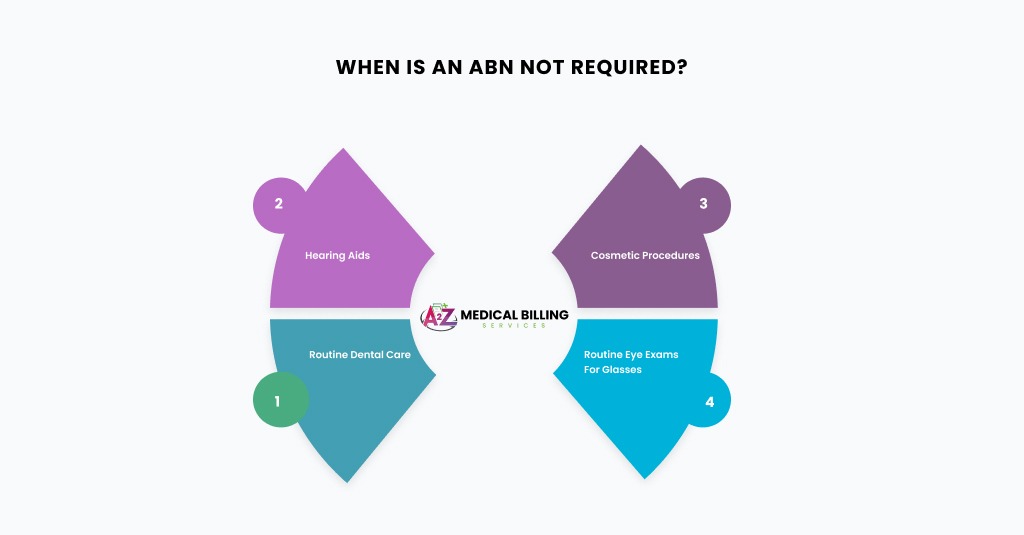
There are several situations where an ABN is not required under Medicare rules. One common scenario involves services that are statutorily excluded from Medicare coverage. These services are never covered, regardless of medical necessity.
Examples include:
- Routine dental care
- Hearing aids
- Cosmetic procedures
- Routine eye exams for glasses
Because Medicare never covers these services, providers are not required to issue an ABN. However, many practices still provide a voluntary notice to ensure patients understand their financial responsibility.
Voluntary ABN Situations
There is also a category of voluntary ABN use. You may choose to issue an ABN as a courtesy, even when you are not technically required to, when providing services that are never covered by Medicare under any circumstances.
These are called statutory exclusions, and they include things like routine dental care, routine eye exams, hearing aids, and cosmetic procedures.
For these never-covered services, Medicare will never pay regardless of medical necessity.
You are not required to issue an ABN, but many practices choose to use a simplified notice anyway to make sure patients understand their financial responsibility upfront.
This is good patient communication practice, even if it is not a compliance requirement.
Quick Decision Framework for Issuing an ABN
Before providing a service, ask:
- Is the patient covered under Medicare Part B?
- Is the service potentially not medically necessary?
- Is there a risk of denial based on NCD or LCD guidelines?
If the answer is yes to all three, an ABN should be issued before the service is performed.
How to Complete the Medicare ABN Form (CMS-R-131)
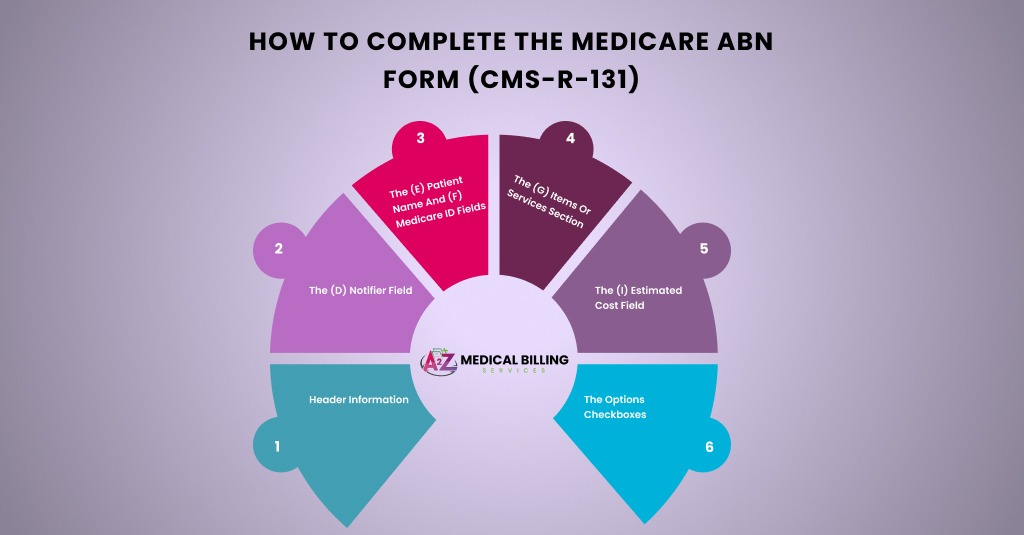
The CMS R 131 ABN form has a specific layout and every section must be completed accurately.
Leaving sections blank or completing them incorrectly can invalidate the ABN and cost you the right to bill the patient.
Header Information
The top of the form requires your practice name, address, and phone number. It also requires the patient’s name and Medicare identification number. This information ties the ABN to a specific patient and a specific encounter. Generic ABNs filled out in bulk and handed to patients without specific information are invalid.
The (D) Notifier Field
This section identifies the provider issuing the notice. It should be completed with your practice or facility name and appropriate contact information.
The (E) Patient Name and (F) Medicare ID Fields
These fields must match the information on the patient’s Medicare card exactly. A mismatch here is a common but easily avoidable error.
The (G) Items or Services Section
This is where you list the specific items or services that may not be covered. You must be specific. Writing ‘Medicare may not cover this service’ is not acceptable. You need to identify the exact service, for example, ‘Lumbar spine MRI, CPT 72148’, and then in the (H) field, explain in plain language why you believe Medicare may not pay. Something like ‘Medicare may consider this test not medically necessary for your current diagnosis’ is appropriate. Vague or generic language makes the ABN legally unenforceable.
The (I) Estimated Cost Field
You must provide the patient with a good-faith estimate of what the service will cost if Medicare does not pay. This does not have to be exact to the penny, but it must be a reasonable estimate. Leaving this blank is a common mistake that invalidates the ABN.
The Options Checkboxes
The patient must select one of three options:
- Option 1: The patient wants the service and wants you to bill Medicare. They agree to pay if Medicare does not cover it.
- Option 2: The patient wants the service but does not want you to bill Medicare. They agree to pay out of pocket.
- Option 3: The patient does not want the service.
The patient must also sign and date the form. You must give the patient a copy and retain the original in their medical record.
Medicare ABN Modifiers: GA, GZ, and GX
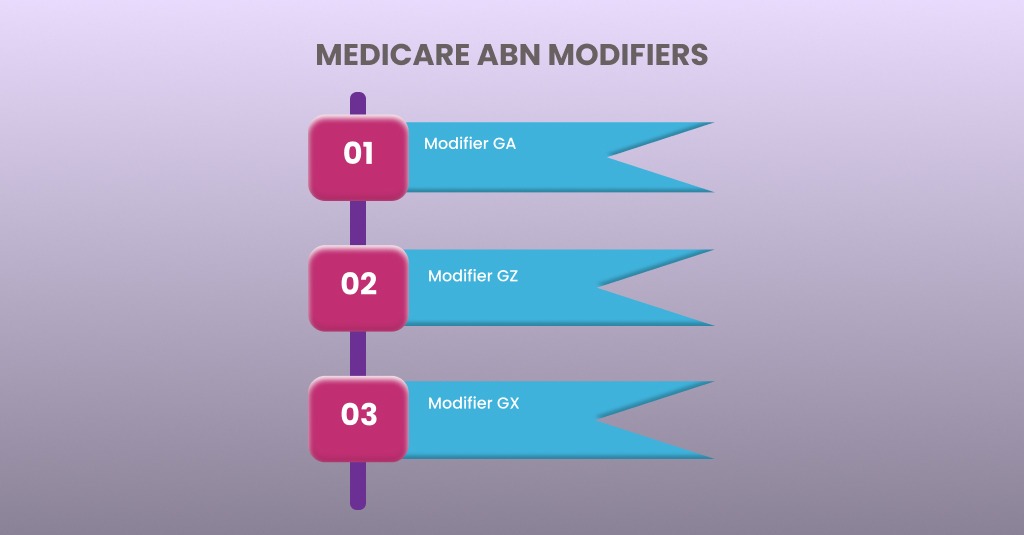
When submitting claims involving services covered by an ABN, providers must use specific Medicare claim modifiers to indicate whether a valid notice was issued.
Modifier GA
Used when a signed ABN is on file, and the patient agreed to receive the service and have the claim submitted to Medicare.
Modifier GZ
Indicates that a service is expected to be denied as not medically necessary, and no ABN was obtained.
Modifier GX
Used for services that are statutorily excluded from Medicare coverage when a voluntary ABN was issued.
How ABNs Affect Claim Submission
When submitting claims to Medicare, ABNs must be properly reflected through modifiers such as GA, GX, or GZ. Incorrect modifier usage can lead to claim rejection or misclassification of financial responsibility.
How and When to Deliver the ABN?
Timing and delivery method both matter when it comes to ABN validity.
The ABN must be delivered with enough time for the patient to make an informed decision. Handing a patient an ABN on the exam table moments before a procedure begins, or after the fact, does not satisfy Medicare’s requirements.
CMS’s guidance says the notice must be given far enough in advance so the beneficiary has time to consider their options and seek other opinions if necessary. In practice, this means presenting the ABN during the scheduling call or when the patient first arrives, not at the last minute.
The ABN must be delivered in writing, either on paper or electronically, if the patient has agreed to electronic communications. You must walk the patient through the form verbally as well.
Simply handing someone a form and asking them to sign it without explanation does not meet the informed notice standard.
If a patient is not fluent in English, you are responsible for providing the notice in a language they can understand. CMS has translated versions of the ABN available on its website for this purpose.
One important note: a patient cannot be pressured or coerced into signing an ABN. If a patient refuses to sign, you should note the refusal on the form and have a witness sign. A patient’s refusal to sign does not prevent you from delivering the service, but it does affect your ability to bill them if Medicare denies.
What Happens After the Patient Signs the ABN?
Once the patient selects an option and signs the ABN, the next steps depend on which option they chose.
If the Patient Chose Option 1
You submit the claim to Medicare normally. If Medicare pays, great. If Medicare denies the claim, you can bill the patient for the amount Medicare denied, up to your Medicare fee schedule amount for participating providers. You must use the claim modifier GA when billing Medicare to indicate that you have a signed ABN on file. Failing to use the modifier GA when required can result in claim processing errors and compliance issues.
If the Patient Chose Option 2
You do not bill Medicare. You bill the patient directly. In this case, use modifier GZ if you believe the service is medically necessary but expect Medicare will deny it anyway. This protects you from a situation where a patient later disputes the bill by claiming Medicare should have paid.
If the Patient Chose Option 3
You do not provide the service. No billing is involved. Document that the patient declined the service after receiving the ABN.
What Happens If an ABN Is Not Issued?
If a required Advance Beneficiary Notice is not issued before a potentially non-covered service, the financial liability usually shifts to the provider rather than the patient. Medicare’s limitation of liability rules prevent providers from billing beneficiaries when they were not properly informed in advance that the service might not be covered.
This means the provider must write off the denied claim and cannot legally collect payment from the patient.
Medicare Limitation of Liability Rule
Under Medicare’s limitation of liability provision, providers cannot bill patients for denied services unless a valid ABN was issued in advance. This rule protects beneficiaries and places financial responsibility on the provider when proper notice is not given.
How ABNs Impact Denial Management
ABNs play a critical role in denial workflows:
- If an ABN is on file → transfer balance to patient
- If no ABN → write-off required under Medicare rules
- Billing team must verify modifier GA was used correctly
ABNs determine whether a denial becomes recoverable revenue or a financial loss.
Who Is Responsible for ABN Compliance?
ABN compliance involves multiple roles:
- Front desk: Identifies services needing ABN
- Provider: Confirms medical necessity risk
- Billing team: Applies modifiers and submits claims
- Compliance team: Audits ABN usage
Clear role assignment reduces errors and improves consistency.
ABN Audit Checklist for Compliance
To ensure ABN compliance, practices should regularly audit:
- Correct CMS-R-131 form version
- Completed estimated cost field
- Specific service descriptions
- Proper patient signature and date
- Correct modifier usage (GA, GX, GZ)
Routine ABN audits help prevent compliance violations and revenue loss.
The Most Common ABN Mistakes Providers Make
ABN compliance failures are one of the most consistent findings in Medicare audits.
Here are the mistakes that come up again and again:
- Using an outdated CMS form. Always confirm your form matches the current CMS R 131 version.
- Completing the ABN after the service was already provided. A retroactive ABN is invalid.
- Using vague or generic language in the reason for potential denial. Specificity is required.
- Leaving the estimated cost field blank. This is a required field, and its absence invalidates the form.
- Issuing a blanket ABN at the start of care without service-specific details. Each ABN must be tied to specific items or services.
- Not providing the patient with a copy. You must give the patient their own copy of the signed ABN.
- Failing to document the ABN in the patient’s medical record alongside clinical documentation.
- Not using modifier GA on the claim when an ABN is on file and the patient selected Option 1.
Medicare Recovery Audit Contractors (RACs) and Comprehensive Error Rate Testing (CERT) auditors regularly review ABN compliance as part of their work. The Office of Inspector General (OIG) has identified improper use of ABNs, including using them to shift costs for services that are actually covered by Medicare, as a compliance risk area.
According to the CMS Medicare Learning Network, providers who fail to issue required ABNs are prohibited from billing the patient for the denied service. The cost of that compliance failure lands entirely on the provider. In a practice with high Medicare volume, even a modest ABN compliance gap across dozens of claims per month adds up to significant write-offs.
Importantly, ABNs cannot be used as a blanket tool to pass costs to Medicare patients. Using ABNs to circumvent Medicare’s coverage rules or to shift charges inappropriately can constitute a False Claims Act violation. Your compliance program should include periodic ABN audits to confirm staff are using them correctly and only when genuinely required.
Can a Provider Bill a Patient Without an ABN?
No. If a required ABN was not issued before the service, the provider is generally prohibited from billing the patient after Medicare denial.
What Makes an ABN Invalid?
An ABN may be considered invalid if:
- It is issued after the service
- It lacks specific service details
- The estimated cost is missing
- The patient did not sign the form
Is an ABN Required for Every Medicare Service?
No. ABNs are only required when a provider expects Medicare may deny a service based on medical necessity, frequency limits, or coverage rules.
Frequently Asked Questions About ABNs
Is an ABN Required for Medicare Advantage Plans?
No. ABNs apply only to Original Medicare (Part B) services. Medicare Advantage plans follow their own notification rules.
ABN vs Medicare Advantage Notice Requirements
Medicare Advantage plans do not use ABNs. Instead, they follow plan-specific prior authorization and coverage notification rules. Providers must verify requirements with each plan before delivering services.
Can an ABN be signed electronically?
Yes. CMS allows electronic ABNs if they comply with electronic signature regulations.
How long is an ABN valid?
An ABN generally applies to a specific service or episode of care and must be renewed if circumstances change.
Can a patient refuse to sign an ABN?
Yes. If the patient refuses, the provider should document the refusal and have a witness sign the form.
Final Thoughts
The Advance Beneficiary Notice is not just paperwork. It is a patient communication tool, a compliance requirement, and a financial protection mechanism all rolled into one document.
When used correctly, it keeps Medicare patients informed about their financial responsibility, protects your practice’s right to collect payment, and demonstrates that you are operating within Medicare’s rules.
The investment in training your staff to issue ABNs correctly, using the right form, at the right time, with the right specificity, pays dividends every time Medicare denies a claim and you have
a valid ABN in the file.
Without that ABN, the denial is the end of the road. With it, you still have a path to collection.
Review your ABN process regularly. Audit a sample of claims where modifier GA was used and confirm the ABN documentation is complete and accurate. Make ABN compliance part of your routine billing audit cycle. In the long run, it protects your revenue, your patients, and your Medicare participation status.
Need Help Managing Medicare Billing and Compliance?
Advance Beneficiary Notice (ABN) compliance is only one part of the broader Medicare billing process. From verifying coverage rules to submitting claims with the correct modifiers and managing denials, even small documentation errors can lead to delayed reimbursements or revenue loss.
A2Z Medical Billing Services helps healthcare providers across the United States streamline their entire revenue cycle. Our team specializes in Medicare billing compliance, claim submission, denial management, and medical coding to ensure providers receive accurate and timely reimbursements.
If your practice treats Medicare patients and wants to reduce claim denials while maintaining full CMS compliance, our billing specialists can help.
Schedule a free billing consultation today to review your Medicare billing process.