

Durable medical equipment billing under Medicare is one of those areas where a lot of providers and suppliers trip up, not because the rules are impossible to follow, but because there are quite a few of them and they interact with each other in ways that are not always obvious.
Get it right, and you get paid. Get it wrong, and you are looking at claim denials, audits, or worse, repayment demands.
Whether you are a physician ordering DME for your patients, a supplier billing Medicare for equipment, or a billing professional trying to understand why claims keep coming back, this guide walks through everything you need to know about how Medicare covers durable medical equipment, what the billing requirements are, and where the common mistakes happen.
What Is Durable Medical Equipment (DME)?
Durable medical equipment (DME) is reusable medical equipment prescribed by a healthcare provider for use in the home to treat a medical condition.
DME must meet specific criteria under Medicare. It must be durable enough for repeated use, medically necessary, not useful for someone without illness or injury, and appropriate for use in a home setting.
Under Medicare Part B, DME is covered when it is used in a patient’s home, including private residences and certain residential settings such as assisted living facilities. However, DME is not covered in settings where Medicare Part A is paying for inpatient care, such as skilled nursing facility stays.
What Counts as Durable Medical Equipment (DME) Under Medicare?
Durable medical equipment (DME) under Medicare Part B includes medically necessary equipment that is used in the home and can withstand repeated use.
Common Categories of Covered DME
Mobility Equipment:
- Manual wheelchairs
- Power wheelchairs and scooters
- Walkers, canes, and crutches
Home Care Equipment
- Hospital beds for home use
Respiratory Equipment
- Oxygen equipment and supplies
- Nebulizers and related supplies
- Continuous Positive Airway Pressure (CPAP) machines for sleep apnea
Monitoring and Treatment Equipment
- Blood glucose monitors and diabetic testing supplies
- Infusion pumps for medications administered at home
Prosthetics and Orthotics
- Artificial limbs and braces
(Note: These are part of a related but distinct Medicare benefit category)
What Does NOT Qualify as DME?
Not all medical-related items are covered under Medicare’s DME benefit.
The following are generally excluded:
- Items used primarily for comfort
- Equipment without a clear medical purpose
- Home modifications (e.g., grab bars, ramps)
- Exercise or fitness equipment
Even if prescribed by a provider, items that do not meet Medicare’s coverage criteria will not be reimbursed.
How Medicare Pays for DME?
Medicare pays for durable medical equipment (DME) under Part B using a cost-sharing model where Medicare covers 80% of the approved amount after the deductible.
Medicare Part B pays for covered DME at 80 percent of the approved amount after the beneficiary has met their Part B deductible. The patient is responsible for the remaining 20 percent coinsurance. If a patient has a Medicare Supplement or Medigap plan, that plan may cover the coinsurance depending on the plan type.
Medicare Advantage plans, which are private plans that cover Medicare benefits, may have different coverage rules, different prior authorization requirements, and different approved supplier requirements for DME. Always verify the specific plan rules for Medicare Advantage patients before supplying equipment.
The DMEPOS Fee Schedule
Medicare pays for DME based on the Durable Medical Equipment, Prosthetics, Orthotics, and Supplies fee schedule, often abbreviated as the DMEPOS fee schedule. CMS updates this fee schedule periodically, and the rates vary depending on the type of item, whether it is a capped rental item or a purchase item, and the geographic area where the beneficiary resides.
Some DME items are classified as capped rentals. This means Medicare pays a monthly rental amount for a set period, usually 13 months for most capped rental items, after which ownership transfers to the beneficiary. Oxygen equipment works differently and is rented for up to 36 months before the beneficiary is considered to own it.
Other items are purchased outright and billed as a single purchase. Complex power wheelchairs and certain prosthetics fall into this category. Knowing whether an item is a rental or a purchase item matters enormously for billing correctly.
Competitive Bidding Areas
Medicare established a Competitive Bidding Program for certain DME categories in specific geographic areas called Competitive Bidding Areas, or CBAs. In these areas, only Medicare-contracted suppliers who won a bid for a particular product category can supply that equipment to Medicare beneficiaries and receive Medicare reimbursement. If a supplier is not a contract supplier for a given CBA, they generally cannot bill Medicare for covered items in that category in that area.
The competitive bidding program covers commonly used items, including CPAP devices and supplies, walkers, power wheelchairs, and several other high-volume categories. Suppliers need to verify their contract status for the specific CBAs where their patients reside before providing equipment.
CMS reported that the DMEPOS Competitive Bidding Program saved Medicare approximately 1.7 billion dollars in 2021 alone. The program has been a consistent target of scrutiny for both suppliers and CMS auditors, making compliance with bidding area requirements a serious operational priority for any DME supplier billing Medicare.
DME Billing Under Medicare Advantage Plans
Medicare Advantage plans often follow different rules than Original Medicare for DME coverage. These plans may require prior authorization, restrict suppliers to specific networks, and apply different reimbursement rates.
Suppliers must verify plan-specific requirements before providing equipment to avoid denials and delays in payment.
Medicare Requirements for Ordering DME
One of the areas where DME billing falls apart most often is at the order stage. Medicare has specific requirements for who can order DME, what the order must contain, and what documentation must support it. Missing any of these pieces will result in a denied claim.
Who Can Order DME?
Under Medicare rules, DME must be ordered by a physician, nurse practitioner, physician assistant, or clinical nurse specialist who is enrolled in Medicare and who is treating the beneficiary for the condition that necessitates the equipment. The ordering provider does not have to be enrolled as a Medicare supplier or participate in Medicare in any other way, but they must be enrolled and have an active NPI. Non-enrolled providers cannot order DME for Medicare beneficiaries.
Written Order Requirements
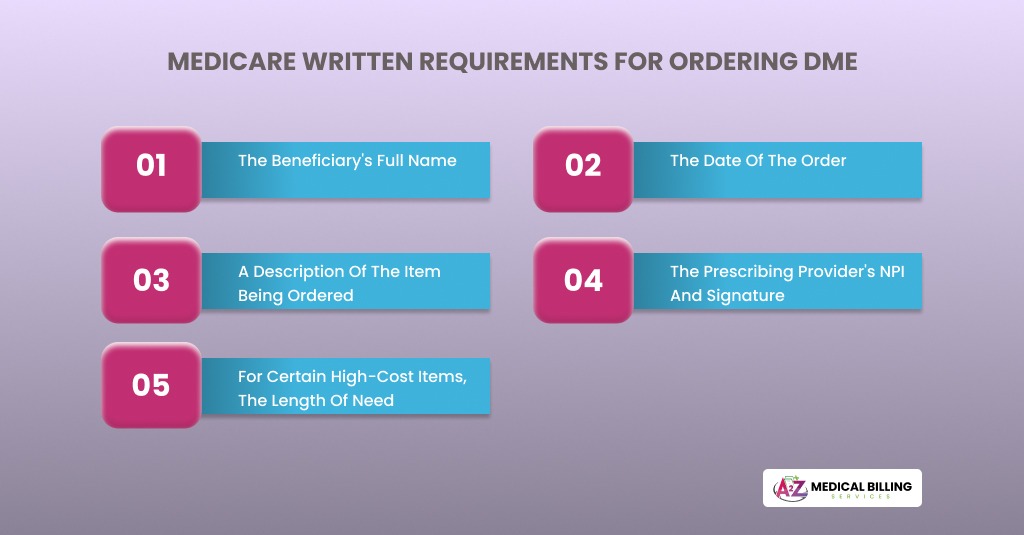
Medicare requires a written order for all DME, also called a prescription. The written order must include specific elements to be valid.
- The beneficiary’s full name
- The date of the order
- A description of the item being ordered, either by name or by HCPCS code
- The prescribing provider’s NPI and signature
- For certain high-cost items, the length of need
For most standard items, a basic written order is sufficient. For higher-cost items like power wheelchairs, power mobility devices, and certain respiratory equipment, Medicare requires a more detailed order and additional documentation that demonstrates medical necessity.
Key Questions Providers Ask About DME Billing
Who can bill Medicare for DME?
Only enrolled and accredited DMEPOS suppliers can bill Medicare for durable medical equipment.
What documentation is required for DME claims?
A valid written order, supporting medical records, and any required CMN or detailed order must be on file.
Written Orders and CMN Requirements
For certain items, Medicare requires a Detailed Written Order, which is a more comprehensive prescription that includes specific clinical details beyond a basic order. Power mobility devices are a prime example. The ordering physician must conduct a face-to-face examination of the patient and document that examination in a specific way before a power wheelchair or scooter can be ordered.
Some items also require a Certificate of Medical Necessity, or CMN. The CMN is a form completed by the supplier based on clinical information from the treating physician that attests to the medical necessity of the ordered item. Oxygen and certain other respiratory equipment require a CMN. These forms must be completed accurately and retained as part of the documentation supporting the claim.
The HHS Office of Inspector General has identified DME as a consistently high-risk area for Medicare fraud and improper payments. In recent OIG reports, DME claims accounted for billions in improper payments annually, with missing or inadequate documentation being the leading cause of those improper payments.
DME Billing Workflow Under Medicare
Understanding the full workflow helps prevent billing errors and claim denials.
- Physician evaluates the patient and determines medical necessity
- Provider issues a written order for DME
- Supplier verifies Medicare eligibility and coverage
- Required documentation (order, medical records, CMN if needed) is collected
- Equipment is delivered to the patient
- Claim is submitted using appropriate HCPCS codes and modifiers
- Medicare processes the claim and issues a payment or a denial
Documentation Checklist for DME Billing
- Written order
- Medical necessity documentation
- CMN (if required)
- HCPCS codes
- Modifiers
DMEPOS Supplier Enrollment and Accreditation
Suppliers who want to bill Medicare for DME must first enroll in Medicare as a DMEPOS supplier. This is separate from physician enrollment. A medical practice that supplies DME directly to patients needs to complete a separate supplier enrollment application and meet specific supplier standards.
Medicare requires DMEPOS suppliers to be accredited by a CMS-approved accreditation organization. Accreditation verifies that the supplier meets quality standards for storage, delivery, patient service, and documentation. Accreditation is not a one-time event. It must be renewed on a regular cycle, and the accreditation status must remain active for the supplier to continue billing Medicare.
Suppliers must also post a surety bond, maintain a physical location that is open during posted business hours, and meet a range of other operational standards. Medicare can revoke a supplier’s billing privileges for failure to meet these standards.
Compliance Risks in DME Billing
DME billing is considered a high-risk area by Medicare due to frequent documentation issues and improper payments. Missing or incomplete documentation, incorrect coding, and billing for non-covered items can result in claim denials, audits, and recoupments.
Maintaining complete documentation and following Medicare guidelines is essential to avoid compliance issues.
Common DME Billing Errors and How to Avoid Them
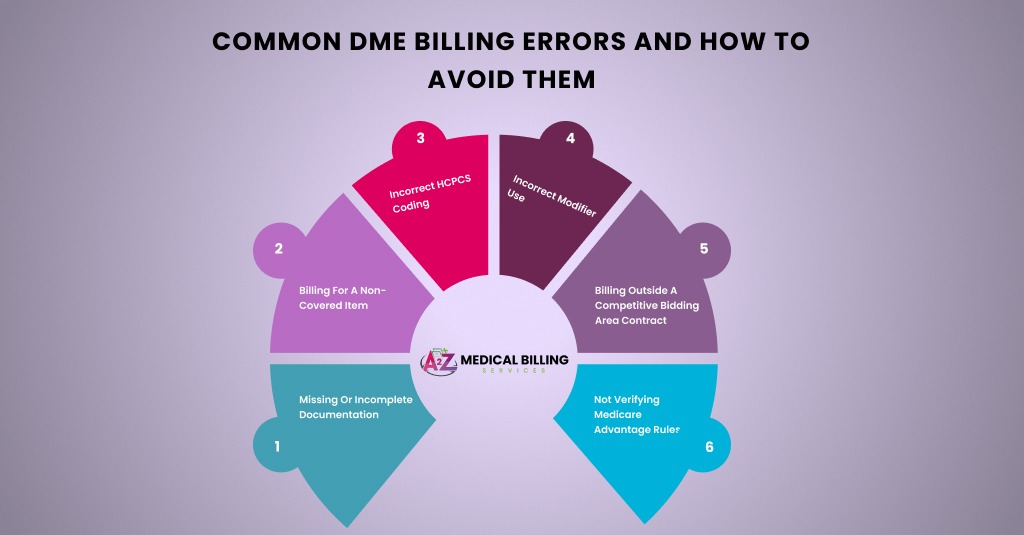
DME billing generates a lot of denials and a lot of audit activity, and most of it comes down to the same recurring errors. These issues not only cause claim denials but also negatively impact revenue cycle performance and cash flow for DME suppliers.
Here is what to watch for.
- Missing or incomplete documentation: The written order, medical records supporting medical necessity, and any required CMN or Detailed Written Order must all be on file before the claim is submitted. A claim without documentation is a denial waiting to happen.
- Billing for a non-covered item: Just because a physician ordered something does not mean Medicare covers it. Verify coverage before supplying the item.
- Incorrect HCPCS coding: DME is billed using HCPCS Level II codes. Using the wrong code or using a miscellaneous code when a specific code exists leads to denials and audit scrutiny.
- Billing outside a Competitive Bidding Area contract: Supplying a competitive bid item to a beneficiary in a CBA without holding a contract for that area is a billing violation.
- Incorrect modifier use: DME claims often require modifiers that describe the condition of the equipment (new, rental, purchased) and the setting. Missing or incorrect modifiers are a consistent cause of denials.
- Not verifying Medicare Advantage rules: Standard Medicare DME rules do not automatically apply to Medicare Advantage plans. Always verify plan-specific DME coverage before providing equipment to an MA patient.
Why DME Billing Requires Specialized Expertise
DME billing involves strict documentation requirements, complex coding rules, and compliance risks. Many providers and suppliers rely on experienced billing teams to manage claims, reduce denials, and maintain compliance with Medicare regulations. Many providers choose to outsource DME billing as part of a broader medical billing service to improve accuracy and reduce denials.
Frequently Asked Questions About DME Billing
Who can bill Medicare for DME?
Only suppliers enrolled and accredited as DMEPOS providers can submit claims to Medicare.
What documentation is required for DME billing?
Medicare requires a valid written order, supporting medical records, and any necessary CMN or detailed documentation.
What is required for DME medical necessity?
Medical necessity must be supported by clinical documentation and provider orders that justify the equipment.
Are DME claims audited by Medicare?
Yes. DME is a high-risk category and is frequently reviewed for documentation and compliance issues.
What HCPCS codes are used for DME billing?
DME items are billed using HCPCS Level II codes, which identify specific equipment and supplies for Medicare reimbursement.
Does Medicare require prior authorization for DME?
Some DME items require prior authorization depending on Medicare rules or Medicare Advantage plan requirements.
Conclusion
DME billing under Medicare is genuinely detailed work. The documentation requirements, the enrollment and accreditation obligations, the competitive bidding rules, and the coding requirements all have to come together correctly before Medicare will pay. None of it is impossible to manage, but all of it requires attention and a working knowledge of how the rules fit together.
If you are a supplier or a billing professional working in this space, invest the time in building solid documentation workflows, verifying coverage and contract status before providing equipment, and staying current with CMS policy changes to the DMEPOS fee schedule and competitive bidding program. The compliance risk in DME billing is real, but so is the revenue opportunity when the process runs correctly.
Mastering DME billing is not just about compliance; it is essential for reducing denials, improving reimbursement accuracy, and maintaining a stable revenue cycle.