
Emergency departments run on the busiest, least predictable schedule in healthcare, and their ER billing compliance carries the same pressure. Recent industry claims analysis puts emergency department denial rates at roughly three times what they were only a few years ago, with close to a third of ED claims coming back unpaid on first submission. For a department seeing hundreds of patients a week, that is more than a paperwork problem, since it translates directly into slower cash flow, added staff time, and greater audit exposure.
At A2Z Medical Billing, we work inside this pressure every day. This guide explains where ED coding compliance fails, how the emergency department is structurally different from every other care environment, and what an audit-ready billing process really entails so that your claims are properly paid in full on first submission rather than denied and appealed (and resubmitted).
What Is ER Billing Compliance?
ER billing compliance is the practice of ensuring that each emergency department (ED) claim, whether facility or professional, accurately matches the care documented in the chart; complies with CMS and payer-specific coding guidelines; and holds up to an audit without repayment demands. It includes E/M level selection, modifier usage, medical necessity documentation, and critical care time, as well as how AI-assisted charting tools are judged at sign-off with increasing scrutiny since 2023.
When handled correctly, claims flow clearly the first time but when it is not done right then on top of clinical chaos that ED operates on shouldering rework costs, payer takebacks and added compliance risk.
Why Emergency Department Coding Carries Unique Compliance Risk
No other care setting stacks this many variables into a single encounter. That is what makes ED coding compliance its own specialty rather than a subset of general medical billing.
Dual Claims: Facility and Professional
Every ED visit generates two separate claims that run on two separate rule sets. The facility claim, filed on a UB-04, bills for the hospital’s resources such as space, nursing, supplies, and equipment, and is leveled based on resource intensity. The professional claim, filed on a CMS-1500, bills for the physician’s clinical work and is leveled based on medical decision-making. It is entirely normal for these two claims to land on different ED E/M levels for the same patient. The compliance risk shows up when coders apply professional side logic to a facility claim, or the reverse, and create a mismatch that payers flag automatically.
Unpredictable Acuity Across a Single Shift
A single ED shift can move from a sprained ankle to a cardiac arrest within the span of an hour, and the coding has to track that swing accurately, encounter by encounter. There is no typical visit to build a template around, which means documentation has to justify the acuity level every single time, not just describe symptoms.
Heavy Modifier Dependency
Because EDs frequently perform a procedure and bill an E/M visit in the same encounter, modifiers carry enormous weight. Modifier 25, modifier 59, and the X modifiers (XE, XS, XP, XU) all separate services that would otherwise bundle. Payers know this, which is exactly why modifier accuracy sits near the top of every payer’s audit priority list.
No Surprises Act Exposure
Emergency care sits squarely inside the No Surprises Act’s protections against balance billing for out-of-network care. That means qualifying payment amount calculations, independent dispute resolution documentation, and patient notice requirements now sit alongside standard coding accuracy as a compliance obligation, one most billing teams were not managing five years ago.
The Rule Most Coders Get Wrong: MDM Only, Never Time
This is the single most common, and most costly, mistake we see in ED coding audits.
Why Time-Based Logic Doesn’t Apply in the ED
Since the 2023 E/M guideline overhaul, office and outpatient visits can be leveled by either medical decision making or total time. Some coders who trained on outpatient coding carry that same logic into the ED, and it is just wrong. CPT specifically states that time cannot be used as a criterion for emergency department E/M codes 99281–99285 since ED encounters do not have the neat, trackable beginning and end point of an office visit.
Level selection has to rest entirely on medical decision-making: the complexity of the problem, the data reviewed and ordered, and the risk of the presenting condition and treatment. Critical care codes, 99291 and 99292, are the one exception. They are time-based and require their own separate, minute-by-minute documentation.
The Freestanding ED vs. Urgent Care Trap
Freestanding emergency departments look and feel like urgent care centers from the outside, but they bill under an entirely different framework: hospital-based ED codes and facility rules, not urgent care’s outpatient logic. Coders moving between the two settings, or billing systems that default to urgent care templates, routinely misapply the wrong rule set. That single setup error can push every claim from a facility into automatic review.
High Risk Denial Triggers in ED Coding
These are the specific failure points payers are trained to catch first.

E/M Level and MDM Mismatch
A level 5 code with documentation that only supports a level 3 problem is the fastest way to trigger a reduced payment or a full denial. Payers compare the number and complexity of problems addressed, data reviewed, and risk of complications against the level billed, not against how busy the shift was.
Medical Necessity and Diagnosis to Procedure Mismatch
Every procedure and every diagnostic test needs a diagnosis code on the claim that actually supports why it was ordered. A CT scan billed against a diagnosis that does not clinically justify imaging is an automatic medical necessity denial.
Missed Separately Billable Procedures
Laceration repairs, fracture care, foreign body removal, and similar procedures performed during an ED visit are often billable separately from the E/M code, and just as often left off the claim entirely, leaving reimbursable work uncaptured.
Modifier Misuse on Bundled or Staged Procedures
NCCI edits bundle many code pairs common in ED work. Billing both codes without the modifier that justifies them as distinct services, such as different sites, different sessions, or different providers, triggers an automatic bundling denial.
Critical Care Time Documentation Gaps
Critical care requires the total minutes spent, minus any time spent on separately billable procedures performed during that window. A note that simply states critical care was provided, without the specific time and the clinical instability being managed, will not survive review.
Drug Wastage Modifier Errors
Single-dose vial drugs billed by units require either the JW modifier, reporting discarded medication, or the JZ modifier, confirming no waste occurred. Since this became mandatory, claims missing both modifiers are among the most common, and most avoidable, denial reasons in ED pharmacy billing.
Facility E/M Level Mismatches
Facility side leveling should reflect the resources the department actually used for that patient, not simply mirror whatever level the physician billed on the professional side. Automatically mirroring the two claims is a pattern payer audit algorithms are specifically built to catch.
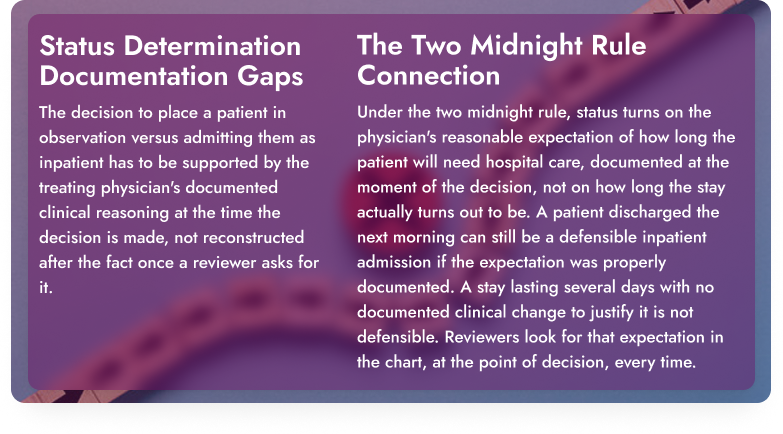
Observation vs. Inpatient Status: A Growing Audit Flashpoint
Status determination has become one of the fastest-growing sources of ED-adjacent denials, and it starts the moment a patient does not get discharged from the ED.
The New Compliance Risk: AI-Generated ED Documentation
This is the risk area moving fastest, and most ED compliance programs have not caught up to it yet.
Why AI Scribes Are Spreading in High Volume EDs
Ambient AI scribes are being adopted across high-volume emergency departments because they measurably cut documentation time and reduce after-shift charting. Recent published studies of ED-specific rollouts have shown meaningful reductions in on-shift documentation time when physicians use them consistently.
Physician Review and Attestation Requirements
The compliance risk here does not come from the speed of the tool, but from output that is never actually reviewed before it becomes part of the billed record. AI-generated notes still have to be reviewed, corrected where needed, and personally attested to by the treating physician before they support a billed code.
A note the physician never actually verified is a liability the moment it is audited, no matter how accurate the AI turned out to be. Compliance programs need a documented review and attestation step built into the AI scribe workflow, not just a policy that assumes it happens.
Building an Audit-Ready ED Compliance Program
Compliance in the ED works best as a standing process built into daily operations, rather than a one-time coding review that gets revisited only when a problem surfaces.
Recommended Audit Cadence
A monthly sample of level 4 and level 5 E/M claims and all critical care claims catches most high-risk errors early. A deeper quarterly audit, covering modifier accuracy, drug wastage documentation, and observation status decisions, catches the patterns a monthly spot check misses.
Coder Education Feedback Loop
Audit findings only reduce denials if they get back to the coders who need them, in specific and immediate terms, not as a quarterly report nobody reads. The fastest improving departments close that loop within days of an audit finding, not months.
Teaching Facility Considerations
Teaching hospitals carry an added layer: resident documentation has to be supported by the supervising physician’s own attestation of their personal involvement in the encounter, and virtual supervision now has to meet CMS’s current real-time audio-video requirements. Audio-only no longer qualifies.
What This Means for Your Revenue Cycle
Every one of these triggers has a dollar figure attached to it. Rework on a single denied claim routinely costs more in staff time than the claim was worth pursuing the first time around, and that is before counting the compliance exposure of an audit that finds a pattern rather than a one-off mistake.
For an emergency department without a coding team built specifically around ED’s dual claim, MDM-only, modifier-heavy structure, these losses compound quietly. They show up as slower cash flow and a growing accounts receivable backlog long before anyone traces it back to a specific coding gap. Our denial management and AR recovery service is built to find and fix that backlog before it becomes permanent revenue loss.
How We Help EDs Stay Compliant and Get Paid
A2Z Medical Billing builds our emergency department process around the way ED claims actually work, not around a generic billing template retrofitted for emergency medicine.
Dual Claim Handling Built Around ED Logic
We code and audit facility and professional claims as the two distinct claim types they are, checking that each one is leveled against its own correct standard- resource intensity for facility and medical decision-making for professional- instead of letting one mirror the other by default.
Modifier and Critical Care Time Audits
Our certified coding and compliance audit team is trained specifically on ED-heavy modifier use, including modifier 25, modifier 59, the X modifiers, JW, and JZ, and on the exact documentation critical care time requires. That focus is what keeps our clients’ first-pass acceptance rate well above the industry average, and it is the difference between a claim that clears in days and one that sits in appeal for months.
If your emergency department is losing revenue to denials, reduced payments, or repeat audits, contact our team, and we can review your last quarter of ED claims and show you exactly where the pattern is, before your next audit finds it for you.
Frequently Asked Questions
Can time ever be used to select an ED E/M level?
No. CPT rules specifically exclude time as a basis for selecting ED E/M codes 99281 through 99285, because emergency visits do not have a defined start and end point the way office visits do. The one exception is critical care, billed as 99291 and 99292, which is time-based and requires its own separate documentation of total minutes spent.
What’s the difference between a facility and a professional ED claim?
The facility claim, filed on a UB-04, bills for the hospital’s resources such as space, equipment, nursing, and supplies, coded from resource intensity. The professional claim, filed on a CMS-1500, bills for the physician’s clinical work, coded from medical decision-making. They can, and often do, land on different E/M levels for the same visit.
What are JW and JZ modifiers, and when do they apply?
Both apply to single-dose vial drugs billed by units. JW reports a discarded, unused portion of the vial. JZ confirms there was no discarded amount. One of the two is now required on every applicable claim line. Leaving both off is a guaranteed denial trigger.
How often should an ED compliance program audit high-level claims?
Most effective programs run a monthly sample of level 4 and level 5 E/M claims and critical care claims, backed by a deeper quarterly audit covering modifier usage, drug wastage documentation, and observation status decisions.
