

You have a patient. You provide a service. You send a claim. It gets denied.
Half the time, the problem isn’t medical necessity. It’s the HCPCS code.
Here is what most people get wrong. They treat HCPCS like a backup to CPT. That is not how it works. HCPCS Level II codes are not “extra” codes.
They are the primary codes for supplies, drugs, equipment, and a growing list of non-physician services. If you are billing for anything that is not a straightforward office visit, you need to know HCPCS cold.
This guide walks through what HCPCS is, how it differs from CPT, where the codes come from, and how to use them without getting hammered by Medicare audits.
What You Will Learn About HCPCS Coding
- What HCPCS codes are
- How HCPCS differs from CPT
- When to use HCPCS vs CPT
- How HCPCS impacts reimbursement
- Common billing mistakes and fixes
What HCPCS Is and What It Is Not?
HCPCS stands for the Healthcare Common Procedure Coding System. CMS maintains it. HIPAA mandates it. You cannot bill Medicare, Medicaid, or most commercial payers without it.
But here is where people get confused.
HCPCS has two levels.
- Level I – These are CPT codes. Five digits. No letters. Owned and published by the American Medical Association. Used for procedures, surgeries, evaluations, and most face-to-face physician work.
- Level II – These are the alphanumeric codes CMS controls. One letter followed by four digits. Think of Level II as the code set for everything that is not a typical physician procedure.
Most providers say “HCPCS” and actually mean Level II. That is fine as long as you understand the difference internally. Just know that when a payer asks for an HCPCS code on a DME claim, they do not want a CPT code. They want E1399 or something similar.
Why HCPCS Codes Directly Impact Reimbursement Outcomes
HCPCS coding is not just about identifying a service—it directly determines whether a claim will pass through payer adjudication systems or get flagged for denial. In programs like Medicare Part B, HCPCS Level II codes are tightly linked to fee schedules, coverage policies, and medical necessity criteria.
For example, Durable Medical Equipment, Prosthetics, Orthotics, and Supplies (DMEPOS) claims rely entirely on HCPCS codes for reimbursement. If the submitted code does not align with the Medicare DMEPOS fee schedule or lacks required documentation per Local Coverage Determinations (LCDs), the claim will either be denied or downcoded.
From a revenue cycle perspective, HCPCS codes act as a bridge between:
- Clinical documentation
- Coverage eligibility
- Payment calculation systems
Even when documentation is accurate, a mismatch between the HCPCS code and National Coverage Determinations (NCDs) can result in zero reimbursement.
This is why HCPCS coding is not just a coding function—it is a revenue validation mechanism within the medical billing process.
Who Maintains HCPCS Level II?
CMS runs the show for Level II. They have a formal process called the HCPCS Workgroup. This group meets regularly to review requests for new codes, revise existing ones, and delete codes that are obsolete.
The workgroup includes representatives from:
- CMS itself
- The AMA
- Blue Cross Blue Shield Association
- DME Medicare Administrative Contractors (MACs)
- Various clinical specialty societies
Why does this matter to you? Because code changes are not random. They come from real requests. If you cannot find a code for a new device or drug, someone else probably already requested one. You can look up the workgroup meeting minutes on the CMS website to see why a code exists and how it should be used.
HCPCS Level II Code Structure
Every Level II code starts with a letter. That letter tells you something important.
Here is the breakdown based on the official HCPCS coding guidelines.
| First Letter | Category | Examples |
| A | Transportation, surgical supplies, medical supplies | A0420 (ambulance), A4649 (surgical supply) |
| B | Enteral and parenteral therapy | B4087 (parenteral nutrition) |
| C | Temporary codes for the hospital outpatient prospective payment system | C9757 (new technology procedure) |
| D | Dental codes (rarely used by medical billers) | D0120 (exam) |
| E | Durable medical equipment | E1399 (DME, not otherwise classified) |
| G | Temporary procedures and professional services | G2212 (prolonged office visit) |
| H | Mental health and substance abuse | H2035 (partial hospitalization) |
| J | Drugs administered other than the oral method | J1030 (methylprednisolone, 40mg) |
| K | Temporary DME codes | K0001 (standard wheelchair) |
| L | Orthotic and prosthetic procedures | L4350 (ankle brace) |
| M | Medical services (often temporary) | M0201 (home COVID vaccine admin) |
| Q | Temporary codes for devices and services | Q2038 (influenza vaccine) |
| R | Diagnostic radiology (rare) | R0076 (transport of portable x-ray) |
| S | Private payer codes (not for Medicare) | S9140 (diabetes management training) |
| T | State Medicaid codes | T1015 (day treatment services) |
| U | Advanced diagnostic lab tests | U0001 (SARS-CoV-2 test) |
Do not memorize this table. Keep it on a cheat sheet near your billing station. The moment you see a J code, you know you are dealing with an injectable drug. The moment you see an E code, you are in DME territory.
Modifiers: The Details That Save Your Claim
A code alone is rarely enough. Payers want to know laterality, special circumstances, or partial services. That is what modifiers do.
HCPCS Level II modifiers are two characters. They can be numbers or letters. Some are shared with CPT. Some are unique to HCPCS.
Common HCPCS modifiers you will use every week:
- LT – Left side (used with E codes for unilateral equipment)
- RT – Right side
- NU – New equipment (DME only)
- RR – Rental equipment
- RA – Replacement of a DME item
- EY – No physician order (rare, but used when you have to provide something without an order)
- KX – Medical necessity requirements met (often used for DME after documentation review)
- GY – Item is not covered by Medicare
- GZ – Item is expected to be denied as not reasonable and necessary
Here is where claims die. You use an E code for a wheelchair, but forget the LT or RT modifier. Payer denies. You use a J code for a drug, but forget the dosage modifier. Payer denies. Modifiers are not optional suggestions. They are part of the code.
How Payers Interpret HCPCS Modifiers During Claim Adjudication
When a claim is submitted, payer systems do not read modifiers as optional annotations—they process them as decision-making triggers within automated adjudication workflows.
For example:
- Modifier KX signals that documentation meets policy criteria defined in an LCD
- Modifier NU indicates a purchase, which routes the claim through a different payment logic than rental (RR)
- Modifier GY triggers automatic denial under statutory exclusion rules
In Medicare claims processing systems, modifiers are evaluated alongside:
- Place of Service (POS) codes
- Diagnosis pointers (ICD-10-CM)
- Units of service
If any of these elements conflict, the claim may fail front-end edits before even reaching manual review.
This is especially critical in high-risk categories like:
- DME billing
- Drug administration (J codes)
- Home health services
In short, modifiers are not descriptive—they are instructional inputs for payer algorithms.
The Three Separate Questions: Coding, Coverage, and Payment
A code does not equal payment.
CMS is very clear about this. There are three separate questions you must answer for every claim.
Question 1: Does a code exist for this service or item?
Look it up in the HCPCS Level II code set. If a code exists, you can use it. If not, you may need to use a miscellaneous code like E1399 or A4649. Miscellaneous codes exist, but they get heavy scrutiny and usually require paper claims with documentation.
Question 2: Does Medicare (or the payer) cover this item or service?
Coverage is not automatic. Medicare has National Coverage Determinations (NCDs) and Local Coverage Determinations (LCDs). An NCD applies nationwide. An LCD applies only in your MAC’s jurisdiction. Even with a valid code, if there is a non-coverage policy, you are not getting paid.
Question 3: How much does the payer reimburse?
Payment rates vary by region, site of service, and fee schedule. DME has a fee schedule. Drugs under Part B are usually paid at ASP (average sales price) plus 6 percent. There is no single “HCPCS payment rate.” You have to look up your local MAC’s fee schedule.
Here is the practical takeaway. Do not assume that finding a code means the claim is clean. Always check coverage separately.
The Role of Medicare Administrative Contractors (MACs) in HCPCS Billing
While CMS defines HCPCS codes at the national level, actual claim processing and coverage enforcement are handled by Medicare Administrative Contractors (MACs). Each MAC governs a specific geographic jurisdiction and applies localized rules through LCD policies.
This creates a critical operational reality:
A HCPCS-coded service may be valid nationally but non-payable in a specific MAC region.
For example:
- A DME item may be covered under an NCD
- But restricted under an LCD issued by Noridian, CGS, or Palmetto GBA
MACs also control:
- Prepayment review programs
- Documentation thresholds
- Frequency limitations
This means billing teams must validate not just:
✔ Code accuracy
✔ But also MAC-specific coverage criteria
Ignoring MAC-level rules is one of the most common causes of recurring denials in HCPCS billing.
HCPCS Update Cycles: You Cannot Afford to Be Late
CPT updates once per year, effective January 1. HCPCS Level II updates four times per year.
Quarterly updates for drugs and biologicals:
- January 1
- April 1
- July 1
- October 1
Annual updates for everything else:
- January 1
But here is the catch. CMS sometimes releases new codes outside these cycles for urgent situations. The COVID-19 vaccine codes were created outside the normal schedule. If you are not watching CMS transmittals, you will miss them.
What this means operationally: Your billing software must update quarterly. Your paper code books must be current. If you are using a 2024 code book in April 2025, half your codes are already wrong.
CMS publishes quarterly updates on its HCPCS website. The files are downloadable in Excel and PDF formats. Do not wait for your software vendor to push an update. Check the CMS site yourself the first week of each quarter.
HCPCS Codes and ASP Pricing for Drug Reimbursement
For drugs billed under HCPCS J-codes, reimbursement is not arbitrary—it is calculated using the Average Sales Price (ASP) methodology defined by CMS.
Under Medicare Part B:
- Most drugs are reimbursed at ASP + 6%
- ASP is updated quarterly based on manufacturer-reported pricing data
This creates a direct dependency between:
- Correct HCPCS unit reporting
- Accurate drug reimbursement
For example:
If a drug is defined as “per 10 mg” under a J-code and the provider administers 100 mg:
- Billing 1 unit instead of 10 units results in significant underpayment
Additionally, incorrect unit reporting can trigger:
- Claim rejections
- Overpayment audits
- Refund demands
In drug billing, HCPCS accuracy is directly tied to financial precision at the unit level.
The Lifecycle of a HCPCS Code: How New Codes Get Created
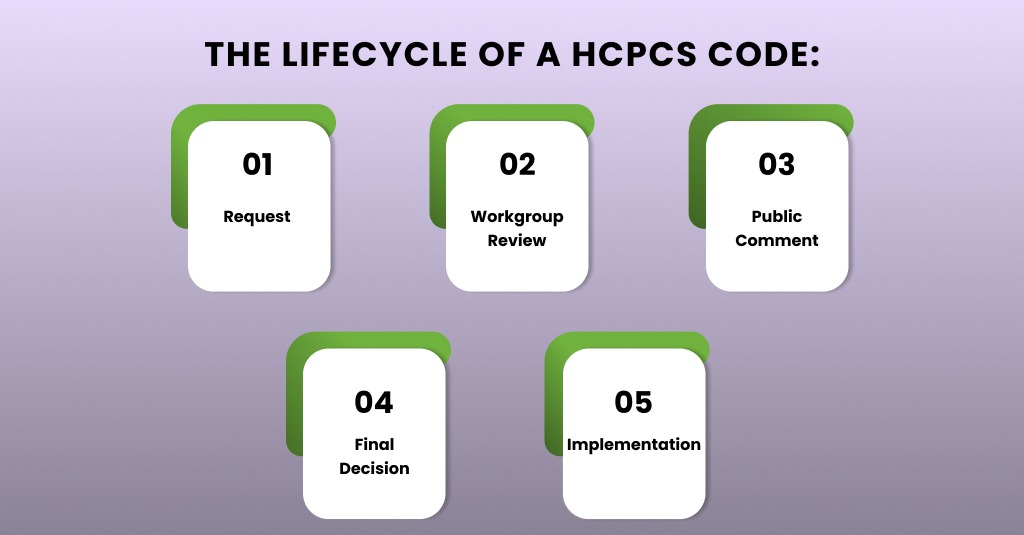
If you work with new devices, drugs, or technologies, you need to understand how codes are born. This is not academic. It directly affects whether you can bill for something new.
- Step 1: Request – A manufacturer, provider, or specialty society submits a coding application to CMS. The application includes clinical data, FDA status, and proposed pricing information.
- Step 2: Workgroup review – The HCPCS Workgroup meets twice per year (spring and fall) to review applications. They discuss whether a new code is needed or if an existing code works.
- Step 3: Public comment – CMS publishes proposed coding decisions in the Federal Register. Anyone can comment. Manufacturers often submit additional data during this period.
- Step 4: Final decision – CMS issues a final decision. If approved, the new code gets a release date. Usually, the code becomes effective on the next quarterly update date after the decision.
- Step 5: Implementation – The code is added to the HCPCS Level II file. Providers can begin using it on the effective date.
If you submit a request in January, the workgroup reviews it in the spring. A decision comes in the summer. The code becomes effective October 1. That is nine months from request to use.
If you are launching a product, start the coding process at least a year in advance.
HCPCS Modifier KX: Your Best Friend for Medical Necessity
One modifier deserves special attention because it prevents so many denials.
Modifier KX means “requirements specified in the medical policy have been met.”
Here is how it works. An LCD or NCD lists specific documentation requirements for certain DME items. For example, a power wheelchair requires a face-to-face exam, a written order, and a specialized evaluation. If you submit a claim for the wheelchair with just the E code, it gets denied.
If you attach modifier KX, you are certifying that all those requirements are met and the documentation is on file.
Do not use KX unless you actually have the documentation. Medicare auditors actively look for KX claims without supporting records. The penalty for false KX claims is not just a recoupment. It can trigger a prepayment review on every claim you submit.
Use KX correctly, and your clean claim rate goes up. Abuse it, and you invite an audit.
| Real World Examples: Putting HCPCS to Work. Let us walk through three common scenarios so you can see how this actually works in practice. Example 1: Injectable Drug in the Office You administer 80mg of methylprednisolone to a patient with a severe allergic reaction. The drug comes in 40mg vials. You use two vials. – HCPCS code: J1030 (methylprednisolone, 40mg) – Units: 2 – Modifiers: None required for this drug The claim tells the payer exactly what you gave and how much. If you used a single 80mg vial that does not exist, you would still bill two units because the code is defined per 40mg. Example 2: Standard Power Wheelchair A patient qualifies for a Group 2 power wheelchair with standard features. You have the face-to-face exam, the written order, and the evaluation. – HCPCS code: K0822 (power wheelchair, group 2, standard) – Modifiers: KX (requirements met), NU (new equipment) – Additional codes: May need E2601-E2609 for seating and positioning If you forget KX, the claim will likely be denied for lack of medical necessity documentation. If you forget NU, the payer might assume rental instead of purchase. Example 3: COVID-19 Vaccine Administered at Home You go to a patient’s home to administer the COVID-19 vaccine. The patient is homebound. – Vaccine administration code: 90471 (CPT, for the injection itself) – Home-specific code: M0201 (HCPCS, for the home setting and associated payment) – Vaccine product code: 91304 (for Pfizer, as an example) Notice the mix. You use a CPT code for the injection and an HCPCS code for the home situation. If you only bill the CPT code, you get paid for the injection but not the extra home visit amount. The M code captures the additional resource cost of going to the home. |
PDAC Verification and Product-Level HCPCS Coding Accuracy
For DME items, selecting the correct HCPCS code is not always straightforward. Many products appear similar but are assigned different codes based on technical specifications and intended use.
This is where the Pricing, Data Analysis, and Coding (PDAC) contractor plays a critical role.
PDAC maintains a database of:
- Manufacturer-specific products
- Verified HCPCS code assignments
If a product is not PDAC-verified:
- Claims may be denied
- Or flagged for manual review
For suppliers and billing teams, PDAC verification ensures that:
- The billed HCPCS code matches the exact product
- Documentation aligns with coding standards
Using a generic or incorrect code instead of a PDAC-verified code is a major compliance risk in DME billing.
Common HCPCS Billing Mistakes That Get Claims Rejected
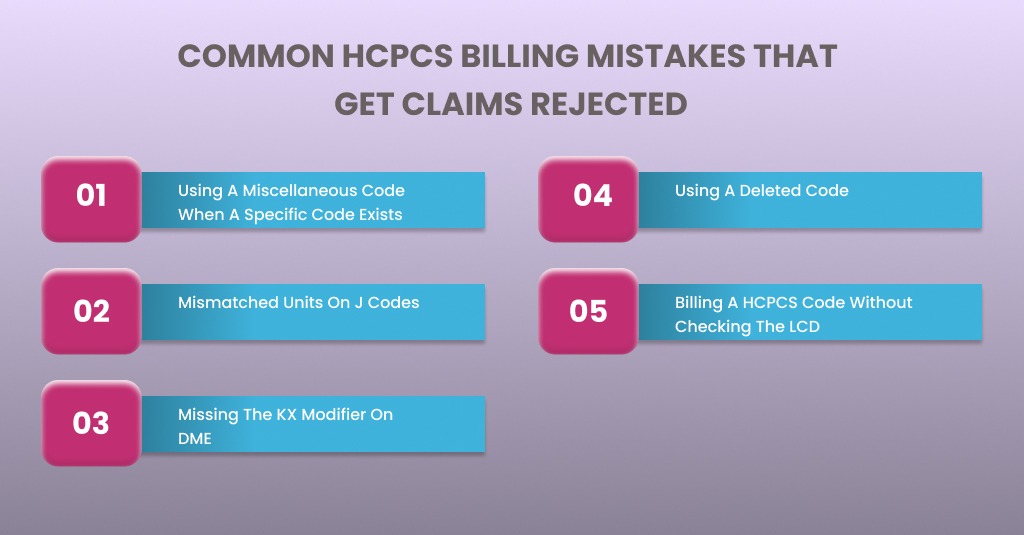
You can avoid most denials by watching for these specific errors.
Mistake 1: Using a miscellaneous code when a specific code exists
Payers hate miscellaneous codes. If you use E1399 (DME, not otherwise classified) when there is an actual K code for the same item, the claim gets rejected. You are expected to look up the specific code first.
Mistake 2: Mismatched units on J codes
J codes have defined dose units. J1030 is per 40mg. If you give 100mg, you do not bill 1 unit. You bill 2.5 units. But not all payers accept fractional units. Some require rounding. Check your MAC’s policy before billing partial units.
Mistake 3: Missing the KX modifier on DME
This is the number one reason for the denial of power mobility devices. You have the documentation. You just forgot to add the modifier. The automated system flags the claim as missing medical necessity documentation and denies it. Add KX, and the same claim passes.
Mistake 4: Using a deleted code
HCPCS codes get deleted every year. CMS publishes a deleted code crosswalk showing which new code replaces the old one. If you miss that update, you are billing an invalid code. The claim is rejected with no opportunity to correct it without resubmitting.
Mistake 5: Billing a HCPCS code without checking the LCD
Just because Medicare covers an item nationally does not mean your local MAC covers it. Some LCDs add restrictions. Some exclude coverage entirely for certain conditions. Always check your MAC’s website before assuming coverage.
Where to Get Official HCPCS Information
Do not rely on random internet lists. Do not use a free code lookup tool from a vendor that sells supplements. Go to the source.
Official CMS HCPCS website – www.cms.gov/hcpcs
This has the quarterly alpha-numeric file, the coding manual, and all public meeting notices. Download the Excel file. Filter by code. See the exact short description and any coverage notes.
Medicare Administrative Contractor (MAC) websites – Each MAC publishes LCDs for its jurisdiction. You can search by code to see if there are local coverage restrictions. Noridian, Palmetto, CGS, NGS – find your MAC and bookmark their LCD search page.
AMA CPT site – For Level I (CPT) codes when they interact with HCPCS Level II. Not strictly necessary for HCPCS alone, but useful when you need to know the relationship between a CPT procedure and a HCPCS supply.
PDAC (Pricing, Data Analysis, and Coding) contractor – For DME coding verification. If you are not sure whether a specific product maps to a specific HCPCS code, PDAC offers product code verification. They maintain a database of DME products and their correct codes.
How Professional Medical Billing Services Reduce HCPCS Errors
HCPCS-related denials are rarely caused by a single mistake—they are usually the result of breakdowns across coding, documentation, and payer policy validation.
A specialized medical billing team addresses these gaps by integrating:
- Real-time LCD/NCD verification before claim submission
- Modifier validation protocols for DME and drug claims
- MAC-specific compliance checks
- Automated alerts for HCPCS quarterly updates
- Denial pattern tracking across payers
For example, in high-risk categories like DMEPOS and Part B drug billing:
- Billing teams ensure PDAC alignment
- Validate ASP-based unit calculations
- Attach correct modifiers such as KX, NU, or RR
This reduces:
- First-pass denial rates
- Audit exposure
- Revenue leakage
In complex HCPCS environments, billing accuracy is not just about knowledge—it requires systems, workflows, and continuous monitoring.
Final Operational Checklist for Your Billing Team
You do not need to memorize every HCPCS code. You do need a system.
- Subscribe to CMS HCPCS updates – CMS offers an email notification for HCPCS updates. Sign up. Read every quarterly announcement.
- Update your software quarterly – Set a calendar reminder for the last week of March, June, September, and December. Check for new codes. Test the new codes before they go live.
- Keep a current crosswalk – Build a spreadsheet of the HCPCS codes you use most often. Next to each code, note the LCD coverage status, the required modifiers, and the typical units. Update this spreadsheet every January.
- Train staff on the letter prefixes – A new biller should be able to look at E1399 and know it is DME. Train them on the first letter. The rest they can look up.
- Audit your own KX claims – Pull 10 claims per month where you used the modifier KX. Verify the documentation exists. If it does not, stop using KX on that item until you fix the process.
- Check deleted codes before submitting – At the start of each year, run a report of every HCPCS code you used in the prior year. Compare to the CMS deleted code list. Update or remove any deleted codes from your templates.
HCPCS is not complicated. It is detailed. Those are two different things. You can learn the details. You just have to put in the time to check updates, read LCDs, and use modifiers correctly. Do that, and your claims will stop getting denied for the stupid stuff.