

Days in A/R clearly signals how your practice’s revenue cycle functions. Cash flow tightens when it climbs while the practice sees equal numbers of patients and bills for the same payers. This guide explains what a healthy A/R days figure is, why it rises in the first place, and how to reduce A/R days in your medical practice.
What A/R Days Mean in Medical Billing?
Days in A/R calculates the average number of days it takes a practice to receive payment after billing services. It is worked out by overall AR over common day-to-day costs and is the solitary number that best represents whether guarantees are moving through payers cleanly or get stuck somewhere en route.
High A/R days lock up the cash with which a practice should pay its employees, purchase supplies, and cover overhead. It also obscures all the other revenue cycle issues: older claims pile up silently behind those still being worked. Another practice that doesn’t harness this number closely finds itself with a problem only when the cash flow comes under pressure.
The effect compounds over time. An unworked claim at 45 days is more difficult to collect than the same 20-day-old claim, simply because documentation becomes harder and harder over time (think of all that gets shuffled), staff turnover erases institutional memory as to why a claims shipment stalled even further back in its history, and many payer timely filing windows begin closing.
Increasing A/R days is primarily a symptom of trouble upstream, whether it be slower claim submission, greater denials, or weaker follow-up.
What Is a Good A/R Days Benchmark?
Practice top performers have less than 30 days in A/R (MGMA DataDive benchmarking data). Average days to fill across the entire industry varies by specialty, but is around 35-45.
Under 35 days would usually be front-door pharmacy practices. Behavioral health and oncology practices, which have more prior authorization and documentation complexity, run closer to 45 days before the number becomes a concern.
When practice crosses that 50-60 day mark, MGMA considers it a revenue risk with an intervention required (e.g., once the charged claim has been outstanding for longer than sixty days, this usually indicates some sort of systemic failure somewhere in the actual claims submission or follow-up process).
The story in the A/R aging buckets:s An average practice should maintain about 50 to 65 percent of total receivables in the zero to thirty days bucket, between fifteen and twenty-five percent on accounts aged thirty-one to sixty days old, and ten to fifteen percent over one hundred days old. MGMA considers a balance greater than 20 percent of total A/R that is more than 90 days old to be structural, because claims this aged have very little chance of being collected at all.
Why Are Your A/R Days Increasing?
A/R days usually climb because of a handful of recurring breakdowns, each adding its own delay to the time between service and payment.
- Claim submission delays. Days before a payer ever receives them, documentation or claims held for internal review (or missing altogether) expire.
- Coding and documentation errors. Not having a diagnosis to support the service billed, or documentation that doesn’t match the code, can start an additional denial cycle of added weeks.
- Eligibility issues. Coverage that lapsed or changed before the visit is one of the most common and most preventable causes of a denied claim.
- Prior authorization problems. In other words, medical necessity does not matter if a payer has required prior authorization for an entire service and that was never obtained; it will be denied completely.
- Claim denials and rejections. Every denial left unworked contributes directly to aging A/R, with recovery unlikely as time passes.
- Slow payer follow-up. Even properly submitted claims age if their status isn’t checked until the timely filing window for a payer is already closing.
- Patient balances. As deductibles and coinsurance shift more cost onto patients, the portion of A/R sitting in patient responsibility, which collects slower than payer balances, keeps growing.
Most practices don’t have just one of these problems. It implies that a claim can pass eligibility and pre-authorisation checks only to stall at coding review, whilst it also indicates that a clean claim getting denied due to some other reason still needs the same follow-up discipline as one coded wrong from day one.
Identifying which cause is driving the most dollars into aging A/R is usually the faster path to a lower number.
8 Ways to Reduce A/R Days in a Medical Practice
Reducing A/R days is less about one miracle cure and more a matter of tightening the screws at every interval in order to understand how you can lessen the reach.
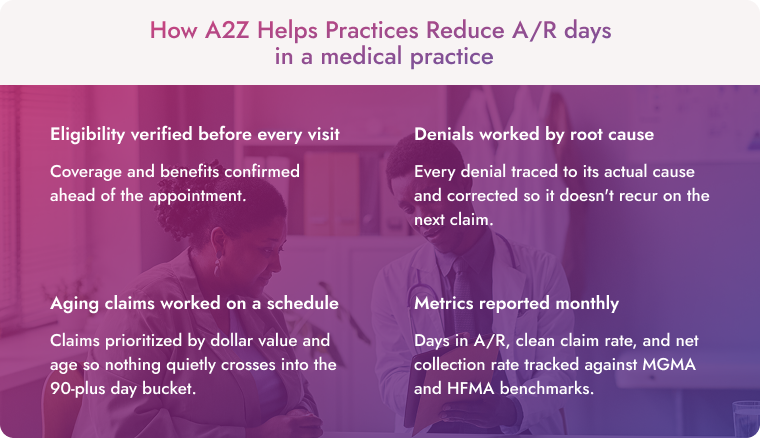
- Verify eligibility before every visit. The only thing that could be a denial prevention strategy is to confirm active coverage and benefit details of the patient before the appointment.
- Obtain prior authorization early. Many denials are related to the timing of authorization; beginning this process as soon as a service is scheduled eliminates the possibility of a denial that has nothing to do with medical necessity.
- Submit clean claims quickly. One measure of success is the clean claim rate, meaning a submission with fewer than 5 percent denials and within one or two days following the visit, not an arbitrary goal but rather what helps top-performing practices obtain A/R under 30 days.
- Monitor claim status regularly. By running claim status on a systematized schedule, stalled claims are identified and corrected early enough to be re-filed before the end of any filing deadline.
- Work denials by root cause. HFMA reports that some 65 percent of denied claims are never resubmitted, and AJMC research estimates the potential share of avoidable denials at more than four times greater. Address the root cause so that denial on next claim does not happen again.
- Prioritize high-value and aging claims. A worklist based on dollar amount and aging recovers more revenue sooner; it will prevent claims from crossing into the 90+day bucket where recovery probabilities decline significantly.
- Improve patient payment collection. Recurring and Persistent Balances: Addressing the Most Defensible Portion of A/R by Collecting Estimated Patient Responsibility at Time-of-Service & Providing Transparent Payment Plan Options for Larger Balances To Prevent Further Growth in What is, Nowadays, a Slower-Collecting Component of A/R.
- Automate repetitive RCM workflows. Automation of eligibility checks, claim scrubbing,g and tracking status reduces the human lag inherent in each step discussed above, so staff is freed up to work on the claims that truly require judgment.
A practice that automates eligibility checks but continues to batch claims for a weekly submission will see A/R days creep upward as well. Just as if a practice that works denied claims right back to the origin and never corrects their coding pattern causing those denials.
Track the Right A/R Metrics
Days in A/R is a summary number. These six metrics show where in the cycle a practice is actually losing time, and the benchmark for each comes from MGMA and HFMA’s published revenue cycle standards.
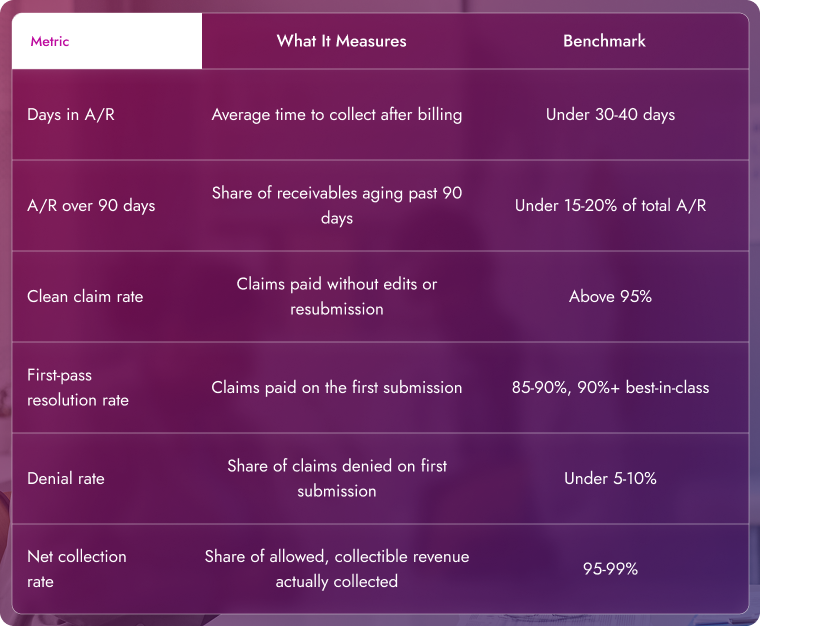
These metrics work together. A high clean claim rate with a low first-pass resolution rate usually points to a payer-side adjudication issue. A strong net collection rate alongside rising days in A/R often means claims are eventually paid correctly, just too slowly. Reviewing all six together shows where in the cycle time is actually being lost.
When Should a Practice Consider Outsourcing A/R?
A few specific patterns suggest internal resources alone won’t close the gap on a high A/R days number.
- A growing backlog. A worklist that keeps expanding despite staff working it daily usually means volume has outgrown current capacity.
- Increasing denials. A denial rate that keeps climbing points to a root-cause problem that needs dedicated attention.
- Lack of billing staff. Turnover or understaffing in billing often shows up first as aging claims nobody has time to follow up on.
- Persistent 60- and 90-plus day balances. When the same claims keep rolling forward in the aging report month after month, in-house follow-up isn’t keeping pace with new volume.
A practice still has to do its own front-end work, such as collecting accurate patient information at check-in. Outsourcing adds dedicated capacity for the follow-up, denial work, and daily claim monitoring that tends to fall behind first when staff is stretched across scheduling, check-in, and billing at once.
Frequently Asked Questions
How do you calculate days in A/R?
Divide total accounts receivable by average daily charges, calculated over a trailing period such as the last 90 days. The result is the average number of days it takes to collect after billing.
What is considered a good A/R days number?
Under 30 days is top-performer territory according to MGMA, with 35 to 45 days considered a normal industry average depending on specialty. Above 50 to 60 days is treated as a revenue risk needing attention.
How often should A/R be worked?
Claims should be checked on a set schedule. Aging claims should be worked at least weekly so nothing drifts past a payer’s timely filing deadline unnoticed.
How can a practice reduce A/R over 90 days?
Prioritize those claims by dollar value, confirm the actual denial or delay reason for each one, and work them to resolution or appeal. Preventing new claims from reaching that bucket matters just as much as clearing the existing ones.
Does a high clean claim rate guarantee low A/R days?
Not on its own. A clean claim rate above 95 percent means fewer claims bounce back for correction, but A/R days also depend on how quickly claims are submitted after the visit and how consistently denials and aging claims are followed up on afterward.
Conclusion and Call to Action
Reducing A/R days comes from faster clean-claim submission, denials worked by root cause, consistent payer follow-up before deadlines close, and front-end processes, like eligibility and authorization, that catch problems before a claim ever goes out.
A2Z reviews where your practice’s A/R is actually getting stuck and builds a plan to bring it back in line with MGMA and HFMA benchmarks.
