If you bill for healthcare services, you’ve seen those ten mysterious digits called an NPI — your National Provider Identifier. It appears on every claim form, electronic file, referral, and credentialing document. But what does it really mean? Why is it so important? And what happens if you use it wrong?
Let’s break it down clearly.
What Is a National Provider Identifier (NPI)?
The National Provider Identifier (NPI) is a unique 10-digit identification number that CMS (Centers for Medicare & Medicaid Services) assigns to healthcare providers and organizations in the United States.
In simple terms, your NPI is your digital ID badge in the healthcare billing world. Every time you submit a claim, refer a patient, or verify eligibility, your NPI identifies who you are — no matter which payer or state you’re working in.
It’s a single, nationwide ID that replaces all the old payer-specific numbers providers used before HIPAA standardized healthcare transactions.
Think of it as your “billing fingerprint.” You only get one, and it follows you everywhere — across states, jobs, and payers.
Why the NPI Was Created
Before 2004, each insurance company had its own provider identification system. One doctor could have a dozen different IDs depending on which payer they billed. It was inefficient, confusing, and error-prone.
To address this issue, the Health Insurance Portability and Accountability Act (HIPAA) required a universal identifier for all healthcare providers and entities involved in billing.
The goals were simple but crucial:
- To simplify and standardize electronic healthcare transactions.
- To reduce administrative costs and claim errors.
- To prevent duplicate records and fraudulent billing.
- To make credentialing and payer communication easier.
By 2007, CMS made NPIs mandatory for all HIPAA-covered entities — from solo doctors and therapists to massive hospital systems.
What Your NPI Actually Does?
Your NPI’s primary purpose is identification. It tells payers, clearinghouses, and EHR systems who provided or billed the service.
Here’s what it helps with:
- Submitting electronic claims (CMS-1500 or UB-04)
- Sending referrals and prior authorizations
- Enrolling with insurance payers
- Checking patient eligibility
- Linking individual and group billing information
But here’s what it doesn’t do:
- It doesn’t prove you’re licensed or credentialed.
- It doesn’t guarantee payment or network participation.
- It doesn’t replace your EIN or Tax ID.
So, while your NPI identifies you, it doesn’t authorize or credential you. That’s still up to your state license and payer contracts.
If you provide healthcare services, transmit claims, or handle any HIPAA-covered transactions, you must have an NPI.
Types of NPI
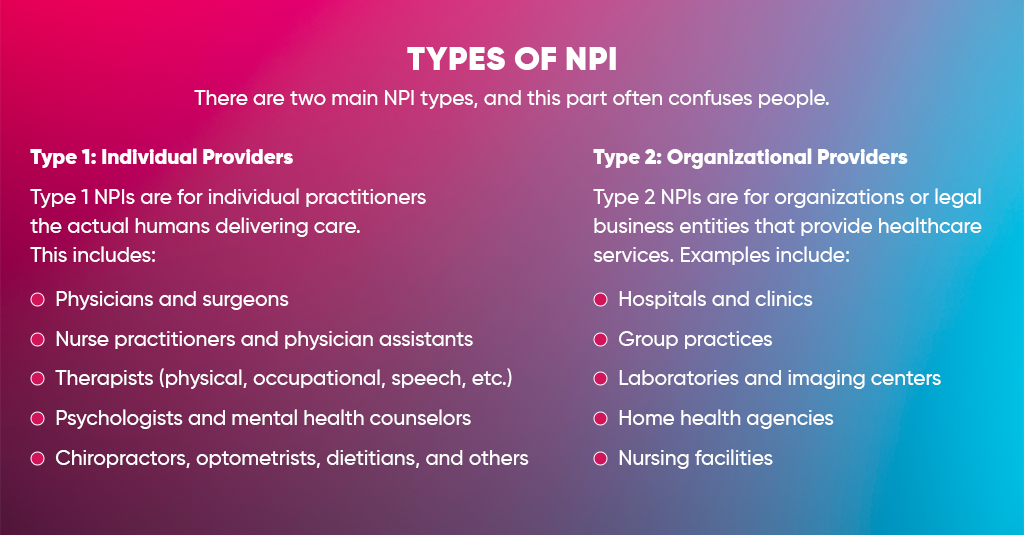
There are two main NPI types, and this part often confuses people.
Type 1: Individual Providers
Type 1 NPIs are for individual practitioners — the actual humans delivering care. This includes:
- Physicians and surgeons
- Nurse practitioners and physician assistants
- Therapists (physical, occupational, speech, etc.)
- Psychologists and mental health counselors
- Chiropractors, optometrists, dietitians, and others
You only get one NPI for life. Even if you move states, change employers, or switch from private practice to hospital work, that same number stays with you.
Type 2: Organizational Providers
Type 2 NPIs are for organizations or legal business entities that provide healthcare services. Examples include:
- Hospitals and clinics
- Group practices
- Laboratories and imaging centers
- Home health agencies
- Nursing facilities
Each organization gets its own NPI separate from the individual providers working there.
Example:
A pediatrician has her own Type 1 NPI. Her group practice, “BrightStar Pediatrics,” has a Type 2 NPI. When they bill a claim, both NPIs appear — the group’s as the billing provider and Dr. Brooks’s as the rendering provider.
NPI vs. Other Provider Identifiers
Many new providers mix up NPI with other identifiers. Here’s how to think of them:
- NPI: Universal ID for HIPAA transactions and claims.
- EIN (Employer Identification Number): For taxes and payroll.
- PTAN (Provider Transaction Access Number): Medicare-specific ID used for enrollment and correspondence.
- State License: Legal authority to practice.
| Identifier | Purpose | Issued By | Used For |
| NPI | Universal provider ID | CMS | Claims, billing, HIPAA transactions |
| Tax ID (EIN) | Employer identification for tax purposes | IRS | Business income reporting |
| Medicare PTAN | Medicare-specific provider number | MAC (Medicare Admin Contractor) | Enrollment and payment processing |
| State License Number | Legal authorization to practice | State Board | Credentialing, compliance |
How to Apply for an NPI
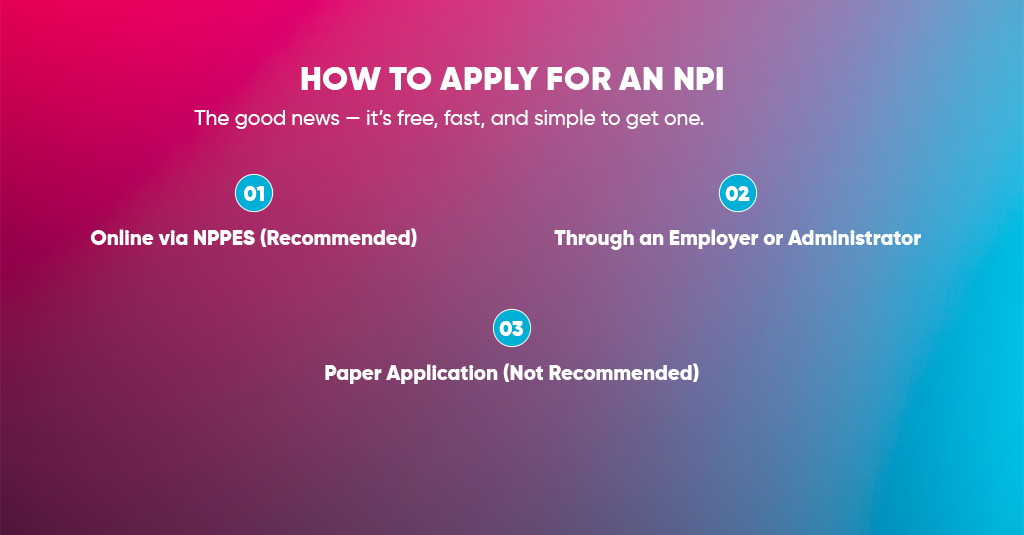
The good news — it’s free, fast, and simple to get one.
You can apply in three main ways:
1. Online via NPPES (Recommended)
Go to the official National Plan and Provider Enumeration System (NPPES) website: https://nppes.cms.hhs.gov.
You’ll create a login, fill out your provider information (name, taxonomy, address, license, etc.), and submit.
Most providers receive their NPI number within 24–48 hours by email.
2. Through an Employer or Administrator
Hospitals, group practices, and large healthcare systems can apply for NPIs on behalf of employed providers. This ensures that both Type 1 and Type 2 NPIs are adequately linked in their system.
3. Paper Application (Not Recommended)
CMS still allows paper applications using Form CMS-10114, but it’s slower and rarely used now.
Pro Tip: Always keep your NPPES login and email active. If you move or change credentials, update your NPI record immediately — outdated addresses or taxonomies can cause claim mismatches or payer rejections.
How NPIs Work in Medical Billing
Every claim you send must include the correct NPIs — and this is where most billing errors happen.
Let’s look at how NPIs appear on claims:
- Billing Provider NPI (Type 2): The organization or entity receiving payment.
- Rendering Provider NPI (Type 1): The individual who actually performed the service.
- Referring Provider NPI (Type 1): The provider who referred the patient.
- Supervising Provider NPI (Type 1): Used when a mid-level provider (like an NP or PA) works under physician supervision.
Example:
A physical therapist employed at a rehab clinic sees a Medicare patient.
- The therapist’s Type 1 NPI goes in the rendering field.
- The clinic’s Type 2 NPI goes in the billing field.
- If a physician referred the patient, that doctor’s NPI is listed as the referring provider.
If any of these fields are wrong or missing, the claim can get rejected or paid incorrectly.
Why Taxonomy Codes Matter
When you apply for an NPI, you must select a taxonomy code — basically, your specialty classification.
Taxonomy codes help payers know what kind of services you provide. For example:
- 207Q00000X = Family Medicine
- 207R00000X = Internal Medicine
- 225100000X = Physical Therapist
If your taxonomy doesn’t match the CPT codes or services you’re billing, it can trigger denials or prepayment reviews.
Always double-check that your NPI taxonomy reflects your current practice and credentials.
Common NPI Mistakes Providers Make
Even experienced billing teams get tripped up by simple NPI errors. These are the top ones to watch out for:
- Using the wrong NPI type: Many solo providers mistakenly use their organization’s Type 2 NPI on individual claims. Always verify which number the payer expects.
- Not including a rendering provider: Some commercial payers reject claims without a rendering NPI, even for group practices.
- Failing to update address or name changes can lead to outdated NPI records, which may delay credentialing and cause claim mismatches.
- Incorrect taxonomy or specialty code: Your taxonomy must align with the services you perform — not what your clinic offers generally.
- Unlinked NPIs in payer portals: Always confirm that your individual and group NPIs are connected correctly in each payer’s system.
If a claim keeps being denied for “invalid NPI,” check both the rendering and billing provider records in the payer’s credentialing system — not just your claim form.
How to Verify an NPI
You can check any NPI (including your own) using the CMS NPI Registry at https://npiregistry.cms.hhs.gov.
This free tool lets you search by:
- Provider name
- NPI number
- Taxonomy (specialty)
- City or state
It helps verify referrals, confirm group NPIs, or check if a provider is actively listed.
Many billing teams use it before claim submission to avoid miskeyed NPIs that cause denials.
Updating or Deactivating Your NPI
CMS requires providers to update their NPI record within 30 days of any change — like a new location, name change, or change in specialty.
To update, log in to NPPES and edit your profile.
If you’re retiring or closing your practice, you can deactivate your NPI through the same portal.
Keeping your record current protects you from fraud and ensures payers don’t misroute payments or correspondence.
What Happens if You Use the Wrong NPI
Using the wrong NPI can mess up everything.
Here’s what might happen:
- Claim rejections occur because the payer can’t match the provider to the contract.
- Incorrect payments — paid under the wrong tax ID or rate.
- There are delays in reimbursement while payer systems reprocess claims.
- There are compliance risks if claims are billed under another provider’s NPI.
For Medicare and Medicaid, primarily, billing under the wrong NPI (intentionally or not) can even raise audit flags.
Always ensure the NPI listed matches the actual provider of service and the credentialed entity under that payer.
Compliance and Best Practices
To stay compliant and avoid billing headaches:
- Keep both Type 1 and Type 2 NPIs active and up to date.
- Review payer contracts to confirm which NPI to use.
- Store NPI records securely — they’re considered sensitive identifiers.
- Train new billing staff on proper NPI use.
- Periodically verify your NPI info on CMS’s registry.
- If you suspect fraud (like someone using your NPI without consent), report it immediately to CMS or the OIG hotline.
They all serve different purposes but work together in billing and credentialing.
Final Thoughts
Your National Provider Identifier (NPI) number might look like a string of digits, but it’s the foundation of your entire billing identity. Without it, no payer — not Medicare, Medicaid, or commercial — can recognize you in their system.
An NPI is your “professional DNA.” Protect it, keep it accurate, and use it wisely.
A single mistake in your NPI setup can ripple through your billing workflow — causing denials, compliance flags, and delays that eat into your revenue.
So if you haven’t checked your NPI profile in a while, log in to NPPES today. Make sure it reflects who you are, where you work, and what you do.
Because in the world of healthcare billing, those 10 digits tell your whole story.