

Psychologists use several CPT codes to report diagnostic evaluations, individual psychotherapy, family therapy, and group psychotherapy. Choosing the right code depends on the service provided, time requirements, patient participation, documentation, and payer rules. This guide covers the most common psychotherapy codes for psychologists, including 90791, 90832, 90834, 90837, 90846, 90847, 90849, and 90853, along with billing requirements, documentation tips, reimbursement factors, and common coding mistakes.
What Are Psychotherapy CPT Codes?
Psychotherapy CPT codes identify behavioral health services that psychologists and other qualified mental health professionals provide.
These codes help payers understand what service the provider performed.
The appropriate code may depend on:
- The type of service.
- Whether the psychologist performed a diagnostic evaluation.
- Whether the session involved individual, family, or group psychotherapy.
- Whether the patient participated in the session.
- The amount of time involved when the code uses time as a selection factor.
- The provider’s qualifications.
- The patient’s insurance plan.
- Payer-specific billing rules.
Psychologists should always code from the actual service and documentation.
A longer appointment does not automatically justify a higher-paying code.
Also Read: Mental Health Billing and Coding Guide
Common Psychotherapy Codes for Psychologists
The following CPT codes commonly appear in behavioral health billing.
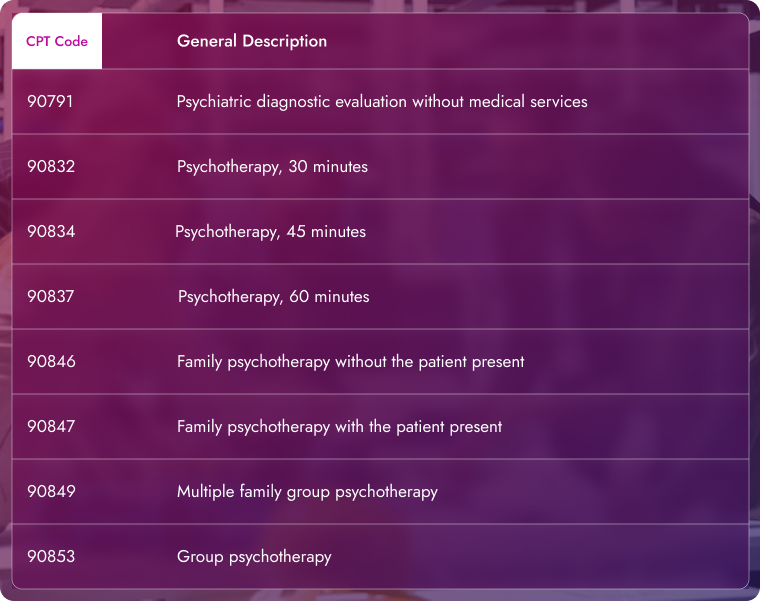
Each code serves a different purpose.
CPT Code 90791: Psychiatric Diagnostic Evaluation
CPT 90791 represents a psychiatric diagnostic evaluation without medical services.
Psychologists may use this code when they perform a comprehensive diagnostic evaluation that meets the applicable CPT requirements.
The evaluation may include:
- Presenting problems.
- Psychiatric history.
- Relevant medical history.
- Family history.
- Social history.
- Substance use history when clinically relevant.
- Mental status examination.
- Psychosocial assessment.
- Risk assessment when appropriate.
- Diagnostic impression.
- Treatment recommendations.
- Initial treatment planning.
The provider should document the clinical information necessary to support the evaluation.
Important point
90791 does not simply mean “new patient visit.”
A psychologist should not report 90791 at every first appointment without performing a qualifying psychiatric diagnostic evaluation.
The service must meet the applicable code requirements, and the payer must allow reimbursement.
CPT Code 90832: Psychotherapy, 30 Minutes
CPT 90832 represents psychotherapy that meets the applicable time requirements for the 30-minute service.
A psychologist may use this code when providing individual psychotherapy to a patient.
The session may address:
- Anxiety.
- Depression.
- Trauma related symptoms.
- Stress.
- Grief.
- Behavioral concerns.
- Relationship issues.
- Emotional regulation.
- Coping strategies.
The psychologist should document the clinical problem, therapeutic intervention, patient response, and progress toward treatment goals when applicable.
The note should demonstrate that the provider actually performed psychotherapy.
CPT Code 90834: Psychotherapy, 45 Minutes
CPT 90834 represents psychotherapy that meets the applicable time requirements for the 45-minute service.
This code often applies to standard individual psychotherapy sessions that do not meet the requirements for 90837.
The psychologist may use evidence-based interventions such as:
- Cognitive behavioral therapy.
- Dialectical behavior therapy techniques.
- Exposure based interventions.
- Supportive psychotherapy.
- Trauma focused interventions.
- Behavioral activation.
- Problem solving strategies.
The specific therapeutic approach does not determine the CPT code by itself.
The psychologist should select the code based on the service performed and the applicable coding requirements.
CPT Code 90837: Psychotherapy, 60 Minutes
CPT 90837 represents psychotherapy, 60 minutes with the patient.
Psychologists often use this code for longer individual psychotherapy sessions.
However, providers should not automatically report 90837 whenever an appointment lasts approximately one hour.
The documentation should support the reported psychotherapy service and the applicable time requirements.
Some payers also apply specific policies to 90837.
For example, a payer may conduct additional review of extended psychotherapy sessions or require specific documentation.
Psychologists should therefore monitor payer policies and denial patterns.
CPT Code 90846: Family Psychotherapy Without the Patient Present
CPT 90846 represents family psychotherapy without the patient present.
The psychologist provides psychotherapy to family members or caregivers while the identified patient does not participate in the session.
The provider may address:
- Family dynamics.
- Communication problems.
- Caregiver concerns.
- Behavioral management.
- Treatment support.
- Family responses to the patient’s condition.
The documentation should explain why the family session without the patient supports the patient’s treatment.
For example, a psychologist may meet with a patient’s parents to address behavioral strategies and discuss how the family can support the child’s treatment plan.
The note should connect the family psychotherapy service to the patient’s clinical needs.
CPT Code 90847: Family Psychotherapy with the Patient Present
CPT 90847 represents family psychotherapy with the patient present.
The psychologist conducts psychotherapy involving the patient and one or more family members.
The session may focus on:
- Family conflict.
- Communication.
- Relationship patterns.
- Parenting concerns.
- Caregiver support.
- Treatment planning.
- Behavioral changes.
- Family adjustment to illness.
The psychologist should document who participated and explain the therapeutic purpose of the session.
The presence of a family member alone does not automatically make the service family psychotherapy.
The psychologist must provide a qualifying psychotherapy service.
CPT Code 90849: Multiple Family Group Psychotherapy
CPT 90849 represents multiple family group psychotherapy.
The service involves psychotherapy provided to multiple families or family units in a group setting.
The psychologist should document the nature of the group, the patient’s participation when applicable, and the therapeutic purpose of the service.
Payer coverage can vary significantly for group-based behavioral health services.
Verify coverage and billing requirements before reporting the code.
CPT Code 90853: Group Psychotherapy
CPT 90853 represents group psychotherapy.
The psychologist provides psychotherapy to multiple patients in a group setting.
The service may address conditions such as:
- Substance use disorders.
- Anxiety.
- Depression.
- Trauma.
- Coping skills.
- Behavioral health concerns.
- Social skills.
- Emotional regulation.
The psychologist should document the therapeutic purpose of the group and the patient’s participation.
Some payers require additional information for group therapy claims.
Psychologists should verify payer requirements and ensure that the medical record supports the service.
Psychotherapy Codes for Psychologists: Quick Comparison
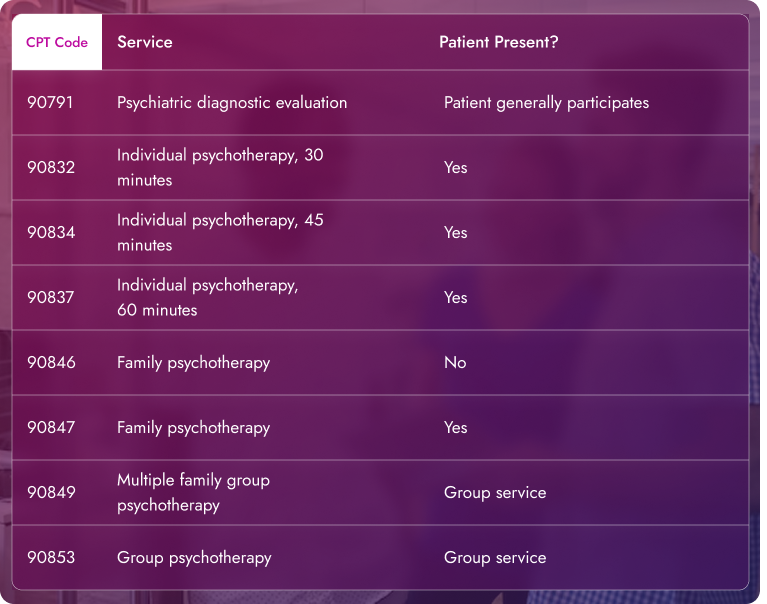
Always check the current CPT code set and payer guidance before billing.
How Psychologists Choose the Right Psychotherapy Code
The code selection process should follow a logical sequence.
Step 1: Identify the Service Type
Ask what service the psychologist actually provided.
Was it:
- A diagnostic evaluation?
- Individual psychotherapy?
- Family psychotherapy?
- Group psychotherapy?
The answer narrows the code options.
Step 2: Determine Who Participated
For family services, determine whether the identified patient participated.
This distinction can affect whether the provider reports 90846 or 90847.
Step 3: Review Time Requirements
For time-based psychotherapy services, verify the applicable CPT time requirements.
Do not select a code based on the scheduled appointment length alone.
Step 4: Review Documentation
Confirm that the medical record supports the service.
The documentation should reflect the actual clinical work.
Step 5: Verify Payer Rules
Check coverage, authorization, provider eligibility, telehealth requirements, and other payer policies.
Psychotherapy Time Rules for Psychologists
Time-based psychotherapy codes require careful attention.
The commonly used codes include:
- 90832 for 30 minutes.
- 90834 for 45 minutes.
- 90837 for 60 minutes.
Psychologists should follow the current CPT psychotherapy time guidance when selecting the code.
Do not assume that a 60-minute appointment automatically supports 90837.
For example, a patient may schedule a 60-minute appointment, but the actual psychotherapy service may not meet the requirements for 90837.
Likewise, the psychologist should not automatically downcode a service simply because the session ended a few minutes early without reviewing the applicable CPT time guidance.
The provider should document the service accurately and follow current coding guidance.
Psychotherapy Documentation Requirements
Good documentation supports both patient care and accurate billing.
A strong psychotherapy note should generally address:
Reason for the Session
Explain why the patient received psychotherapy.
Problems Addressed
Identify the symptoms, conditions, or clinical concerns addressed.
Interventions
Document the therapeutic methods the psychologist used.
For example:
- Cognitive restructuring.
- Behavioral activation.
- Exposure techniques.
- Relaxation training.
- Problem solving.
- Supportive therapy.
- Trauma-focused techniques.
Patient Response
Explain how the patient responded to the intervention.
Progress
Document progress toward treatment goals when appropriate.
Medical Necessity
Connect the service to the patient’s clinical condition and treatment needs.
Treatment Plan
Document ongoing goals and next steps when relevant.
The note should reflect the actual session rather than simply repeat information from previous visits.
Psychotherapy Diagnosis Coding
Psychologists typically report an appropriate ICD-10-CM diagnosis code alongside the CPT procedure code when the payer requires diagnosis coding.
The diagnosis should accurately represent the patient’s condition based on the provider’s clinical assessment.
Examples may include diagnoses involving:
- Anxiety disorders.
- Depressive disorders.
- Trauma and stressor related disorders.
- Obsessive compulsive related disorders.
- Bipolar disorders.
- Personality disorders.
- Other behavioral health conditions.
Psychologists should not select a diagnosis simply because it produces better reimbursement.
The diagnosis should reflect the patient’s documented clinical condition.
When the diagnosis remains uncertain, providers should follow applicable coding and documentation rules for provisional or uncertain diagnoses in outpatient settings.
Psychotherapy Modifiers
Modifiers may apply in specific circumstances, but psychologists should not add them automatically.
Modifier 25
Modifier 25 generally applies to a significant, separately identifiable E/M service reported on the same day as another service.
Psychologists who do not provide separately reportable E/M services generally will not use modifier 25 for routine psychotherapy.
Modifier 59
Modifier 59 identifies a distinct procedural service when the applicable circumstances support its use.
Providers should not use modifier 59 simply to force a payer to process a denied claim.
Telehealth Modifiers
Telehealth claims may require specific modifiers depending on the payer.
Requirements vary among:
- Medicare.
- Medicaid programs.
- Commercial insurance plans.
The practice should verify current requirements before submitting telehealth claims.
Psychotherapy Codes and Telehealth
Telehealth has become an important part of behavioral health care.
Psychologists may provide eligible services remotely when the service, provider, patient, and payer meet applicable requirements.
Before billing a telehealth psychotherapy service, verify:
- Payer coverage.
- Provider eligibility.
- State licensure requirements.
- Patient location.
- Provider location.
- Place of service.
- Modifier requirements.
- Consent requirements.
- Documentation rules.
Medicare telehealth requirements can change, and state Medicaid programs may establish their own rules.
Commercial insurers may also follow different policies.
Never assume that one payer’s telehealth billing rules apply to another payer.
Psychotherapy Reimbursement Rates
Psychotherapy reimbursement varies by payer and provider.
Factors that affect payment include:
- CPT code.
- Insurance plan.
- Provider credentials.
- Provider specialty.
- Geographic location.
- Network participation.
- Contracted reimbursement rate.
- Place of service.
- Telehealth status.
- Medical necessity.
- Authorization requirements.
There is no single reimbursement rate that applies to every psychologist.
For example, a psychologist may receive one contracted rate for 90834 from an insurance company and a different rate for 90837.
Another payer may reimburse the same codes at completely different amounts.
The practice should review current payer fee schedules and contracts.
Also Read: Timed vs Untimed CPT Codes
How Psychologists Can Improve Billing Accuracy
Verify Benefits Before the First Appointment
Check coverage, deductible, copayment, coinsurance, authorization requirements, and behavioral health limitations.
Keep Provider Enrollment Current
Maintain accurate payer credentialing and enrollment information.
Train Psychologists on CPT Codes
Providers should understand the difference between diagnostic evaluations, individual psychotherapy, family therapy, and group therapy.
Use Patient Specific Documentation
Avoid relying on generic notes that fail to explain the clinical work.
Track Denial Trends
Look for repeated denials involving specific codes, payers, or providers.
Review High Risk Claims
Pay close attention to claims involving extended psychotherapy sessions, modifier use, telehealth, and services that require authorization.
Conduct Periodic Audits
Regular audits can help identify documentation gaps and coding inconsistencies.
Final Thoughts
Accurate psychotherapy coding requires more than memorizing CPT numbers.
Psychologists need to understand the difference between diagnostic evaluation and psychotherapy, individual and family services, and different psychotherapy time-based codes.
The most important rule remains simple:
Choose the code that accurately represents the service you provided and document the clinical work that supports it.
A strong billing process also includes eligibility verification, authorization checks, accurate diagnosis coding, payer specific claim submission, denial management, and payment review.
When psychologists combine accurate clinical documentation with a disciplined billing workflow, they can reduce avoidable claim problems and improve revenue cycle performance without compromising coding compliance.
Your Psychology Practice Deserves More Than a Billing Backlog
Psychologists should spend their time helping patients, not repeatedly checking unpaid claims, correcting preventable billing errors, or chasing insurance companies.
A2Z Mental Health Billing Experts can help your practice manage the revenue cycle from the first claim submission through payment posting and denial follow-up services.
Whether you need support with behavioral health billing, claim management, eligibility verification, denial resolution, or accounts receivable follow-up, the right billing partner can help your practice stay focused on patient care.
Your expertise belongs in the therapy room. Our Billing Professionals can handle the billing work behind it.
Frequently Asked Questions
What is the most common psychotherapy CPT code for psychologists?
Common codes include 90832, 90834, and 90837 for individual psychotherapy. The appropriate code depends on the service and applicable time requirements.
What CPT code does a psychologist use for an initial evaluation?
A psychologist may use CPT 90791 for a qualifying psychiatric diagnostic evaluation without medical services.
What is the difference between 90834 and 90837?
90834 represents psychotherapy, 45 minutes, while 90837 represents psychotherapy, 60 minutes. Psychologists should follow current CPT time guidance when selecting the appropriate code.
Can psychologists bill 90837 for telehealth?
A psychologist may bill eligible telehealth psychotherapy services when the payer covers the service and the provider meets applicable federal, state, and payer requirements.
Can psychologists bill 90846?
A psychologist may report 90846 when providing qualifying family psychotherapy without the patient present, subject to payer and provider requirements.
Can a psychologist bill 90791 and 90837 on the same day?
Do not assume that both codes can receive reimbursement on the same date. The psychologist should review current CPT guidance and payer policy before reporting both.
Does psychotherapy require a diagnosis code?
Many payers require an appropriate ICD-10-CM diagnosis code with psychotherapy claims. The diagnosis should accurately reflect the patient’s documented condition.
How much does a psychologist receive for 90834?
Payment varies based on payer, contract, location, provider credentials, and other factors. Practices should check their current contracted rates.
How can psychologists reduce psychotherapy claim denials?
Psychologists can reduce avoidable denials by verifying eligibility, checking authorization requirements, maintaining credentialing, selecting accurate CPT and ICD-10-CM codes, documenting medical necessity, and monitoring payer-specific policies.
