
Healthcare providers, coders, billers, and revenue cycle professionals encounter National Correct Coding Initiative (NCCI) edits every day. These edits play a significant role in determining whether Medicare will reimburse a claim, deny a service, or require additional documentation. Understanding how these edits work can help providers reduce billing errors, improve first-pass claim acceptance, and maintain compliance with Medicare regulations.
One of the most common questions among billing professionals is, “When does CMS update NCCI edits?” Since Medicare updates these edits throughout the year, providers must stay informed to avoid submitting claims based on outdated coding rules.
In this guide, you’ll learn what NCCI edits are, why CMS created them, how they affect claims, when they are updated, where to find the latest edit files, and the best practices for avoiding preventable claim denials.
What Are NCCI Edits?
The National Correct Coding Initiative (NCCI) is a coding policy developed by the Centers for Medicare & Medicaid Services (CMS) to promote correct coding and reduce improper Medicare payments.
NCCI consists of automated coding edits that identify CPT and HCPCS code combinations that generally should not appear together on the same claim when billed by the same provider for the same patient on the same date of service.
These edits help Medicare determine whether the reported services are separately billable or whether one procedure already includes another as part of a more comprehensive service.
Rather than reviewing every claim manually, Medicare applies these edits electronically during claim processing. If a submitted claim contains an invalid code combination, the system flags the claim before payment is issued.
NCCI edits apply primarily to Medicare Part B claims and many Medicaid claims. Numerous commercial insurance companies also incorporate NCCI logic into their own claim editing systems, although they may apply additional proprietary edits.
Why Did CMS Create the National Correct Coding Initiative?
Before CMS implemented the National Correct Coding Initiative in 1996, providers often interpreted coding rules differently. Similar services could receive different coding treatment depending on the provider, specialty, or geographic location.
This inconsistency created several challenges, including:
- Duplicate billing for services already included in another procedure
- Incorrect payment for bundled services
- Unnecessary claim disputes
- Increased risk of fraud and abuse
- Inconsistent reimbursement across Medicare contractors
To address these issues, CMS established the National Correct Coding Initiative to create uniform coding standards for Medicare claims.
Today, NCCI serves as one of Medicare’s primary tools for ensuring that providers report services accurately and receive payment only for medically necessary and separately reportable procedures.
Goals of the NCCI Program
The National Correct Coding Initiative supports several important objectives within the Medicare program.
Its primary goals include:
- Promoting accurate CPT and HCPCS coding
- Preventing unbundling of services
- Reducing duplicate payments
- Encouraging consistent claim processing nationwide
- Supporting compliance with national coding guidelines
- Protecting the Medicare Trust Fund from improper payments
Although many providers associate NCCI edits with claim denials, the program also protects providers by establishing clear coding expectations that apply consistently across Medicare.
How NCCI Edits Improve Claim Accuracy
Every Medicare claim passes through numerous automated validation checks before payment.
NCCI edits compare the CPT and HCPCS codes reported on the claim against CMS’s edit files.
If the submitted code combination follows CMS coding policy, the claim continues through adjudication.
If the claim violates an NCCI edit, Medicare may:
- Deny one of the procedure codes
- Reduce reimbursement
- Reject the claim for correction
- Request additional documentation in certain circumstances
This automated review helps ensure Medicare pays only for services that qualify as separately billable according to national coding guidelines.
Who Should Understand NCCI Edits?
Although certified medical coders work with NCCI edits most frequently, many healthcare professionals’ benefit from understanding these rules.
NCCI knowledge is especially important for:
- Medical coders
- Medical billers
- Physicians
- Nurse practitioners
- Physician assistants
- Physical therapists
- Occupational therapists
- Speech-language pathologists
- Behavioral health providers
- Ambulatory surgery centers
- Hospital outpatient departments
- Revenue cycle managers
- Compliance officers
Anyone involved in coding, billing, or claim review should understand how NCCI edits influence reimbursement decisions.
Medicare vs. Commercial Insurance Use of NCCI Edits
NCCI is a CMS program designed for Medicare and Medicaid claims. However, many commercial insurance companies have adopted similar editing logic because it promotes consistent coding practices.
That does not mean every commercial payer follows Medicare’s NCCI edits exactly.
Private insurers may:
- Apply additional coding edits
- Use proprietary reimbursement policies
- Require different modifiers
- Maintain separate bundling rules
For this reason, providers should always review both CMS guidance and payer-specific billing policies before submitting claims.
Modifier Indicators
Not every NCCI edit results in an automatic denial. CMS assigns each PTP edit a modifier indicator, which tells providers whether a modifier may allow separate reimbursement when documentation supports distinct services.
The three modifier indicators are:
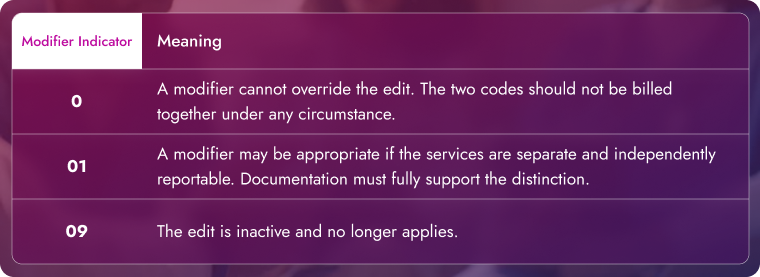
Understanding these indicators is critical because using a modifier incorrectly can lead to claim denials, overpayments, or audit findings.
When Can Modifiers Override an NCCI Edit?
Many providers mistakenly believe that adding Modifier 59 automatically resolves an NCCI denial. That is not correct.
A modifier should only be reported when the documentation demonstrates that the services were separate according to CMS and CPT guidelines.
Situations that may support modifier use include:
- Procedures performed during separate patient encounters on the same day.
- Services performed on different anatomical sites.
- Procedures performed by different practitioners when payer policy allows.
- Separate operative sessions that are independently reportable.
CMS also recognizes the more specific X{EPSU} modifiers, which describe distinct circumstances more precisely than Modifier 59.
Regardless of the modifier used, documentation must clearly explain why the services qualify for separate reimbursement.
How NCCI Edits Affect Claim Processing
NCCI edits are built directly into Medicare’s electronic claims processing system.
When a provider submits a claim, the system automatically compares every reported CPT and HCPCS code against the current NCCI edit files.
If the claim complies with CMS coding rules, processing continues normally.
If an edit is triggered, Medicare may:
- Deny one procedure code while paying the other.
- Reduce reimbursement.
- Reject the claim for correction.
- Return the claim with edit messages.
- Request additional review when necessary.
Because this review occurs automatically, providers often receive denials within days of claim submission if coding errors exist.
For this reason, many practices use coding software that incorporates the latest NCCI edit files before claims are submitted. Performing these checks in advance helps reduce preventable denials, minimizes rework, and improves first-pass claim acceptance.
When Are NCCI Edits Updated and Released by CMS?
The National Correct Coding Initiative is not a static program. As medical procedures, CPT codes, HCPCS codes, and Medicare billing policies evolve, CMS regularly updates the NCCI edit files to keep them aligned with current coding standards and payment policies.
Healthcare providers who continue using outdated edit files risk submitting claims that no longer comply with Medicare requirements. This can result in avoidable denials, delayed reimbursements, and increased administrative work.
For this reason, every medical practice, billing company, and healthcare organization should establish a process for reviewing NCCI updates before they become effective.
CMS Updates NCCI Edits Every Quarter
Unlike ICD-10-CM codes, which are generally updated once each year, CMS updates the National Correct Coding Initiative four times every year.
The quarterly update schedule allows CMS to respond more quickly to changes in:
- CPT code revisions
- HCPCS Level II code updates
- Medicare payment policies
- New medical technologies
- Coding corrections
- National coverage policies
- Clinical practice changes
These routine updates help ensure that Medicare’s claim editing system remains accurate and consistent throughout the year.
Providers should never assume that an edit from a previous quarter will remain unchanged in the next update.
Official CMS NCCI Update Schedule
CMS publishes updated NCCI edit files on a quarterly basis.
The updates become effective on the following dates every year:
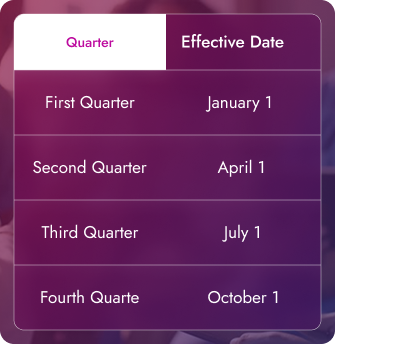
These effective dates remain consistent each year unless CMS announces otherwise.
Healthcare organizations should review each quarterly update before its effective date to ensure billing systems and coding references reflect the latest edits.
Release Date vs. Effective Date
One of the most common misconceptions about NCCI updates involves the difference between the release date and the effective date.
These two dates are not the same.
The release date is the date when CMS publishes the updated edit files on its website. This gives providers, software vendors, and Medicare contractors time to review the revisions and update their systems.
The effective date is the date on which Medicare begins applying those edits during claim processing.
For example, CMS typically publishes the January quarterly files several weeks before January 1. Providers can review the changes in advance, but the edits do not affect claims until the official effective date.
Understanding this distinction helps providers avoid applying new edits too early or relying on outdated edit files after a new quarter begins.
What Changes in a Quarterly NCCI Update?
Each quarterly release may include several types of revisions.
CMS may:
- Add new Procedure-to-Procedure (PTP) edit pairs.
- Delete obsolete edit pairs.
- Revise existing code combinations.
- Update modifier indicators.
- Add new HCPCS codes.
- Remove discontinued codes.
- Revise Medically Unlikely Edit (MUE) values.
- Update policy guidance to reflect CPT coding changes.
Not every quarterly release contains major revisions. Some updates include only a small number of changes, while others introduce significant modifications that affect thousands of claims.
For this reason, coding professionals should review every quarterly update rather than assuming there are no meaningful changes.
Where Does CMS Publish NCCI Updates?
CMS makes all official NCCI resources available free of charge through its website.
The official NCCI resources include:
- Procedure-to-Procedure (PTP) edit files
- Medically Unlikely Edit (MUE) files
- NCCI Policy Manual
- Quarterly update information
- Practitioner edit tables
- Hospital Outpatient Department edit files
- Educational articles and guidance documents
These files represent the official source for Medicare NCCI edits. While many coding software vendors incorporate these edits into their products, providers should rely on CMS publications whenever questions arise about coding policies or edit changes.
How Providers Can Stay Current with NCCI Updates
Waiting until claims begin getting denied is not an effective way to discover that NCCI edits have changed.
Instead, healthcare organizations should build a routine process for monitoring quarterly CMS updates.
Some practical strategies include:
- Review CMS NCCI updates before each new quarter begins.
- Update coding and billing software promptly.
- Educate coding staff about newly added or revised edits.
- Audit frequently billed CPT and HCPCS code combinations after each update.
- Monitor Medicare remittance advice for unexpected edit-related denials.
- Subscribe to CMS email notifications and Medicare Administrative Contractor (MAC) newsletters for coding and billing updates.
A proactive approach helps reduce preventable denials and ensures that claims reflect the most current Medicare coding requirements.
Why Quarterly NCCI Updates Matter?
Even a small change to an NCCI edit can affect hundreds or even thousands of claims submitted by a busy healthcare organization.
Using outdated edit files may lead to:
- Increased claim denials
- Delayed reimbursement
- Higher administrative costs
- More corrected claims
- Greater audit risk
- Reduced revenue cycle efficiency
By reviewing each quarterly update and implementing the changes before the effective date, providers can improve claim accuracy, maintain compliance with CMS policies, and reduce unnecessary payment delays.
How to Access the Latest NCCI Edit Files
Staying current with NCCI edits is just as important as understanding how they work. CMS updates the edit files every quarter, and providers who continue using outdated files increase their risk of claim denials, coding errors, and payment delays.
Fortunately, CMS makes all NCCI resources publicly available at no cost. Medical coders, billers, compliance officers, software vendors, and healthcare organizations can download the latest files directly from the CMS website and use them to verify coding decisions before claims are submitted.
Below are the primary NCCI resources every billing professional should know.
Procedure-to-Procedure (PTP) Edit Files
The Procedure-to-Procedure (PTP) edit files are among the most frequently used NCCI resources. These files contain code pairs that Medicare generally does not allow providers to report together for the same patient, by the same provider, on the same date of service.
Each PTP file identifies:
- Column 1 and Column 2 code pairs
- Modifier indicators
- Effective dates
- Deletion dates, when applicable
Coders often review these files before billing multiple procedures performed during the same encounter. This helps determine whether the procedures qualify for separate reimbursement or whether Medicare considers one service to be included in another.
Practices that frequently perform surgeries, therapy services, diagnostic testing, or interventional procedures should review PTP edits regularly because these specialties commonly report multiple CPT codes during a single visit.
Medically Unlikely Edits (MUEs)
While PTP edits focus on code combinations, Medically Unlikely Edits (MUEs) focus on the number of units billed for a single service.
An MUE establishes the maximum number of units of service that CMS expects a provider to report for one patient, on one date of service, under normal circumstances.
For example, if a procedure is typically performed only once during a patient encounter, CMS may assign an MUE value of 1. Billing five or six units of that procedure would likely trigger an edit because the reported units exceed what CMS considers medically reasonable.
It is important to understand that an MUE does not automatically mean additional units are impossible. Some unusual clinical situations may justify higher units. However, providers should have clear documentation to support those circumstances, and payment depends on CMS editing rules and the specific MUE adjudication indicator.
Add-on Code Edits
Certain CPT codes are designated as add-on codes. These codes describe services that cannot stand alone and must always accompany an appropriate primary procedure.
CMS includes edit logic to ensure that providers report add-on codes only when the required primary procedure also appears on the claim.
If an add-on code is billed without its qualifying primary code, Medicare will generally deny the service because the claim does not meet CPT reporting requirements.
Before billing any add-on code, verify that the corresponding primary procedure is also reported and that both services are supported by the medical record.
Hospital Outpatient NCCI Edit Files
CMS also publishes NCCI edit files specifically for Hospital Outpatient Prospective Payment System (OPPS) claims.
These edits apply to services billed by hospital outpatient departments and differ from practitioner edits in certain situations.
Hospital billing departments should ensure they reference the appropriate edit files based on the type of claim being submitted.
Using practitioner edits for hospital outpatient billing, or vice versa, may lead to incorrect coding decisions.
Medicare Administrative Contractor (MAC) Resources
Although CMS develops the National Correct Coding Initiative, Medicare Administrative Contractors (MACs) often provide additional educational resources to help providers understand how the edits affect claim processing.
MAC websites frequently publish:
- Billing articles
- Educational webinars
- Coding newsletters
- Frequently asked questions
- Claims processing guidance
- Local educational materials
Reviewing MAC publications alongside CMS resources helps providers stay informed about coding updates and billing expectations within their jurisdiction.
Coding Software and Clearinghouse Updates
Most electronic health record (EHR) systems, coding applications, and claims management software incorporate NCCI edits into their editing tools.
However, providers should never assume their software has automatically installed the latest quarterly updates.
Healthcare organizations should work with their software vendors to confirm that:
- Current quarterly NCCI files have been installed.
- CPT and HCPCS updates are current.
- Modifier indicators have been updated.
- Newly added edit pairs are included.
- Deleted edits have been removed.
Keeping software current helps identify coding issues before claims are transmitted to Medicare.
Common NCCI Denials and How to Avoid Them
Reporting Incorrect Modifier 59
Modifier 59 remains one of the most frequently misused modifiers in medical billing.
Some providers add Modifier 59 simply because a claim was previously denied by an NCCI edit. However, CMS allows this modifier only when documentation clearly supports that the services were separate and independently reportable.
Improper use of Modifier 59 may result in:
- Claim denials
- Post-payment audits
- Refund requests
- Compliance concerns
Always review the medical record before applying Modifier 59 or one of the X{EPSU} modifiers.
Billing Duplicate Procedures
Duplicate billing occurs when the same procedure is reported multiple times without clinical justification.
This may happen because of:
- Data entry mistakes
- Duplicate charge capture
- Incorrect claim corrections
- Billing system errors
Review the final claim carefully to ensure each procedure is reported only once unless multiple services are fully supported by the documentation.
Exceeding MUE Limits
Claims frequently deny when the reported units exceed Medicare’s Medically Unlikely Edit value.
Although some clinical situations justify additional units, providers should verify:
- The correct number of units.
- The applicable MUE value.
- Supporting documentation.
If the reported units exceed CMS expectations without adequate support, reimbursement may be reduced or denied.
Incomplete Documentation
Even when the CPT codes are correct, documentation must support every reported service.
The medical record should clearly describe:
- The procedures performed.
- Medical necessity.
- Separate anatomical sites, when applicable.
- Separate encounters, if reported.
- Clinical circumstances supporting modifier use.
Strong documentation remains the best defense against both claim denials and future audits.
Best Practices for Reducing NCCI Denials
Healthcare organizations can significantly improve claim accuracy by following several simple practices.
These include:
- Review NCCI edits before submitting claims.
- Update coding software every quarter.
- Verify modifier indicators before appending modifiers.
- Educate coding staff on CMS policy changes.
- Conduct periodic internal coding audits.
- Monitor denial trends and correct recurring issues.
- Use the official CMS NCCI Policy Manual when coding questions arise.
Conclusion
The National Correct Coding Initiative plays a critical role in Medicare claims processing by promoting accurate coding and preventing improper payments. Rather than viewing NCCI edits as obstacles, providers should see them as standardized coding rules that support consistent reimbursement and compliance across the healthcare system.
Understanding the difference between Procedure-to-Procedure (PTP) edits and Medically Unlikely Edits (MUEs) helps providers report services correctly and avoid common billing mistakes.
Knowing when modifiers are appropriate, maintaining complete documentation, and reviewing quarterly CMS updates further reduce the risk of claim denials and payment delays.
Because CMS updates NCCI edits every quarter, healthcare organizations should regularly review the latest edit files, educate coding staff, and keep billing software current. These proactive steps improve first-pass claim acceptance, strengthen compliance, and contribute to a more efficient revenue cycle.
Whether you are a physician, therapist, hospital biller, or medical coding professional, staying informed about NCCI edits is an essential part of accurate Medicare billing and long-term financial success.
Frequently Asked Questions
What are NCCI edits?
NCCI edits are coding rules developed by the Centers for Medicare & Medicaid Services (CMS) to prevent improper payments. They identify CPT and HCPCS code combinations that generally should not be billed together and establish limits on the number of units that providers can report for certain services.
What does NCCI stand for?
NCCI stands for National Correct Coding Initiative. CMS introduced the program to promote correct coding, reduce unbundling, and improve consistency in Medicare claims processing.
Where can I download the latest NCCI edit files?
CMS publishes the official NCCI resources on its website. Providers can access the latest Procedure-to-Procedure (PTP) edit files, Medically Unlikely Edit (MUE) files, the NCCI Policy Manual, and quarterly update information directly from CMS at no cost.
What is the difference between PTP edits and MUEs?
PTP edits determine whether two CPT or HCPCS codes may be reported together during the same encounter. MUEs establish the maximum number of units of service that Medicare generally expects providers to report for a single patient on a single date of service.
Can Modifier 59 override every NCCI edit?
No. Modifier 59 may be appropriate only when the NCCI modifier indicator allows it and the documentation clearly supports that the services were separate and independently reportable. It should never be used solely to bypass an edit or obtain payment.
Do NCCI edits apply only to Medicare?
NCCI edits were developed for Medicare and Medicaid programs. However, many commercial insurance companies use similar coding logic or incorporate portions of the NCCI edit files into their own claims processing systems. Providers should always review each payer’s specific billing policies.
Why are NCCI edits important for medical billers?
NCCI edits help medical billers submit accurate claims, reduce coding errors, prevent claim denials, and ensure compliance with Medicare billing requirements. Understanding these edits also improves first-pass claim acceptance and supports a healthier revenue cycle.
How can healthcare providers reduce NCCI-related claim denials?
Providers can reduce NCCI-related denials by reviewing official CMS edit files before submitting claims, using modifiers correctly, maintaining complete clinical documentation, updating billing software each quarter, educating coding staff, and performing regular internal coding audits. These practices improve coding accuracy and support timely reimbursement.
