

Insomnia is one of the most prevalent sleep disorders affecting adults in the United States. Patients often report difficulty falling asleep, staying asleep, or experiencing restorative sleep. Chronic insomnia can severely impact daytime functioning, mood, productivity, and overall quality of life. From a healthcare provider’s perspective, insomnia may seem straightforward, but billing, coding, and documentation are complex.
Errors in coding, insufficient documentation, or improper payer submission often lead to claim denials, delayed reimbursements, or compliance risks. Understanding the nuances of ICD-10-CM codes, proper documentation, CPT coding for services, and payer expectations is crucial for medical offices, particularly those managing behavioral or sleep medicine services. This guide is designed to help providers and billers navigate these challenges efficiently.
Understanding Insomnia: Clinical Overview
Before discussing coding and billing, it’s essential to clarify what insomnia is from a clinical standpoint. Insomnia is more than “trouble sleeping”; it’s a disorder that meets specific diagnostic criteria and requires documentation of frequency, duration, and functional impact.
Key Features of Insomnia
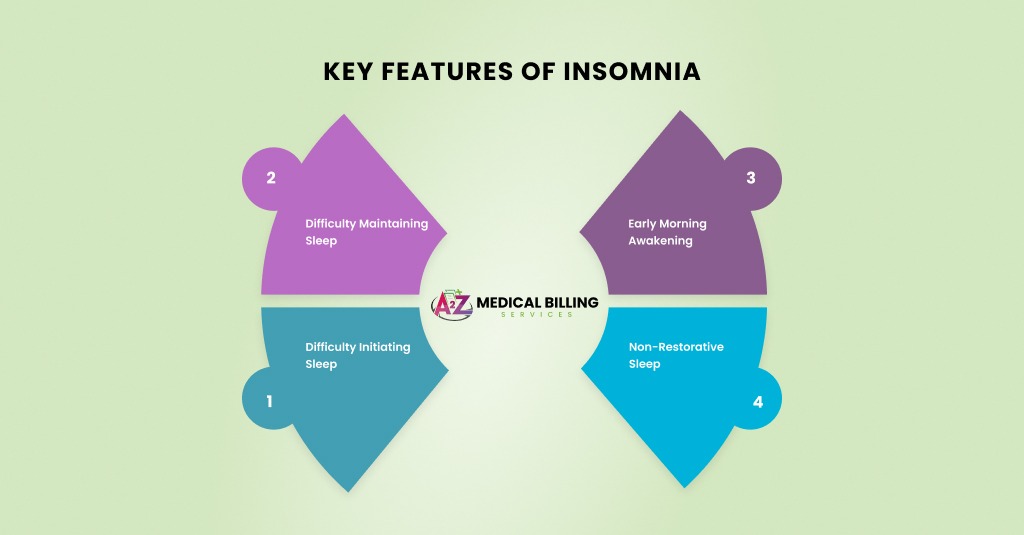
Insomnia typically involves:
- Difficulty Initiating Sleep: Taking longer than 30 minutes to fall asleep regularly.
- Difficulty Maintaining Sleep: Waking frequently during the night.
- Early Morning Awakening: Waking too early and being unable to return to sleep.
- Non-Restorative Sleep: Feeling unrefreshed despite adequate sleep duration.
For a diagnosis of chronic insomnia, symptoms should persist for at least 3 months, occurring at least 3 nights per week, and cause significant daytime impairment, such as fatigue, irritability, or cognitive difficulties.
Detailed documentation of these symptoms is necessary to justify medical necessity for treatment, including behavioral therapy, counseling, and medication management. Payers often scrutinize claims that lack sufficient detail.
ICD-10-CM Codes for Insomnia
Accurate ICD-10 coding is critical for reimbursement and compliance. Using the correct code ensures your claim reflects the patient’s clinical presentation and the service provided. ICD-10 codes for insomnia fall under sleep disorders (G47._) and behavioral sleep disorders (F51._).
Common ICD-10 Codes for Insomnia
- G47.00 – Insomnia, unspecified
- Use when documentation does not specify the cause or type.
- Typically used for general insomnia complaints without clear causation.
- G47.01 – Insomnia due to a medical condition
- For insomnia secondary to another medical diagnosis (e.g., chronic pain, depression).
- Requires documentation linking insomnia to the underlying condition.
- G47.09 – Other insomnia
- For insomnia types not specified by other codes.
- Rarely used if more precise codes are available.
- F51.01 – Primary insomnia
- Non-organic or behavioral insomnia is not linked to medical or psychiatric conditions.
- Requires thorough history and documentation of sleep habits and lifestyle factors.
- F51.03 – Paradoxical insomnia
- Patient reports severe insomnia, but objective testing (polysomnography) shows regular sleep.
- Documentation must include testing results and patient-reported symptoms.
Distinguish between primary insomnia (behavioral/psychological) and secondary insomnia (medical/psychiatric). Using the wrong code can result in claim denials.
Primary vs. Secondary Insomnia: ICD-10-CM Coding and Sequencing Guidelines
Accurate insomnia coding requires distinguishing between primary (non-organic) insomnia and secondary insomnia due to medical or psychiatric conditions. Misclassification can result in denials, incorrect sequencing, and compliance risks under payer audits.
Primary (Non-Organic) Insomnia – F51.01
Use F51.01 when insomnia is behavioral or psychological in origin and not directly caused by another medical condition. Documentation should support:
- Chronic sleep disturbance lasting ≥3 months
- No identifiable medical etiology
- Behavioral or psychosocial contributing factors
Secondary Insomnia – G47.01
Use G47.01 when insomnia is clearly linked to a documented medical condition such as:
- Chronic pain
- Major depressive disorder
- Anxiety disorders
- Neurological conditions
Per ICD-10-CM Official Guidelines for Coding and Reporting, when insomnia is secondary, the underlying condition should be sequenced first, followed by the insomnia code when appropriate.
Key Sequencing Rule:
- If insomnia is due to depression → Code depression first.
- If insomnia is independently treated and documented as clinically significant → Both codes may be reported.
Correct sequencing ensures accurate claim processing and reduces payer rejections related to diagnosis hierarchy.
Documentation Requirements for Insomnia ICD-10
Comprehensive documentation is essential not only for coding accuracy but also for payer compliance. Poor documentation is the leading cause of denied claims for insomnia management. Each visit note should clearly describe symptoms, duration, severity, and the impact on daily life.
What to Include in Documentation
- Chief Complaint:
- Clear statement of sleep issues (e.g., “Difficulty falling asleep 4 nights/week for 5 months”).
- History of Present Illness (HPI):
- Duration of symptoms, frequency, severity, triggers, and prior treatments.
- Daytime Consequences:
- Fatigue, concentration problems, irritability, and work impairment.
- Comorbidities:
- Medical, psychiatric, or medication-related causes.
- Lifestyle Factors:
- Sleep hygiene, caffeine/alcohol consumption, screen time, shift work.
- Assessment and Plan:
- Diagnosis with ICD-10 code, recommended interventions (CBT-I, medications), and follow-up.
Example Note for Chronic Insomnia:
- HPI: Patient reports difficulty falling asleep and multiple nighttime awakenings for 6 months, occurring 5 nights/week. Reports daytime fatigue, irritability, and impaired concentration. Denies alcohol or substance misuse.\
- Assessment: Chronic insomnia (G47.00), affecting daily function.
- Plan: Initiate CBT-I, review sleep hygiene strategies, and follow up in 4 weeks.
CPT Codes for Insomnia Services
ICD-10 codes identify the diagnosis, but CPT codes define the services billed. For insomnia, providers may bill evaluation & management (E/M), behavioral therapy, or diagnostic sleep studies.
Evaluation & Management (E/M)
Outpatient office visits for insomnia typically use:
- New Patient: 99202 – 99205
- Established Patient: 99212 – 99215
Documentation should support the level of service based on:
- History
- Examination
- Medical decision-making
- Counseling time
Insomnia visits often include comprehensive behavioral and psychosocial assessments, supporting higher-level E/M billing when properly documented.
Sleep Studies
When ordering diagnostic testing:
- 95810: Polysomnography, overnight attended
- 95811: Polysomnography with CPAP/BiPAP titration
Include medical necessity justification in documentation to avoid denials.
Behavioral Sleep Medicine
Cognitive Behavioral Therapy for Insomnia (CBT-I) is first-line therapy for chronic insomnia. CPT codes include:
- 90834: Psychotherapy, 45 minutes
- 90837: Psychotherapy, 60 minutes
- 99401-99404: Preventive counseling (if education-focused)
Ensure documentation includes time, techniques, patient engagement, and progress.
Telehealth Billing for Insomnia and CBT-I Services
Telehealth has expanded access to Cognitive Behavioral Therapy for Insomnia (CBT-I) and sleep medicine consultations. Proper coding ensures reimbursement compliance under current CMS telehealth policies.
Telehealth Billing Essentials:
- Modifier 95 – Synchronous telemedicine service
- Place of Service (POS) 02 – Telehealth provided other than patient’s home
- POS 10 – Telehealth provided in patient’s home
Medicare and many commercial payers allow psychotherapy codes (90834, 90837) to be billed via telehealth when documentation supports:
- Real-time audio-video interaction
- Session duration
- Techniques used
- Patient engagement and progress
Failure to append correct modifiers or place of service codes is a common cause of insomnia-related claim denials.
Always verify payer-specific telehealth policies before submission.
Medical Necessity and Payer Requirements
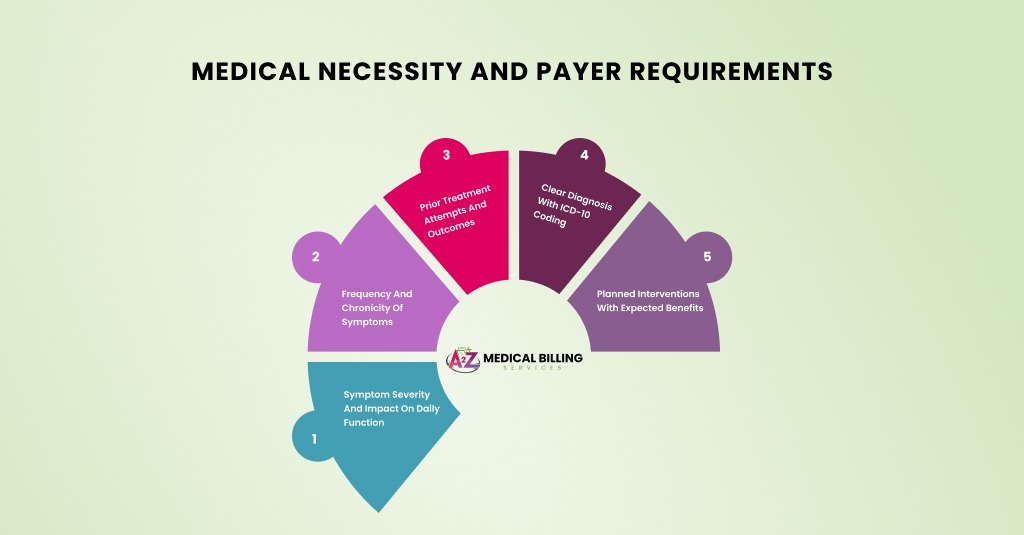
Insomnia services must meet medical necessity criteria for coverage. Documentation should demonstrate:
- Symptom severity and impact on daily function
- Frequency and chronicity of symptoms
- Prior treatment attempts and outcomes
- Clear diagnosis with ICD-10 coding
- Planned interventions with expected benefits
Medicare Guidance:
CMS audits focus on:
- Documentation supporting E/M codes
- Justification for diagnostic sleep studies
- Appropriate ICD-10 code selection
Other commercial payers may have stricter criteria for behavioral interventions or digital CBT-I programs.
DRG and Risk Adjustment Impact of Insomnia Coding
Although insomnia is typically managed in outpatient settings, accurate coding still affects reimbursement integrity.
In Inpatient Settings:
Under the Inpatient Prospective Payment System (IPPS), insomnia may qualify as a comorbidity depending on severity and documentation. Proper reporting can:
- Impact MS-DRG grouping
- Support severity adjustment
- Affect overall inpatient reimbursement
Medicare Advantage & HCC Considerations:
While insomnia alone does not map directly to a Hierarchical Condition Category (HCC), associated conditions such as:
- Depression
- Anxiety disorders
- Chronic pain
- Obstructive sleep apnea
may influence Risk Adjustment Factor (RAF) scoring when properly documented and coded.
Accurate insomnia documentation supports comprehensive condition capture, which protects long-term value-based reimbursement.
Reimbursement Rates for Insomnia-Related Services
Understanding actual reimbursement amounts is vital for coding accuracy, revenue optimization, and realistic practice financial planning. Below is a detailed breakdown of common CPT reimbursement rates you’ll encounter when billing for insomnia evaluations and related services in the U.S. healthcare system, focusing primarily on Medicare (the benchmark payer) and typical commercial/Medicaid variations.
| Payer Category | Typical Reimbursement Range | Notes |
| Medicare (Baseline) | E/M (99214 ~ $125–$130) | Standardized, locality-adjusted pricing. |
| Commercial Insurance | ~115%–160% of Medicare | Often higher than Medicare; negotiations matter. |
| Medicaid | ~50%–70% of Medicare | Varies by state policy and managed care plan. |
| Behavioral Health/Therapy Codes | Variable based on code/time | Depends heavily on payer rules. |
Insomnia Billing Process: Step-by-Step
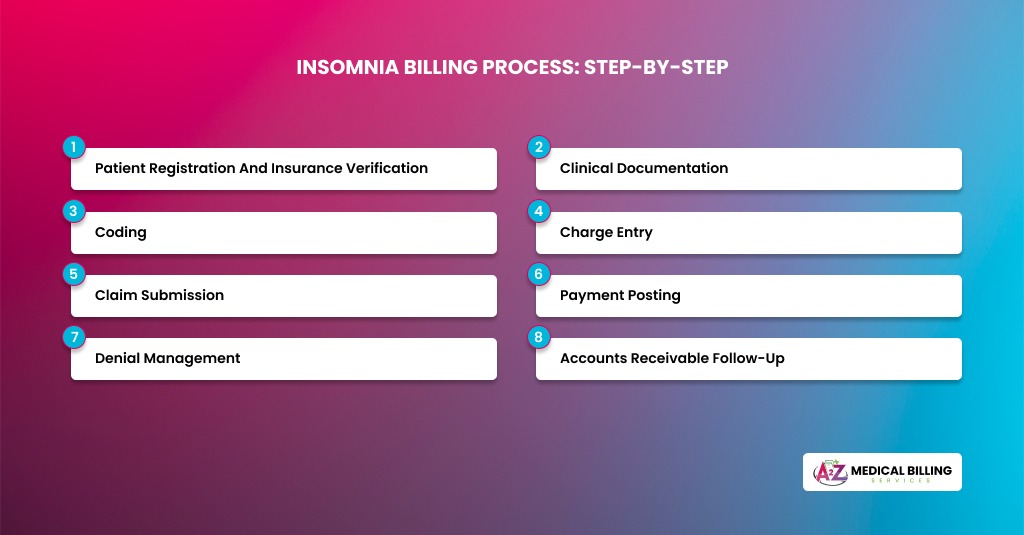
Billing for insomnia services involves multiple stages, from patient registration to final reimbursement. Each step ensures accuracy, compliance, and timely payment. Properly following this process reduces denials, improves revenue, and maintains adherence to payer regulations.
1. Patient Registration and Insurance Verification
The first step in the billing process is patient registration. Accurate information is collected to ensure claims are processed correctly, and patients are aware of their financial responsibilities.
- Collect insurance details, including ID number, policy number, and plan information.
- Verify patient eligibility for services related to insomnia, including office visits, behavioral therapy, and sleep studies.
- Confirm if prior authorization is required for therapy or diagnostic testing.
- Record demographic details such as name, date of birth, address, and employer information for secondary coverage if applicable.
2. Clinical Documentation
Clinical documentation forms the foundation of accurate billing and coding. It establishes the medical necessity of insomnia services and supports reimbursement.
- Document the patient’s chief complaint, including difficulty initiating or maintaining sleep.
- Record the history of present illness, including symptom onset, frequency, duration, and severity.
- Note daytime consequences such as fatigue, irritability, or difficulty concentrating.
- Include comorbid conditions like anxiety, depression, or chronic pain that may contribute to insomnia.
- Detail any interventions provided, such as sleep hygiene counseling, CBT-I techniques, or medications.
- Outline the assessment and plan, including ICD-10 diagnosis codes and follow-up recommendations.
3. Coding
After documentation, coding is performed to assign accurate diagnoses and service codes. Correct coding ensures claims are processed and reimbursed correctly.
- Assign the appropriate ICD-10 code based on the documentation:
- G47.00 – Insomnia, unspecified
- G47.01 – Insomnia due to a medical condition
- F51.01 – Primary insomnia
- Assign CPT codes for services provided:
- E/M office visits (99212–99215)
- Psychotherapy or CBT-I sessions (90834, 90837)
- Sleep studies if applicable (95810, 95811)
- Use modifiers when necessary to indicate exceptional circumstances, such as Modifier 25 for significant E/M on the same day as a procedure.
4. Charge Entry
Charge entry ensures that all services rendered are captured accurately in the billing system.
- Enter ICD-10 and CPT codes into the practice management or EMR system.
- Include patient details, date of service, provider information, and service location.
- Record units and any applicable modifiers.
- Confirm that charges align with clinical documentation.
5. Claim Submission
Submitting claims is the process of sending coded, documented services to the payer for reimbursement.
- Submit claims electronically through the clearinghouse for faster processing.
- Include all required information, including patient details, codes, and date of service.
- Follow payer-specific rules to avoid initial denials or rejections.
6. Payment Posting
Payment posting reconciles the payments received against the expected reimbursement.
- Record payments from both insurance and patients in the system.
- Compare the amount paid to the expected reimbursement based on fee schedules.
- Identify discrepancies, underpayments, or denials for further follow-up.
7. Denial Management
Denial management addresses claims that are rejected or partially paid by the payer.
- Review the Explanation of Benefits (EOB) to understand the reason for denial.
- Categorize denials based on cause, such as coding errors, missing documentation, or coverage issues.
- Correct the claim or provide additional documentation and submit an appeal.
- Track and monitor recurring denials to prevent future occurrences.
8. Accounts Receivable Follow-Up
Accounts receivable follow-up ensures all claims are collected on time.
- Review unpaid claims regularly and prioritize high-dollar accounts.
- Contact payers or patients to resolve issues or outstanding balances.
- Maintain documentation to support any follow-up actions.
- Ensure claims are resolved before payer deadlines to prevent revenue loss.
Common Billing Mistakes in Insomnia Services and How to Avoid Them
Even experienced practices can make errors when billing for insomnia-related services. These mistakes can result in claim denials, delayed reimbursements, or underpayments. Understanding common pitfalls and implementing strategies to prevent them is essential for accurate billing and compliance.
Using Unspecified ICD-10 Codes
Many providers default to G47.00 – Insomnia, unspecified, when documenting insomnia. While convenient, overuse of unspecified codes can trigger payer scrutiny and denials.
- Avoid using unspecified codes unless documentation truly does not support a specific diagnosis.
- Use specific codes like G47.01 for insomnia due to medical conditions or F51.01 for primary insomnia.
- Ensure that documentation supports the selected ICD-10 code.
Incomplete Documentation
Incomplete or vague documentation is one of the most common causes of denied claims. Payers require evidence of medical necessity and sufficient detail to justify services.
- Document the duration, frequency, and severity of insomnia symptoms.
- Include daytime consequences, comorbid conditions, and prior treatments.
- Record all interventions, counseling, and follow-up plans.
- Ensure clinical notes clearly link the patient’s symptoms to the ICD-10 code used.
Incorrect CPT Coding
Selecting the wrong CPT code or undercoding services can result in underpayment or rejection. For insomnia services, coding errors often involve E/M visits or behavioral therapy.
- Match the CPT code to the level of service performed and time spent.
- Use E/M codes 99212–99215 for office visits based on complexity.
- Code behavioral therapy sessions correctly with 90834, 90837, and apply time-based rules.
- Use modifiers properly, such as Modifier 25 when counseling occurs alongside procedures.
Failing to Demonstrate Medical Necessity
Payers often deny claims if medical necessity is not clearly documented. Insomnia claims require clear justification for evaluation, therapy, or sleep studies.
- Document the impact of insomnia on daily functioning and quality of life.
- Include prior non-pharmacologic interventions, such as sleep hygiene or CBT-I.
- Justify additional services such as behavioral therapy or diagnostic testing.
- Link insomnia to secondary conditions when applicable.
Submitting Claims with Errors
Claims with missing or incorrect information can be rejected or delayed. Common errors include inaccurate patient information, wrong codes, or missing modifiers.
- Verify patient demographics and insurance details before submission.
- Cross-check ICD-10 and CPT codes against documentation.
- Include all required data: date of service, place of service, and provider information.
- Submit claims electronically and review for edits or errors before sending.
Ignoring Denial Patterns
Many practices fail to analyze denial patterns, resulting in repeated errors and lost revenue.
- Track denials and categorize by reason (coding errors, documentation issues, coverage limitations).
- Correct issues at the source and resubmit claims promptly.
- Implement process improvements to prevent recurring mistakes.
- Maintain organized records for follow-up and appeals.
Failing to Capture Behavioral or Counseling Time
Behavioral interventions like CBT-I or counseling sessions are often underbilled because time and content are not documented clearly.
- Record the duration of counseling or therapy sessions.
- Specify techniques used and patient engagement.
- Bill appropriate CPT codes separately from E/M visits when indicated.
Key Performance Indicators (KPIs) for Insomnia Billing Performance
Sleep medicine and behavioral health practices should monitor billing performance metrics to maintain revenue stability.
Important KPIs include:
- Clean claim rate for E/M and psychotherapy codes
- Denial rate by payer for insomnia-related claims
- Average reimbursement per CPT code
- Authorization approval rate for sleep studies
- Accounts receivable aging (30/60/90 days)
- Telehealth claim acceptance rate
Monitoring these indicators allows practices to identify documentation gaps, payer-specific patterns, and revenue leakage in insomnia billing workflows.
Strong revenue cycle oversight reduces compliance risk and improves financial predictability.
Strengthen Your Insomnia Billing with Expert Medical Billing Services
Insomnia claims require precise ICD-10-CM coding, accurate CPT selection, proper modifier usage, and complete medical necessity documentation. Even minor errors in sequencing, telehealth billing, or psychotherapy coding can result in denials or underpayments.
At A2Z Medical Billing Services, we provide specialized medical billing services for sleep medicine, behavioral health, and primary care practices, including:
- Insomnia ICD-10 coding audits and validation
- E/M and psychotherapy CPT optimization
- Telehealth billing compliance review
- Sleep study and polysomnography claim management
- Denial prevention and appeal support
- End-to-end revenue cycle management services
Our certified medical billing and coding specialists ensure your insomnia-related claims meet CMS, Medicare Administrative Contractor (MAC), and commercial payer requirements before submission.
If your practice provides CBT-I, medication management, or sleep diagnostics, accurate coding is essential to protect reimbursement and maintain compliance.
👉 Partner with A2Z Medical Billing Services to optimize your insomnia billing and revenue cycle today.
Final Thoughts
Insomnia management in clinical practice is common but requires precision in documentation, coding, and billing. Using the correct ICD-10 codes, documenting symptoms and impact, selecting appropriate CPT codes, and understanding payer expectations are crucial to reducing denials and maximizing revenue. Providers who integrate detailed charting with structured billing workflows see better compliance, faster reimbursement, and improved patient care outcomes.
Proper attention to detail in insomnia billing ensures your practice captures all eligible revenue while staying fully compliant with Medicare, Medicaid, and commercial payers.