
Medical Payment Posting and ERA Reconciliation That Catches Underpayments, Denials and Recoupments
A2Z’s payment posting services cover every insurance and patient payment, and each 835 is reconciled to its deposit before the posting is closed. Posting is the time when underpayments, recoupments, and zero-payment denials will be identified or hidden. The medical payment posting services team works with practices, physician groups, and billing departments who want every dollar matched, every adjustment coded accurately, and every exception sent to the appropriate work queue.
Payment posting services will post every payment from a payer or patient to the proper claim and service line, as well as any adjustments and denials. Your balances will then show the amount that has been paid.
Four kinds of payment data reach your posting team: electronic remittance advices (ERAs), paper EOBs, lockbox and patient payments, and PLB adjustments. Our insurance payment posting covers all four, and each one is read against the claim before anything is applied.
Four items depend upon the accuracy of that posting: Patient Statements, Secondary Claims, Denial Work Queues, and AR Reporting. If you make an error when posting a contractual adjustment as “Patient Responsibility”, then a patient will receive a statement for an amount that they are not responsible for paying. A wrong posting is invisible until a patient disputes a statement or an auditor asks.
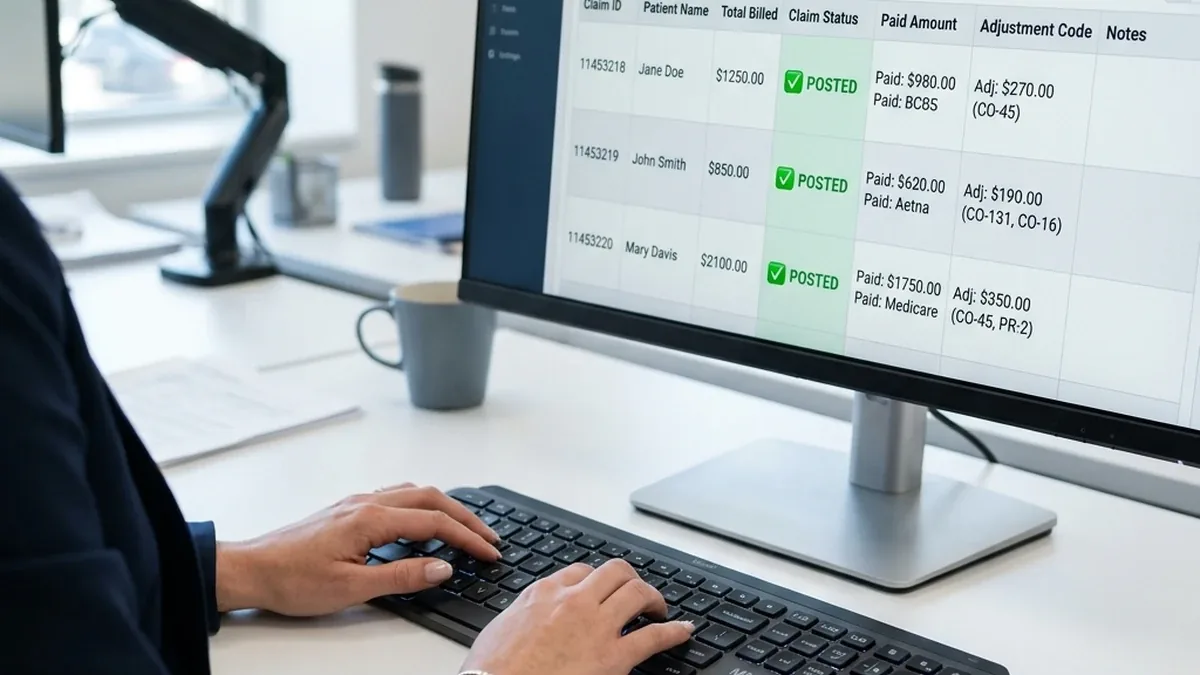

The ERA and EFT reconciliation process is a method used by our company to match an ERA (Electronic Remittance Advice) that provides details about how we were paid, with an EFT (Electronic Funds Transfer) that represents the money we received. We link these two types of transactions together through the use of a “Trace Number”, and then resolve any differences between them daily so that we can have a zero balance each day.
The ERA is the X12 835 (version 5010), the HIPAA standard for electronic remittance advice, and contains claim-level and line-item payment and adjustment details. The EFT utilizes the ACH CCD+ format, the HIPAA standard for electronic funds transfers for healthcare. The addendum to the CCD+ format contains the re-association trace number, which will appear on the 835 as TRN02 and must be identical.
Under the CAQH CORE 370 Reassociation Rule, the health plan must release the ERA no sooner than three business days before, and no later than three business days after, the EFT effective entry date. An EFT or ERA is late or missing after four business banking days.
When the ERA arrives and the deposit does not, we contact the payer about the missing funds. When a deposit arrives with no ERA, it is held as unapplied cash, and we request the remittance, so nothing is posted blind. Our ERA posting services and electronic remittance posting follow this same check for every payer you bill. For Medicare, we use Medicare Remit Easy Print (MREP) for professional remittances and PC Print for institutional ones, and EFT enrollment is done on form CMS-588. This reconciliation is part of our wider medical billing services.
We review all CAS groups, CLP02 statuses, and PLB codes prior to posting, as they may have different meanings for the same dollar amount. CO is a contractual obligation, so it is written off and never billed to the patient. PR is patient responsibility, so it moves to the patient balance or the secondary payer.
| Code | What It Means | Posting Action |
|---|---|---|
|
CAS group CO
|
Contractual obligation
|
Write off to contractual adjustment. Never bill to the patient.
|
|
CAS group PR
|
Patient responsibility (deductible, coinsurance, copay)
|
Transfer to patient balance or to the secondary payer.
|
|
CAS group OA
|
Other adjustment
|
Review. Often coordination of benefits or bundling.
|
|
CAS group PI
|
Payer-initiated reduction
|
Review against the contract. Frequently an underpayment.
|
|
CLP02 status 4 |
Claim denied
|
Post the zero pay and route to denial management the same day.
|
|
CLP02 status 22
|
Reversal of previous payment
|
Reverse the original posting before applying any correction.
|
|
CLP02 status 19
|
Processed as primary, forwarded to another payer
|
Do not send a duplicate secondary claim. Track the crossover.
|
|
PLB code WO
|
Overpayment recovery (recoupment)
|
Post against the original claim, not as a lump deduction on the deposit.
|
|
PLB code L6
|
Interest owed
|
Post as interest income, separate from claim payment.
|
|
PLB code FB
|
Forwarding balance
|
Track the carried balance until it clears on a later remittance.
|
Patient payment posting and manual posting cover the payments that never arrive as an ERA: paper EOBs, mailed checks, lockbox files, card and portal payments, and copays collected at time of service.
The matching process for lockbox files takes place prior to application of payment. Daily activity (such as payments via your portal, credit card terminal, and front desk) is posted to the appropriate account and date; this posting process forms the basis for maintaining accuracy within the cash posting function of medical billing. When patient payments are posted late, statements are wrong. Wrong statements produce calls, and calls turn into disputes. We post patient payments as they come in so the next statement balance is accurate. Statement and collection work continues in our patient billing service.


A credit balance is money you hold that belongs to a payer or a patient. Posting is where credit balances first appear, and for Medicare and Medicaid the 60-day overpayment rule starts once an overpayment is identified.
Medicare and Medicaid overpayments must be reported and returned within 60 days of identification, under Social Security Act § 1128J(d) and 42 CFR 401.305. Since 1 January 2025, the 60-day clock can be suspended for up to 180 days during a timely, good-faith investigation for related overpayments. If no real investigation happens, the 60 days apply. A practice that posts without reviewing credit balances can hold a Medicare overpayment past the deadline without knowing it.
We identify credit balances at posting, document the source and the amount, and give you the list so you can decide on refunds within the deadline. Commercial refund deadlines come from payer contracts and state rules, and state unclaimed property rules can apply to patient credit balances that stay unresolved.
Posting is where recovery starts. Every remittance we post is checked for three things that cost practices money: denials, underpayments, and secondary claims released too early.
A CLP02 status 4 is posted as a zero-pay and routed to denial management the same day, so it is worked when the appeal window is still open instead of discovered at 60 days.
We compare allowed amounts to your contracted rates, so PI reductions and silent underpayments are flagged and sent to AR follow-up as a work item.
A secondary claim is released only after the primary posting is complete, using the coverage on file from insurance verification. A claim with CLP02 status 19 has been forwarded to another payer, so we track the crossover and send no duplicate.


Outsourced payment posting means A2Z posts your payments and reconciles your deposits inside your own practice management system, and your team keeps its time for the front desk, clinical work, and patients.
When you outsource payment posting, you hand over remittance intake, ERA and EFT reconciliation, insurance and patient payment posting, and credit balance identification. You keep your payer contracts, your refund decisions, and your patient communication. We work inside your existing practice management system with access you control, so no migration is needed. Onboarding takes 2 to 4 weeks depending on your EHR and payer mix.
Each month you receive deposit reconciliation, unapplied cash, a credit balance list, and a denial and underpayment summary.
Every 835 is matched to its EFT by the TRN02 trace number, so a missing deposit or a missing ERA shows up the day it happens instead of at month-end.
PLB overpayment recoveries are traced to the claim being recovered, so your AR shows the real balance, and you can dispute a recoupment that is wrong.
Credit balances are identified and documented at posting, which gives you a list to act on before the deadline.
Our team holds CPB and CPC credentials, and the people who read your 835s know what CO, PR, and PI mean.
