

The CMS is suggesting that the 2027 Medicare Conversion Factor for doctors will go down by 1.68 percent starting on January 1, 2027. The proposed Medicare Physician Fee Schedule for 2027 also includes payments when a doctor sees a patient and does a procedure on the same day. The code G2211 will be changed into a modifier. There are also strict rules for billing when using remote monitoring. This 2027 Medicare Physician Fee Schedule proposed changes article talks about these four changes and what to do about them.
The final rule is expected to come out on or around November 1st,t so this page will be updated after that happens.
What Is the 2027 Medicare Physician Fee Schedule Proposed Rule?
The Medicare Physician Fee Schedule is a list of prices that CMS pays for services done by doctors and other health care professionals. The rule for 2027 is called CMS-1848-P. CMS put out the proposed rule on July,14, 2026. It was in the Federal Regiser, on July 16. The time to give comments ended on September 14, 2026. The changes will start after January 2027.
Each payment is made using relative value units based on where the doctor works. Then the units are multiplied by the conversion factor.
Payment = (work RVU × work GPCI + practice expense RVU × PE GPCI + malpractice RVU × MP GPCI) × conversion factor
The schedule is budget neutral, so large RVU changes get offset somewhere else in the rates.
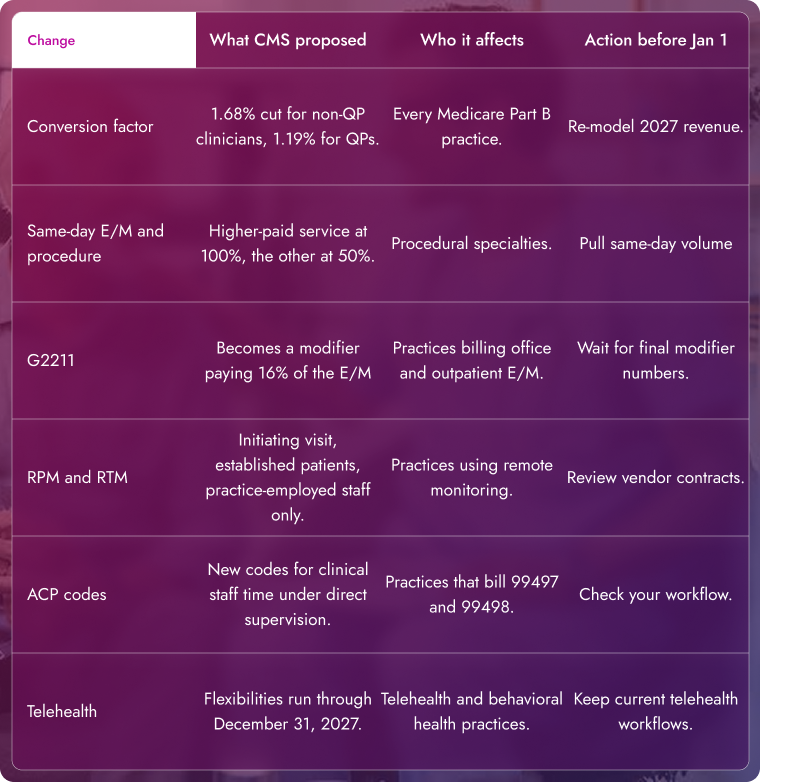
Key 2027 Changes at a Glance
Details can still change in the final rule.
Key 2027 PFS Proposals
2027 Medicare Conversion Factor: How Much Will Payments Drop?
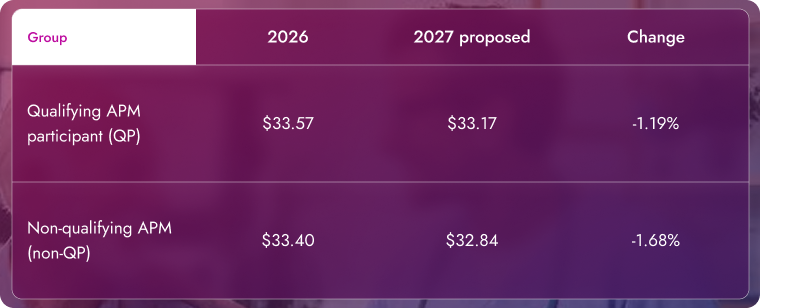
Most clinicians would see the conversion factor fall 1.68%, from $33.40 to $32.84.
Proposed 2027 conversion factors
Why the conversion factor is going down
The Public Law 119-21, Working Families Tax Cut, allowed for a 2.50% increase to the 2026 conversion factor for one year. The 2.50% increase expires at the end of 2026, so current law pulls the rate back down.
The 0.25% MACRA statutory increase for non-QPs and the 0.75% MACRA statutory increase for QPs will mitigate the decline in reimbursement, but will not eliminate the decline.
What a 1.68% cut means for a practice
A practice with $500,000 in annual Medicare PFS revenue would lose about $8,400 ($500,000 × 1.68%). That is an estimate.

Same-Day E/M and Global Procedure Payment Reduction
This is the revenue risk for procedural specialties. When a clear office or outpatient E/M visit occurs on the same day as a procedure with a 0-, 10-, or 90-day global period, CMS suggests paying the most expensive service at 100% and all other services that day at 50%.
How the 100% / 50% rule would work
Take an established patient visit billed with modifier 25 plus a joint injection on the same day. Say the visit pays ninety dollars and the injection pays sixty dollars. Today you collect $150. Under the proposal, the visit stays at $90, and the injection drops to $30, so you collect $120. Those amounts are made up to show the math and are not Medicare rates. It also helps to see how NCCI edits already bundle your common code pairs.
Which specialties feel it most
Any practice that performs a visit and a procedure on the same day will see the impact: orthopedics, dermatology, podiatry, urology, pain management, and ENT.
Modifier 25 is still required.
The proposal changes payment. It does not affect the way documentation is done. Modifier 25 still shows the payer that the E/M was important and clearly separate, and whichever service gets the 50% cut, the note must back up both services. If modifier 25 claims are already being denied in your practice, our denial management services team can work them.
G2211 Becomes a Modifier in 2027
CMS proposes turning G2211 from a separate add-on code into a modifier added to the E/M code.
What G2211 is today
G2211 is the visit complexity add-on for office and outpatient E/M visits that involve ongoing, longitudinal care of a patient’s serious or complex condition. Medicare has paid for it since January 2024, as its own line on the claim.
How the proposed modifier pays
The placeholder modifier MOD1 would raise the E/M payment by 16%. Because it is a percentage of the E/M base code, a higher-level visit would earn more than a lower-level one, whereas today the add-on is one flat amount.
The 32% ACO modifier
A second placeholder modifier, MOD2, would raise the E/M payment by 32% for practitioners in a Medicare Shared Savings Program ACO or a LEAD Model participant provider. It would be voluntary and could be billed for all of the practitioner’s Medicare patients, whether or not they are assigned to the ACO.
The final modifier codes are not assigned yet, so hold off on charge master changes.
RPM and RTM Billing Changes for 2027
CMS proposes four limits on remote physiologic monitoring (RPM, codes 99453, 99454, 99457 and 99458) and remote therapeutic monitoring (RTM, codes 98975 to 98981):
- A separately reportable initiating visit is required when RPM or RTM begins.
- RTM would be limited to established patients, as RPM already is.
- Payment would apply only when clinical staff employed by the practice deliver the service. Monitoring delivered by contractors would not be billable.
- Device valuation would be updated, because devices may cost less than CMS first estimated.
The management codes are time-based, so timed vs. untimed CPT code rules apply when you document minutes.
What this means if you use a third-party RPM vendor
If your vendor’s staff make the monitoring calls and your practice bills for them, that model may stop being billable as proposed. Ask your vendor now whether their clinicians can become your employees or whether the work can move in-house.
The bundling idea CMS is weighing
CMS also asked for comment on bundling the RPM and RTM codes into four new HCPCS G-codes. This is only a request for comment.
Other 2027 Proposals Worth Knowing
- Advance care planning codes
CMS is proposing two new HCPCS codes for ACP services furnished by clinical staff under the direct supervision of the billing practitioner. The billing practitioner will only use CPT 99497 and 99498 to report the amount of time he/she spent on the service.
- Telehealth through December 31, 2027
The Consolidated Appropriations Act, 2026 allows for Medicare telehealth flexibility to continue through December 31, 2027. During this time frame, the in-person requirement for mental health visits at RHCs and FQHCs will not be effective. The behavioral health telehealth billing and coding guide is provided by us.
- Behavioral health RVU increases.
CMS proposes including smoking and tobacco use cessation and SBIRT services in the final year of the four-year work RVU transition that began with timed psychotherapy codes in the CY 2024 final rule.
- Shared medical appointments
CMS proposes separate coding and payment for these group visits, since no HCPCS code describes them today. They are a different service from group therapy, which is covered in our CPT 90853 guide.
- Practice expense methodology
CMS plans to move from AMA survey data to routinely updated cost data over several years and would replace a step tied to data from 2007 or earlier with a practice expense stabilizer. MIPS also changes in this rule, including a proposal to make MVPs mandatory in 2029.
How to Prepare Your Practice Before January 1, 2027
- Model 2027 revenue. Rerun your Medicare revenue at $32.84, or $33.17 if you are a QP.
- Pull same-day volume. Count the E/M visits billed with a procedure on the same day over the last 12 months.
- Audit modifier 25 documentation. Read a sample of notes and confirm each shows a separate service.
- Review RPM and RTM. Check staffing and vendor contracts against the four proposed limits.
- Update your charge master. Change fee tickets once the final modifier numbers are published.
- Watch for the final rule.
- Check commercial contracts. Find the ones tied to Medicare rates and note their renewal dates.
- Track your numbers. Keep an eye on medical billing KPIs and how to reduce A/R days as the new rates start.
Frequently Asked Questions
When does the 2027 Medicare Physician Fee Schedule take effect?
The policies in the proposed rule take effect on or after January 1, 2027.
What is the 2027 Medicare conversion factor?
CMS proposes $32.84 for non-qualifying APM clinicians, down from $33.40, and $33.17 for qualifying APM participants, down from $33.57.
Is the 2027 Medicare payment cut final?
No. The comment period closed on September 14, 2026, and CMS has not published the final rule.
Will G2211 still be billable in 2027?
Under the proposal, yes, but as a modifier on the E/M code instead of a separate add-on code. MOD1 would pay 16% of the E/M.
Can I still bill an E/M with modifier 25 on the same day as a procedure in 2027?
Yes. Modifier 25 is still how you show a separately identifiable visit.
Can a third-party vendor still bill RPM in 2027?
As proposed, payment would apply only when the practice’s own employed clinical staff deliver the monitoring. A vendor-delivered model may stop being billable.
Does the 2027 PFS affect commercial insurance payments?
Often, yes. Many commercial contracts are priced as a percentage of Medicare rates, and some Medicare Advantage plans follow Medicare rates. Read our guide on Medicare Advantage v. Original Medicare billing and check your contracts.
Is Medicare telehealth still covered in 2027?
Yes. Under the Consolidated Appropriations Act, 2026, Medicare telehealth flexibilities are extended through December 31, 2027.
Talk to A2ZAbout the 2027 Medicare Changes
Our Medicare billing services team can model your 2027 rates, review your modifier 25 claims, and watch the final rule for you. For other changes coming in 2027, read our guide to the 2027 ICD-10-CM code changes.
