

A provider in Colorado submits a claim to Health First Colorado, the state’s Medicaid program. The claim gets paid, but the amount is lower than expected. The provider does not know if the fee schedule has changed. The provider does not know where to look up current rates. The provider keeps billing the old rates and losing money on every claim.
This happens when providers do not understand the Colorado Medicaid fee schedule system. Unlike Medicare with one national fee schedule, Colorado Medicaid has multiple fee schedules that vary by service type, provider type, and even by region. Rates change throughout the year. Some services get rate increases. Others get cuts. Providers who do not stay current leave money on the table.
This guide explains the Colorado Medicaid fee schedule for 2026. It covers where to find official rates, which services are under review this year, how enrollment and billing rules affect payment, and what changes are coming in 2026 and 2027.
What Is the Colorado Medicaid Fee Schedule?
The Colorado Medicaid fee schedule is the official list of reimbursement rates that Health First Colorado pays to providers for covered services. Every service code has an assigned rate. The rate is what the provider gets paid before any adjustments for copayments or other insurance.
Health First Colorado is Colorado’s Medicaid program. It covers over 1.5 million Coloradans, including low-income adults, children, pregnant women, elderly individuals, and people with disabilities. The program operates under the Colorado Department of Health Care Policy and Financing or HCPF.
The fee schedule is not one document. It is a collection of rate tables organized by service type. Different provider types have different fee schedules. A physician’s office visit pays at a different rate than the same visit in a hospital outpatient department. A behavioral health service pays at a different rate than a dental service.
Providers must use the correct fee schedule for their provider type and service location. Using the wrong rate causes billing errors and potential audit findings.
Where to Find the Official 2026 Colorado Medicaid Fee Schedule
The official fee schedule lives on the HCPF website at hcpf.colorado.gov/provider-rates-fee-schedule . This is the only official source. Third-party websites may have outdated or incorrect rates.
The HCPF Fee Schedule Page
The HCPF fee schedule page organizes rates by service category. Providers should expect to find:
- Physician services rates
- Hospital outpatient and inpatient rates
- Behavioral health fee-for-service rates
- Dental services rates
- Durable medical equipment rates
- Laboratory and radiology rates
- Ambulatory surgical center rates
- Anesthesia rates
- Pediatric behavioral therapy rates
The page also includes historical rates for fiscal year 2024-2025 and prior years. Providers can compare current rates to previous years to track changes.
Provider Bulletins for Rate Updates
HCPF publishes monthly provider bulletins that announce rate changes, new codes, and discontinued codes. The bulletins are the first-place rate changes appear before they get incorporated into the main fee schedule.
For 2026, providers should watch for:
- B2600536 (March 2026) – HCPCS updates for 2026 including discontinued codes, new procedure codes, and ambulatory surgery center HCPCS changes
- B2600535 (March 2026) – Quarterly NCCI notification, pharmacy reimbursement methodology update, physician-administered drug prior authorization update
- B2600534 (February 2026) – Timely filing reminders, home health prior authorization resumption, rate rebalance notice for specific codes
- B2600533 (January 2026) – 2026 enrollment application fee, drug testing medical necessity standards, continuous glucose monitor updates, new transitions of care codes
Providers should subscribe to HCPF email updates and read every bulletin. Missing a bulletin means missing a rate change.
2026 Provider Rate Review Schedule
Colorado law requires HCPF to review Medicaid provider rates on a three-year cycle. Each year, the Medicaid Provider Rate Review Advisory Committee (MPRRAC) focuses on specific service categories.
Services Under Review in 2026
For calendar year 2026, the following services are under rate review:
Surgical Services:
- Cardiovascular system surgeries
- Digestive system surgeries
- Eye and auditory system surgeries
- Integumentary system surgeries
- Musculoskeletal system surgeries
- Respiratory system surgeries
Other Services Under Review:
- Anesthesia services
- Ambulatory Surgical Centers (ASCs)
- Behavioral Health Services (fee-for-service only)
- Maternity Services (surgeries and other maternity services)
- Pediatric Behavioral Therapy (PBT)
- Abortion Services
- Dental Services
- DDID Dental Services (for individuals with developmental disabilities)
Providers in these categories should expect potential rate changes in 2026 or early 2027. The review committee makes recommendations. HCPF implements approved changes.
Services Coming Up for Review in 2027
Providers in these categories should prepare for rate review in 2027:
- Physician services including sleep studies, EEG ambulatory monitoring codes
- Allergy and immunology services
- Cardiology services
- Dermatology services
- Emergency department and hospital evaluation and management
- Ear, nose, and throat (ENT) services
- Family planning services
- Gastroenterology services
- Gynecology services
- Health education services
- Medication injections and infusions
- Neuro and psychological testing services
- Neurology services
- Primary care evaluation and management
- Radiology services
- Respiratory services
- Vaccines and immunizations
- Vascular services
Providers in these categories should gather utilization data and cost information now. When rate review begins, HCPF may request provider input.
Provider Enrollment and the 2026 Application Fee
Providers cannot bill Colorado Medicaid without an active enrollment. The enrollment process includes an application fee for certain provider types.
2026 Enrollment Application Fee
For calendar year 2026, the Medicare, Medicaid, and CHIP provider enrollment application fee for institutional providers is $750.
This fee applies to:
- New enrollments
- Revalidations
- Adding new practice locations
The fee increased from $730 in 2025. CMS adjusts the fee annually using the Consumer Price Index (CPI-U), rounding to the nearest whole dollar. The 2026 fee was calculated from $749.71 and rounded up to $750.
Individual providers (physicians, nurse practitioners, therapists) typically do not pay this fee. The fee applies to institutional providers such as hospitals, clinics, and facilities.
Credentialing and Revalidation Updates for 2026
Providers must keep their enrollment information current. HCPF publishes credentialing and revalidation updates in provider bulletins. For 2026, providers should watch for:
- Revalidation deadlines
- Provider load letters (confirmation of active enrollment)
- Trading partner agreement requirements for electronic claim submission
Behavioral Health Fee Schedule for 2026
Behavioral health services are a major focus for Colorado Medicaid in 2026. The fee-for-service behavioral health rates are.
Psychotherapy & Evaluations
- 90785 (Interactive Complexity Add-on): $4.54
- 90791 (Psychiatric Diagnostic Evaluation): $159.67
- 90792 (Psychiatric Diagnostic Eval with medical): $178.40
- 90832 (Psychotherapy, 30 min): $68.76
- 90833 (Psychotherapy, 30 min with E&M): $62.93
- 90834 (Psychotherapy, 45 min): $91.09
- 90836 (Psychotherapy, 45 min with E&M): $79.63
- 90837 (Psychotherapy, 60 min): $134.51
- 90838 (Psychotherapy, 60 min with E&M): $105.41
- 90839 (Psychotherapy for Crisis, first 60 min): $128.01
- 90840 (Psychotherapy for Crisis, add’l 30 min): $60.69
- 90846 (Family Psychotherapy, without patient): $87.01
- 90847 (Family Psychotherapy, conjoint): $90.09
- 90849 (Multiple-Family Group Psychotherapy): $31.44
- 90853 (Group Psychotherapy): $24.36
- 90863 (Pharmacologic Management with Psychotherapy): $36.45
Testing & Assessment
- 96110 (Developmental Testing, limited): $18.39
- 96116 (Neurobehavioral Status Exam, per hour): $98.46
- 96130 (Psychological Testing Evaluation, first hour): $134.53
- 96131 (Psychological Testing Evaluation, add’l hour): $106.55
- 96132 (Neuropsychological Testing Eval, first hour): $136.66
- 96133 (Neuropsychological Testing Eval, add’l hour): $104.22
- 96136 (Test Admin by Professional, first 30 min): $69.19
- 96137 (Test Admin by Professional, add’l 30 min): $50.64
- 96138 (Test Admin by Technician, first 30 min): $32.93
- 96139 (Test Admin by Technician, add’l 30 min): $19.56
Official documents and full schedules are available through the Health First Colorado Provider Rates and Fee Schedule page
Physician Services Fee Schedule for 2026
For the period of July 1, 2025, through June 30, 2026, Colorado Medicaid (Health First Colorado) rates for physician services are based on the Resource-Based Relative Value Scale (RBRVS). While a 1.6% across-the-board (ATB) increase was initially approved for the 2025-26 fiscal year, an executive order subsequently reduced many professional fee-for-service rates to balance the state budget.
Below are the base reimbursement rates for common Physician Services effective through June 30, 2026:
Evaluation and Management (E/M) – Office Visits
- 99202 (New Patient, Level 2): $50.31
- 99203 (New Patient, Level 3): $78.11
- 99204 (New Patient, Level 4): $119.55
- 99205 (New Patient, Level 5): $162.77
- 99211 (Established Patient, Level 1): $17.65
- 99212 (Established Patient, Level 2): $36.03
- 99213 (Established Patient, Level 3): $59.56
- 99214 (Established Patient, Level 4): $88.16
- 99215 (Established Patient, Level 5): $122.95
Preventive Medicine & Screenings
- 99381 (Initial Preventive, Infant <1yr): $82.44
- 99385 (Initial Preventive, Adult 18-39yrs): $95.12
- 99391 (Periodic Preventive, Infant <1yr): $69.87
- 99395 (Periodic Preventive, Adult 18-39yrs): $82.44
- 96110 (Developmental Screening): $18.39
- 96127 (Brief Emotional/Behavioral Assessment): $4.87
Laboratory & Common Procedures
- 36415 (Routine Venipuncture): $3.00
- 80053 (Comprehensive Metabolic Panel): $10.02
- 81001 (Urinalysis with Microscopy): $3.15
- 85025 (Complete Blood Count): $7.47
- 93000 (Electrocardiogram/EKG): $15.54
Telehealth Services and Reimbursement
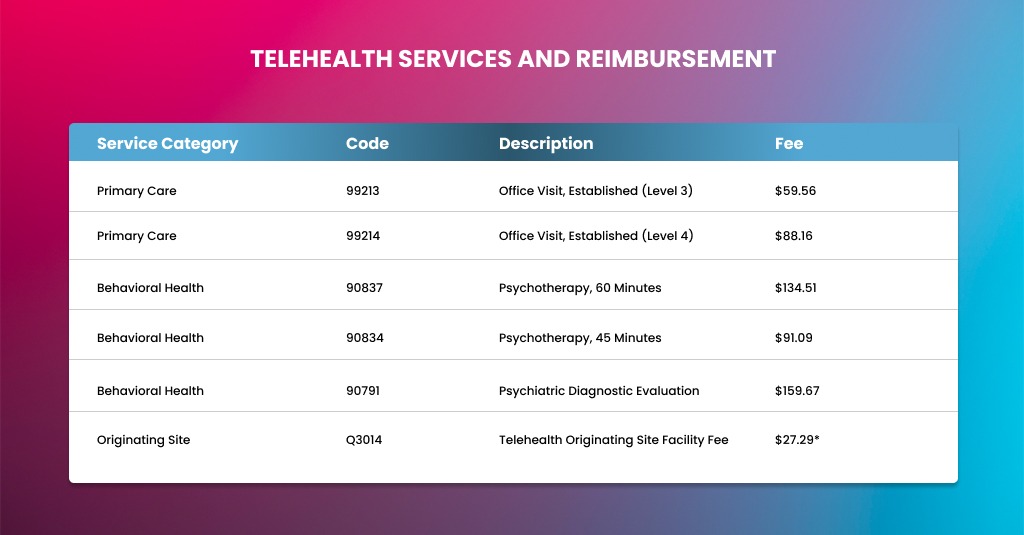
For the 2025-2026 fiscal year, Colorado Medicaid (Health First Colorado) maintains payment parity for telehealth services, meaning virtual visits are reimbursed at the same rate as comparable in-person services.
Core Telehealth Rates (2025-2026)
The following rates are effective through June 30, 2026, for services delivered via synchronous audio-video:
| Service Category | Code | Description | Fee |
| Primary Care | 99213 | Office Visit, Established (Level 3) | $59.56 |
| 99214 | Office Visit, Established (Level 4) | $88.16 | |
| Behavioral Health | 90837 | Psychotherapy, 60 minutes | $134.51 |
| 90834 | Psychotherapy, 45 minutes | $91.09 | |
| 90791 | Psychiatric Diagnostic Evaluation | $159.67 | |
| Originating Site | Q3014 | Telehealth Originating Site Facility Fee | $27.29* |
*Note: Some specialized facility types or worker compensation programs may have variations, such as a maximum allowance of up to $35.70.
Pharmacy Fee Schedule for 2026
For the 2025-2026 fiscal year, Colorado Medicaid (Health First Colorado) has updated its pharmacy reimbursement methodology and dispensing fees to balance state expenditures with provider costs.
As of April 1, 2026, pharmacy claims are processed by MedImpact Healthcare Systems, Inc., replacing Prime Therapeutics.
Dispensing Fee Schedule (2026)
Dispensing fees are tiered based on a pharmacy’s annual prescription volume (Total Prescriptions Filled). The following rates are effective through June 30, 2026:
- Tier 1 (0 – 59,999 Rx/year): $13.40 per prescription
- Tier 2 (60,000 – 109,999 Rx/year): $11.49 per prescription
- Tier 3 (110,000 – 169,999 Rx/year): $9.93 per prescription (reduced from $10.25)
- Tier 4 (170,000+ Rx/year): $8.72 per prescription (reduced from $9.31)
Drug Reimbursement Methodology
Reimbursement for drug ingredient costs follows a “lesser-of” logic. The allowed cost is the lowest of:
- Average Acquisition Cost (AAC)
- National Average Drug Acquisition Cost (NADAC)
- Maximum Allowable Cost (MAC): Now updated to Wholesale Acquisition Cost (WAC) minus 22% for generics and WAC minus 4% for brand drugs.
- Submitted Ingredient Cost (SIC)
Key Pharmacy Updates for 2026
- Preferred Drug List (PDL): Major updates effective April 1, 2026, added preferred options for anticonvulsants, migraine agents, and targeted immunomodulators.
- Physician Administered Drugs (PADs): Drugs administered in an office or clinic setting must be billed through the medical benefit rather than the pharmacy benefit, unless administered in the member’s home or a long-term care facility.
- Copayments: Health First Colorado does not charge copayments for most pharmacy services, and providers are prohibited from balance-billing
Durable Medical Equipment (DME) Fee Schedule for 2026
For the period of July 1, 2025, through June 30, 2026, Colorado Medicaid (Health First Colorado) rates for Durable Medical Equipment, Prosthetics, Orthotics, and Supplies (DMEPOS) reflect a 1.6% across-the-board (ATB) increase over the previous fiscal year.
2026 DME & Medical Supply Rates
The following are estimated base rates for common DME and disposable supply codes effective through June 30, 2026:
- A4206–A4209 (Sterile Syringe with Needle): $0.31 per unit
- A4253 (Blood Glucose Test Strips, box of 50): Rates vary by manufacturer; strictly follows the Preferred Drug List (PDL) requirements
- E0143 (Walker, folding, wheeled): ~$115.42 (Purchase) / ~$11.54 (Monthly Rental)
- E0445 (Pulse Oximeter, fingertip): Use Modifier U1 for billing
- E1390 (Oxygen Concentrator, single delivery): ~$162.44 per month
- K0001 (Standard Manual Wheelchair): ~$525.80 (Purchase)
- B4155 (Human Milk Fortifier): Now a covered benefit as of June 1, 2025
Hospital and Facility Fee Schedule for 2026
For the state fiscal year running July 1, 2025, through June 30, 2026, Colorado Medicaid (Health First Colorado) hospital rates initially included a 1.6% across-the-board (ATB) increase over the previous fiscal year.
However, due to a $1.5 billion state budget shortfall, a 2.0% across-the-board reduction for most Medicaid providers is proposed for the upcoming fiscal cycle, though some services like neonatal intensive care and maternal health may be exempt.
Hospital Inpatient Base Rates (FY 2025-26)
Inpatient reimbursement uses the All Patients Refined Diagnosis Related Group (APR-DRG) methodology. Base rates vary by hospital and include the 1.6% increase through June 2026:
- Large Hospital Peer Group (Base): ~$3,950 – $4,200
- Rural/Critical Access Hospitals: Typically, higher base rates to offset lower volumes.
- Rehabilitation/Long-Term Acute Care: Reimbursed via a per-diem rate or specialized DRG weight.
Hospital Outpatient Base Rates (FY 2025-26)
Outpatient services are reimbursed via Enhanced Ambulatory Patient Groupings (EAPG). Effective October 1, 2025, the base rates for several major facilities were updated:
| Hospital (Example) | EAPG Base Rate (eff. 10/1/25) |
| Denver Health | $214.38 |
| UCHealth University of Colorado | $218.03 |
| St. Anthony Hospital | $223.59 |
| Children’s Hospital Colorado | Specific pediatric adjustment factors apply |
Supplemental Payments & Facility Fees
- Telehealth Originating Site Fee (Q3014): $27.29 (standard) up to $35.70 for specific facilities.
- Hospital Provider Fee (CHASE): Hospitals pay a fee based on net patient revenue (capped at 6.0% for 2026) to draw federal matching funds for supplemental payments.
- Disproportionate Share Hospital (DSH): Supplemental payments are distributed annually to hospitals serving a high volume of Medicaid and uninsured patients.
Key 2026 Operational Updates
- Claims Transition: As of April 1, 2026, fee-for-service hospital claims and prior authorizations are processed by MedImpact Healthcare Systems, Inc..
- Prior Authorization (PAR): Required for specific high-cost inpatient stays, specialized surgeries, and out-of-state facility placements.
- New Codes: 2026 CPT and HCPCS codes were integrated into the system on January 1, 2026.
You can download the full hospital-specific Excel files from the official HCPF Provider Rates and Fee Schedule page.
Laboratory and Drug Testing Fee Schedule for 2026
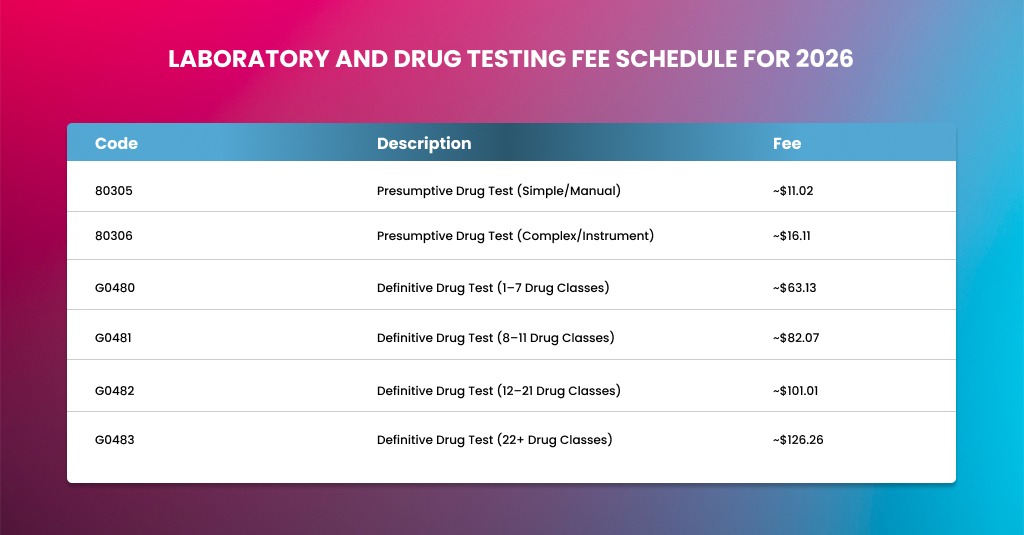
Colorado Medicaid laboratory and drug testing rates reflect a 1.6% across-the-board (ATB) increase over the previous fiscal year.
The state has also implemented significant new coverage limits for definitive drug testing to manage the $1.5 billion budget shortfall.
Drug Testing & Screening Rates
The following base rates are effective through June 30, 2026:
| Code | Description | Fee |
| 80305 | Presumptive Drug Test (Simple/Manual) | ~$11.02 |
| 80306 | Presumptive Drug Test (Complex/Instrument) | ~$16.11 |
| G0480 | Definitive Drug Test (1–7 drug classes) | ~$63.13 |
| G0481 | Definitive Drug Test (8–11 drug classes) | ~$82.07 |
| G0482 | Definitive Drug Test (12–21 drug classes) | ~$101.01 |
| G0483 | Definitive Drug Test (22+ drug classes) | ~$126.26 |
Common Laboratory Service Rates
- 80048 (Basic Metabolic Panel): $8.42
- 80053 (Comprehensive Metabolic Panel): $10.02
- 81001 (Urinalysis, with microscopy): $3.15
- 82306 (Vitamin D test): $29.60
- 85025 (Complete Blood Count): $7.47
- 88142 (Pap Smear, screening): $18.54
Critical Coverage Limits & Rules (2026)
- Definitive Drug Testing Limit: Coverage for adults (21+) is strictly capped at 16 units per State Fiscal Year (SFY) through June 30, 2026. This limit is scheduled to decrease to 12 units starting July 1, 2026.
- Presumptive Testing Frequency: Reimbursable up to 2 times every 7 days, with a maximum of 24 times per calendar year.
- Medical Necessity Enforcement: As of February 1, 2026, all drug testing claims must meet refined medical necessity standards, including orders from a licensed healthcare professional based on specific patient risk assessments.
- Billing Modifiers: The SC modifier is now strictly enforced for certain specialized testing in the MMIS system.
Conclusion
The Colorado Medicaid fee schedule for 2026 is not a single document. It is a living set of rates that change throughout the year. Providers who treat it as static lose money. Providers who stay current get paid correctly.
Colorado Medicaid covers over 1.5 million people. The network is worth being in. But being in the network requires work. Do the work. Stay current on fee schedules. Read the bulletins. Bill correctly. Get paid.
Struggling with underpayments or outdated Medicaid rates?
Managing Colorado Medicaid billing is complex, especially with frequent rate changes, multiple fee schedules, and evolving compliance requirements.
If you want to eliminate underpayments, reduce denials, and ensure accurate reimbursements, working with an experienced billing team can make a measurable difference.
A2Z Medical Billing Services helps healthcare providers stay current with fee schedules, optimize claims, and improve revenue cycle performance.
Get in touch today to streamline your Medicaid billing and maximize your reimbursements.
