

Hearing loss affects millions of older adults in the United States, impacting communication, independence, and overall health. Yet when patients begin exploring treatment, one question almost always comes first: Does Medicare cover hearing aids?
The answer depends on the type of Medicare coverage a person has. While hearing aids can cost thousands of dollars, coverage rules differ between Original Medicare and Medicare Advantage plans. Understanding those differences is essential for patients, providers, and billing teams navigating hearing-related services in 2026.
Let’s break it down clearly.
Does Medicare Cover Hearing Aids?
Original Medicare (Part A and Part B) does not cover hearing aids or routine hearing exams performed for hearing aid fitting. However, Medicare Part B does cover medically necessary diagnostic hearing and balance tests when ordered by a physician. Some Medicare Advantage plans may offer limited hearing aid benefits, depending on the specific policy.
Understanding this distinction is critical before seeking treatment or submitting claims.
Why Hearing Aid Coverage Matters
Hearing loss affects nearly two-thirds of adults over age 70 in the United States, yet fewer than 30% of those who could benefit from hearing aids actually use them. According to the National Institute on Deafness and Other Communication Disorders, cost remains the primary barrier to adoption.
Because devices often cost between $1,000 and $4,000 per ear, coverage decisions significantly impact access to care. Despite ongoing advocacy efforts, comprehensive hearing aid coverage has not been added to Original Medicare as of 2026.
Understanding How Medicare Coverage Is Structured
Medicare is administered by the Centers for Medicare & Medicaid Services (CMS) and divided into four parts. Each part governs different types of healthcare services. Coverage exclusions for hearing aids are outlined in federal Medicare regulations and CMS policy guidance.
Original Medicare consists of Part A and Part B. Medicare Advantage, also known as Part C, is offered by private insurers approved by CMS. Part D provides prescription drug coverage.
Whether hearing-related services are covered depends entirely on which type of Medicare plan applies.
Medicare Part A (Hospital Insurance)
Part A covers inpatient hospital care, skilled nursing facility care, hospice services, and certain home health services.
It does not include benefits for hearing aids or routine hearing evaluations.
Medicare Part B (Medical Insurance)
Part B covers outpatient medical services, including medically necessary diagnostic testing.
For hearing-related conditions, Part B may cover:
- Diagnostic audiology evaluations
- Physician-ordered hearing tests
- Balance assessments
However, hearing aids themselves and routine exams performed solely for fitting purposes are excluded from coverage under federal Medicare law.
Medicare Part C (Medicare Advantage)
Medicare Advantage plans are administered by private insurance companies that contract with CMS. These plans must provide at least the same coverage as Original Medicare but may include additional benefits.
Many Medicare Advantage plans offer supplemental hearing benefits, such as:
- Annual hearing exams
- Hearing aid allowances
- Copay-based device programs
Coverage limits, network restrictions, and replacement frequency vary by plan.
Medicare Part D (Prescription Drug Coverage)
Part D provides prescription drug benefits only. It does not include hearing aid coverage.
Does Original Medicare (Part A & Part B) Cover Hearing Aids?
Let’s be clear right away.
As explained above, Original Medicare excludes hearing aids and routine exams related to hearing aid fitting.
This exclusion has been written into federal Medicare law for decades. It applies nationwide.
That means:
- No coverage for hearing aid devices
- No coverage for hearing aid fittings
- No coverage for routine hearing tests for hearing aid purposes
Patients are responsible for 100% of the cost.
Hearing aids represent a significant out-of-pocket expense.
The average cost of a single hearing aid in the United States ranges between $1,000 and $4,000 per ear. Many patients need two. That means total out-of-pocket expenses can easily reach $5,000–$8,000 or more.
Why Doesn’t Medicare Cover Hearing Aids?
Hearing aids are excluded from coverage under federal Medicare statute. Unlike wheelchairs, oxygen equipment, or prosthetic devices, hearing aids are not classified as Durable Medical Equipment (DME) under Medicare rules.
Because of this statutory exclusion:
- Medicare cannot reimburse hearing aid devices under Part B
- Routine exams related to device fitting are not considered medically necessary services
- Payment responsibility falls to the beneficiary unless supplemental coverage applies
Advocacy groups and lawmakers have proposed expanding hearing aid coverage in recent years. However, as of 2026, Original Medicare has not adopted comprehensive hearing aid benefits.
Understanding this legal framework helps explain why coverage remains limited.
Has Medicare Expanded Hearing Aid Coverage in 2026?
As of 2026, Original Medicare (Parts A and B) has not expanded coverage to include traditional hearing aids or routine hearing exams for fitting. This statutory exclusion remains in place under federal Medicare policy. Some Medicare Advantage (Part C) plans continue to offer supplemental hearing benefits, including hearing exams or hearing aid allowances, but benefits vary by insurer, plan design, and region. Beneficiaries should review their Annual Notice of Change (ANOC) or Evidence of Coverage to understand any updates to hearing-related benefits for the upcoming plan year.
What Does Medicare Cover for Hearing Services?
Although hearing aids are excluded from coverage, Medicare Part B does pay for certain hearing-related services when they are medically necessary.
Coverage applies only when testing is ordered to evaluate or treat a medical condition — not for routine screening or device fitting.
Medicare Part B may cover:
- Diagnostic audiologic evaluations
- Hearing tests ordered due to symptoms
- Balance assessments
- Evaluation of conditions such as tinnitus, vertigo, or sudden hearing loss
For example, if a patient experiences sudden sensorineural hearing loss, conductive hearing loss, persistent tinnitus, dizziness, or balance disturbances, a physician may order diagnostic testing. These services are commonly performed by a licensed audiologist or an otolaryngologist (ear, nose, and throat specialist) to evaluate the type and severity of hearing impairment.
When properly documented, those services are typically covered.
However, testing performed solely to determine hearing aid eligibility remains excluded.
That distinction is critical in both patient expectations and billing compliance.
Medicare Part B Reimbursements
Under Part B:
- Medicare typically covers 80% of the approved amount.
- The patient pays 20% coinsurance after meeting the annual deductible.
Audiology services are billed using CPT codes such as:
- 92557 – Comprehensive audiometry threshold evaluation and speech recognition
- 92567 – Tympanometry
These must be linked to medically necessary ICD-10 diagnosis codes.
If documentation does not support medical necessity, the claim may be denied.
That is why proper documentation and coding are critical.
Does Medicare Advantage Cover Hearing Aids?
Here’s where things get interesting.
Medicare Advantage plans (Part C) are offered by private insurance companies approved by Medicare.
Many Medicare Advantage plans provide additional benefits, including limited hearing aid coverage.
Coverage varies by plan, but often includes:
- Annual hearing exams
- Hearing aid allowances
- Copay-based hearing device coverage
Some plans offer allowances ranging from $500 to $2,000 per year toward hearing aids.
However:
- Coverage may be limited to certain brands
- Network providers may be required
- Replacement frequency limits apply
Patients must carefully review their specific plan details.
Medicare Advantage is where most hearing aid financial assistance exists within the Medicare system.
Over-the-Counter (OTC) Hearing Aids
Recently, over-the-counter hearing aids became available nationwide for adults with perceived mild-to-moderate hearing loss.
These devices are sold directly to consumers without a prescription.
Original Medicare does not cover OTC hearing aids either.
However, some Medicare Advantage plans may offer allowances that can be applied toward these products, depending on plan structure.
OTC devices generally cost less than traditional prescription hearing aids, typically ranging from $200 to $1,000.
While more affordable, they may not be appropriate for severe hearing loss.
Medicaid and Dual Eligibility
For patients who qualify for both Medicare and Medicaid (dual-eligible beneficiaries), coverage can differ.
Medicaid coverage for hearing aids varies by state.
Some states provide partial or full coverage for hearing aids for adults. Others limit coverage to children.
Patients must check state-specific Medicaid policies.
How to Reduce Hearing Aid Costs in 2026
Since Original Medicare does not pay for hearing aids, patients often explore alternative options to reduce out-of-pocket expenses.
Common cost-reduction strategies include:
- Enrolling in a Medicare Advantage plan with hearing benefits
- Reviewing state Medicaid coverage (for dual-eligible beneficiaries)
- Applying Veterans Affairs (VA) benefits, if eligible
- Purchasing FDA-approved over-the-counter (OTC) hearing aids
- Using Health Savings Accounts (HSA) or Flexible Spending Accounts (FSA)
- Exploring nonprofit assistance programs or manufacturer financing
OTC hearing aids, approved for mild-to-moderate hearing loss, typically range from $200 to $1,000. While more affordable, they may not be appropriate for severe hearing impairment.
Patients should consult a qualified audiologist or otolaryngologist before making purchasing decisions.
How to Bill Medicare for Hearing-Related Services
Billing hearing services under Medicare requires a clear understanding of what qualifies as a covered diagnostic service versus what falls under statutory exclusions. Practices that outsource audiology billing services often reduce compliance risks and improve reimbursement accuracy for hearing-related claims.
Because hearing aids and routine fitting exams are not covered benefits under Original Medicare, providers must carefully distinguish between diagnostic evaluations and device-related services before submitting claims.
Improper classification can result in denials, audits, or patient billing disputes.
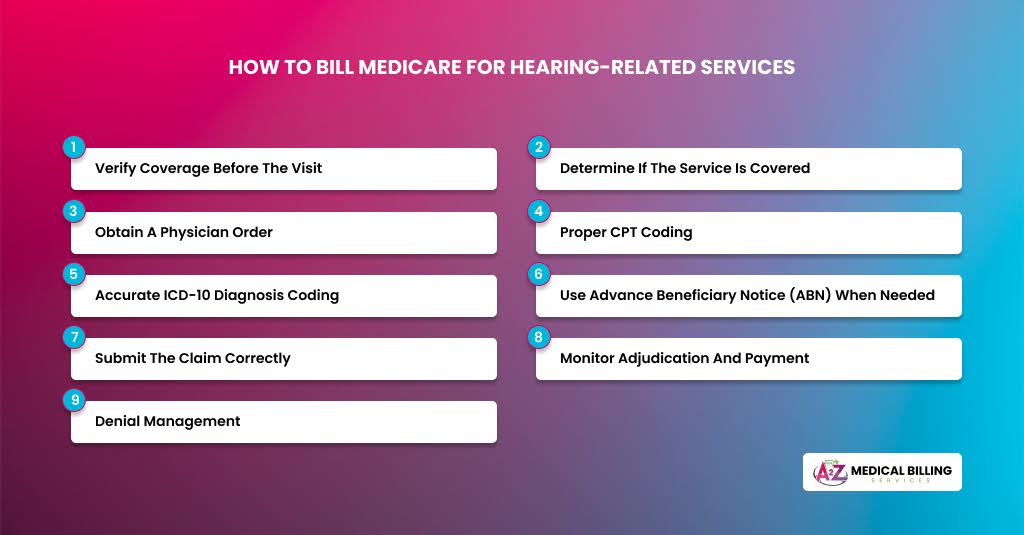
The following steps outline compliant billing practices for Medicare Part B.
Step 1: Verify Coverage Before the Visit
Everything begins with eligibility verification.
Confirm whether the patient has:
- Original Medicare (Part A and B)
- Medicare Advantage (Part C)
- Dual eligibility (Medicare + Medicaid)
If the patient has Medicare Advantage, hearing benefits may exist. Many Advantage plans offer limited hearing aid allowances or routine exam coverage. But coverage varies widely.
Never assume. Always verify. Strong eligibility workflows are essential in professional Medicare billing services to prevent avoidable denials.
For Original Medicare patients, clarify upfront that:
- Hearing aids are not covered
- Routine hearing tests for hearing aid fitting are not covered
Setting expectations avoids disputes later.
Step 2: Determine If the Service Is Covered
Ask yourself one simple question:
Is this service medically necessary for the diagnosis or treatment of a medical condition?
If yes, Medicare Part B may cover it.
If no, it is likely excluded.
Covered services generally include:
- Diagnostic audiologic evaluation
- Hearing tests ordered due to symptoms
- Balance testing when medically necessary
Not covered services include:
- Routine hearing exams
- Hearing aid fittings
- Hearing aid devices
- Follow-up adjustments for hearing aids
Understanding this distinction is critical before billing.
Step 3: Obtain a Physician Order
Medicare requires that a physician or qualified non-physician practitioner order diagnostic hearing tests.
The order must support medical necessity.
For example, acceptable clinical indications may include:
- Sudden hearing loss
- Tinnitus
- Vertigo
- Balance disorder
- Neurological symptoms
Without a valid order, the claim will not meet Medicare requirements.
Documentation should clearly state why the test is needed.
Step 4: Proper CPT Coding
Once the test is performed, assign the correct CPT code.
Common audiology CPT codes include:
- 92557 – Comprehensive audiometry and speech recognition
- 92567 – Tympanometry
- 92550 – Tympanometry and reflex threshold measurements
Ensure the CPT code matches the exact service performed. Accurate code selection often requires experienced medical coding services to ensure compliance with Medicare guidelines and NCCI edits.
Do not upcode or bundle incorrectly.
If multiple tests are performed, confirm whether any National Correct Coding Initiative (NCCI) edits apply.
Step 5: Accurate ICD-10 Diagnosis Coding
Diagnosis codes must support medical necessity.
Acceptable ICD-10 examples may include:
- H91.90 – Unspecified hearing loss
- H93.19 – Tinnitus
- R42 – Dizziness and giddiness
Avoid screening diagnosis codes if billing Medicare. Screening codes suggest routine testing, which is not covered.
If documentation does not clearly show symptoms or medical need, the claim is vulnerable to denial.
Step 6: Use Advance Beneficiary Notice (ABN) When Needed
If a service is likely to be denied because it is not covered, issue an Advance Beneficiary Notice (ABN) before performing the service. If you are unfamiliar with ABN requirements, review our detailed explanation of when an Advance Beneficiary Notice is required under Medicare.
For example:
If a patient wants a hearing test solely for hearing aid fitting, you must issue an ABN explaining that Medicare does not cover the service.
Without a properly executed ABN, the provider may be financially responsible if Medicare denies the claim.
ABNs protect both the provider and the patient.
Step 7: Submit the Claim Correctly
For Medicare Part B:
- Use the correct place-of-service code
- Link CPT codes properly to ICD-10 diagnosis codes
- Confirm provider enrollment and NPI accuracy
Medicare typically reimburses 80% of the approved amount after the deductible is met. The patient is responsible for the remaining 20% coinsurance.
Claims should be submitted electronically whenever possible to reduce processing delays.
Step 8: Monitor Adjudication and Payment
Once the claim is processed:
- Review the Medicare Remittance Advice (RA)
- Confirm payment matches the Medicare Physician Fee Schedule (MPFS) allowable
- Post payment accurately
If denied, review the denial code carefully.
Common denial reasons include:
- Lack of medical necessity
- Missing physician order
- Incorrect diagnosis code
- Service considered routine
Step 9: Denial Management
If a diagnostic hearing test is denied:
First, verify documentation supports medical necessity.
Second, confirm the correct diagnosis was submitted.
Third, confirm an order was on file.
If the documentation supports coverage, submit a corrected claim or an appeal with the records attached.
Do not automatically write off hearing-related denials without review. Many practices rely on structured denial management services to recover revenue and reduce repeat errors.
Medicare Hearing Billing Errors and How to Avoid Them
Billing for hearing services under Medicare is often more complicated than it appears. Even small errors in documentation, coding, or workflow can lead to denials, delayed payments, or compliance issues. Understanding common mistakes and implementing preventive strategies is critical for both revenue integrity and patient satisfaction.
Billing Routine Hearing Exams to Medicare Part B
One of the most frequent errors is submitting claims for routine hearing exams or hearing aid evaluations under Original Medicare.
Original Medicare does not cover hearing aids or routine exams for fitting purposes. It only covers diagnostic hearing and balance tests when medically necessary and ordered by a physician.
Many practices inadvertently bill routine exams as diagnostic, assuming coverage applies. When Medicare processes the claim, it often results in a denial.
How to Avoid:
- Clearly distinguish routine versus diagnostic exams at scheduling.
- Verify coverage for each patient individually.
- Inform patients upfront about non-covered services and costs.
- Use an Advance Beneficiary Notice (ABN) when Medicare is expected to deny payment.
Failing to Obtain a Valid Physician Order
Medicare requires a physician or qualified practitioner’s order for diagnostic hearing tests.
A common mistake occurs when audiology staff perform testing without a formal order documented in the chart. Denials often follow, and audits may flag the service as non-compliant.
How to Avoid:
- Always obtain a signed and dated physician order before testing.
- Ensure the order specifies the clinical reason for testing.
- Keep the order readily available in the electronic health record (EHR) for audits.
Using Screening or Non-Specific Diagnosis Codes
Some offices link CPT codes to general or screening diagnosis codes, such as “screening for hearing loss.” Medicare does not cover screening services under Part B.
Incorrect ICD-10 linkage signals to payers that the service lacks medical necessity, often triggering claim denial.
How to Avoid:
- Use diagnosis codes that reflect actual symptoms or conditions, such as hearing loss, tinnitus, or vertigo.
- Match ICD-10 codes to documented clinical findings.
- Avoid vague or “catch-all” codes unless supported by documentation.
Poor Documentation of Medical Necessity
Even when a physician orders the test, weak documentation can result in partial or full denial. Payers want clear clinical justification for diagnostic exams.
Documentation should include the patient’s symptoms, onset, duration, severity, and any associated conditions that necessitate testing. Simply stating “hearing test performed” is insufficient.
How to Avoid:
- Record a thorough clinical narrative highlighting symptoms and risk factors.
- Document why testing is medically necessary for that specific encounter.
- Include relevant history, examination findings, and clinical decision-making in the note.
Failing to Verify Medicare Advantage or Secondary Coverage
Many patients have Medicare Advantage plans that sometimes include hearing benefits not covered by Original Medicare. Practices often treat all Medicare patients the same, resulting in missed opportunities or improper billing.
How to Avoid:
- Verify the patient’s specific plan and any hearing benefits before the visit.
- Check network requirements, allowance limits, and replacement frequency rules.
- Confirm deductible and copay responsibilities upfront to prevent billing surprises.
Not Issuing an Advance Beneficiary Notice (ABN) When Needed
When a service is likely to be denied, such as a routine hearing exam, failure to issue an ABN exposes the practice to financial risk. Patients may refuse payment if Medicare denies the claim, and the provider may be responsible for the balance.
How to Avoid:
- Issue an ABN before performing non-covered services.
- Clearly explain why Medicare will not pay and the expected patient responsibility.
- Document patient acknowledgment and consent in the medical record.
Poor Denial Management Practices
Denials happen, but many practices fail to follow up appropriately. Some claims are written off immediately, leaving revenue uncollected even when documentation could support an appeal.
How to Avoid:
- Review all denial reason codes carefully.
- Correct coding or documentation errors promptly.
- Submit appeals with supporting records if medical necessity is documented.
- Track denial trends to identify systemic issues.
Frequently Asked Questions
Does Medicare cover hearing aids in 2026?
No. Original Medicare does not cover hearing aids or routine hearing exams for fitting. Some Medicare Advantage plans offer limited hearing benefits.
Does Medicare cover hearing tests?
Medicare Part B covers diagnostic hearing and balance tests when medically necessary and ordered by a physician.
Are over-the-counter hearing aids covered by Medicare?
No. Original Medicare does not cover OTC hearing aids. Certain Medicare Advantage plans may provide allowances.
How much do hearing aids cost without insurance?
Prescription hearing aids typically cost between $1,000 and $4,000 per ear. Total out-of-pocket expenses can exceed $5,000 for bilateral devices.
Does Medicaid cover hearing aids?
Medicaid coverage varies by state. Some states provide adult hearing aid benefits, while others limit coverage to children.
How often can Medicare Advantage replace hearing aids?
Replacement frequency depends on the specific plan. Many Medicare Advantage plans limit replacements to every 3–5 years.
Final Thoughts
If you are enrolled in Original Medicare, hearing aids are generally an out-of-pocket expense. Medicare covers medically necessary diagnostic exams but not the devices themselves.
If you have a Medicare Advantage plan, review it carefully. Many plans offer hearing benefits that significantly reduce costs.
From a billing standpoint, clarity is everything. Verify coverage, confirm medical necessity, document thoroughly, and use ABNs when needed.
Hearing loss may be common, but Medicare coverage for hearing aids remains limited. Understanding the rules upfront prevents confusion, denials, and unexpected bills later.