

If you have been putting off TRICARE credentialing because the process may be confusing.
TRICARE covers over 9.6 million beneficiaries across the United States.
That includes active-duty service members, military retirees, National Guard and Reserve members, their families, and eligible survivors.
That is a massive patient population, and the practices credentialed to serve them have a built-in referral stream that does not depend on marketing spend or on reputation-building from scratch.
TRICARE credentialing is more complicated than it was two years ago.
The contractor transition that took effect January 1, 2025, reshuffled regional boundaries, changed which agency handles which states, and left thousands of providers stuck in administrative limbo during the migration.
If you started this process last year and hit a wall, you were not alone.
And if you are starting fresh in 2026, knowing how the system works right now will save you months of frustration.
This guide walks through everything from the fundamentals of TRICARE’s structure to the step-by-step credentialing process for both regions.
Understanding TRICARE’s Structure in 2026
TRICARE operates through two regional contractors in the continental United States. Humana Military manages the East Region.
The West Region is managed by TriWest Healthcare Alliance, which took over from Health Net Federal Services in one of the most significant administrative transitions in TRICARE’s recent history.
Where you practice determines which regional contractor you deal with. The East Region covers most of the eastern United States.
The West Region covers the western states plus several that moved over from the East as part of the 2025 transition.
Those six states, Arkansas, Illinois, Louisiana, Oklahoma, Texas, and Wisconsin, all moved from East to West effective January 1, 2025.
Providers in those states who credentialed under Humana Military before the transition need to re-establish network status with TriWest.
That migration created a significant backlog that is still working its way through the system in 2026.
Before you do anything else in the credentialing process, confirm which region your practice location falls under. Do not assume.
The state-to-region mapping has changed, and submitting your application to the wrong contractor can waste months.
The Difference Between TRICARE Authorization and Network Credentialing
This distinction trips up many providers new to TRICARE, and it matters for your billing workflow and patient cost-sharing.
TRICARE Authorization
TRICARE authorization, sometimes called TRICARE certification, means you are recognized as an eligible provider who can see TRICARE patients and bill for those services.
Certified non-network providers bill TRICARE and receive payment, but the patient pays a higher cost-share than they would with a network provider.
You also have the option to charge up to 15% above the TRICARE allowable charge as a non-network provider, though that excess charge typically falls on the patient.
Network Credentialing
Network credentialing means you have signed a participation contract with Humana Military or TriWest and agreed to accept the TRICARE allowable charge as payment in full, minus the patient’s cost-share.
Network providers cannot balance-bill patients. In exchange, you get lower patient out-of-pocket costs, which makes your practice more attractive to TRICARE beneficiaries who are often cost-sensitive, and you get listed in the official TRICARE provider directory.
Most practices that are serious about building a TRICARE patient base pursue full network credentialing. TRICARE authorization without a network contract is a halfway point that works in some situations but leaves money and referrals on the table.
TRICARE Plans and What They Mean for Providers

Knowing which TRICARE plans your patients may be enrolled in helps you understand referral requirements and authorization rules before you see your first TRICARE patient.
TRICARE Prime
TRICARE Prime is the HMO-style option. Prime enrollees select a primary care manager and generally need referrals to see specialists.
If you are a specialist pursuing network credentialing, Prime patients will need an authorization before their visit. Seeing a Prime patient without that authorization creates a claims and cost-sharing problem that is hard to unwind after the fact.
TRICARE Select
TRICARE Select is the PPO-style option. Select enrollees have more flexibility to see network providers without referrals. For most outpatient specialties, Select is a simpler billing relationship than Prime.
TRICARE For Life
TRICARE For Life is the supplement benefit for military retirees who are Medicare-eligible. Medicare is primary.
TFL is secondary and covers most of what Medicare does not. Providers who accept Medicare are generally eligible to see TFL patients, and billing follows the Medicare-primary, TFL-secondary coordination-of-benefits structure.
TRICARE Reserve Select and TRICARE Young Adult
TRICARE Reserve Select and TRICARE Young Adult are smaller plan populations but follow billing rules similar to those of TRICARE Select.
Understanding the plan mix in your patient panel matters for authorization management, referral tracking, and claims submission.
The January 2025 Contractor Transition: What Every Provider Still Needs to Know in 2026
The transition from Health Net Federal Services to TriWest Healthcare Alliance in the West Region was among the most operationally disruptive changes in the history of TRICARE’s provider network.
Understanding what happened and the residual effects in 2026 helps you avoid the same traps that delayed thousands of providers over the past year.
Under the old system, providers in the West Region were credentialed and contracted through Health Net.
When TriWest took over, those provider records needed to migrate to the new contractor’s systems.
In practice, data migration issues, communication breakdowns, and processing backlogs created significant delays.
Some providers credentialed with Health Net found themselves in limbo with TriWest, unable to bill until their records were verified and their TriWest contract was executed.
As of 2026, most of the acute migration issues have been resolved, but the process still takes longer than pre-transition norms in the West.
A credentialing application that might have been processed in 60 days under Health Net is realistically taking 90 to 120 days under TriWest in the current environment.
Build that timeline into your planning.
If you have a provider starting in three months and want them to see TRICARE patients on day one, the credentialing process needs to be underway today.
For the six states that moved from East to West, the situation is particularly serious.
Providers in Texas, Illinois, Louisiana, Arkansas, Oklahoma, and Wisconsin who were network providers under Humana Military East cannot simply transfer that status to TriWest West.
They need to go through TriWest’s credentialing process from the beginning. Do not bill TriWest claims assuming your Humana Military credentials still apply in those states. They do not.
TRICARE East Credentialing Through Humana Military
As of the date of this writing, Humana Military is not accepting requests to join the East Region medical, surgical, or ancillary networks for most provider types.
The East network for general medicine and most surgical specialties is effectively closed to new entrants.
The exceptions are meaningful, though. Humana Military is currently accepting new network applications from autism service providers, psychiatric and mental health clinicians, substance abuse treatment providers, doulas, and lactation specialists.
If your specialty falls into one of those categories, the East Region network is actively open. For every other specialty, network participation in the East is not available through new applications right now.
If you are a general internist, orthopedic surgeon, cardiologist, or provider in most other specialties, you can pursue TRICARE authorization to see East Region patients as a non-network provider.
You can bill TRICARE and get paid. But you cannot get a network contract with Humana Military in the East until the network opens again for your specialty type.
Watch Humana Military’s provider portal and their provider communications for announcements about network openings.
These do change. But go in with clear eyes about the current situation so you are not surprised by a rejection that has nothing to do with your credentials.
The East Region Credentialing Process Step by Step
Step 1: Confirm your eligibility and the network status for your specialty.
Check the Humana Military provider portal at tricare-east.com before doing anything else. If the network is closed for your specialty, decide whether TRICARE authorization as a non-network provider meets your needs.
Step 2: Set up or update your CAQH ProView profile.
Humana Military uses CAQH ProView as the primary data source for your credentials. Your profile must be complete, fully updated, and attested within the last 120 days. If your attestation is more than 120 days old, your application will stall. CAQH requires re-attestation every 120 days, regardless of whether anything has changed, so set a calendar reminder for this.
Grant Humana Military authorization to access your CAQH profile. Without that authorization flag checked in CAQH, Humana Military cannot pull your data even if your profile is current.
Step 3: Submit the provider certification application through the Humana Military provider portal.
This initial certification step confirms you meet federal licensing and professional standards. Once approved, you are a TRICARE-authorized non-network provider. The certification step typically processes in about 30 days.
Step 4: Submit your network participation request.
If the network is open for your specialty, you submit a separate request for a participation agreement after certification is approved. This is the step that transitions you from a non-network-authorized provider to a full network participant. Processing time for the network contract step runs 90 to 120 days under current Humana Military timelines.
Your East Region payer ID for electronic remittance and claims submission is 99727. Many states now require enrollment with this payer ID to receive accurate electronic remittances.
Documentation Required for East Region Credentialing
Every document on this list should be ready before you submit.
Incomplete applications are the single biggest cause of processing delays, and Humana Military’s automated screening will flag missing items, adding 30 to 75 days to your timeline.
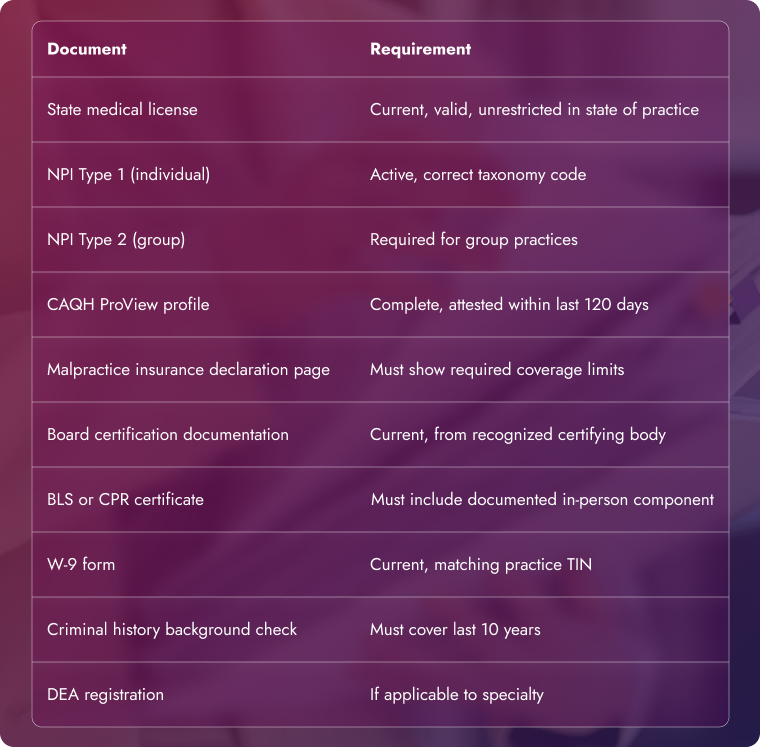
One detail that catches people off guard is the BLS or CPR certificate. Humana Military requires the in-person training component to be documented. Online-only BLS certificates do not satisfy this requirement and will trigger a manual review flag. If your certificate is from a fully online course, get it renewed through an in-person or blended program before submitting your application.
TRICARE West Credentialing Through TriWest Healthcare Alliance
TriWest follows URAC credentialing standards, as well as all applicable federal regulations and TRICARE requirements.
Aperture Credentialing LLC assists TriWest in completing primary source verification. That means TriWest verifies your credentials directly with licensing boards, certifying bodies, and other authoritative sources, not just through CAQH.
The West Region network status situation is more straightforward than the East in 2026.
TriWest is generally open for network applications across most provider types and specialties, though specific geographic areas may have limited network capacity.
Call TriWest at 844-866-9378 before submitting an application to confirm whether the network is open in your specific service area. If the network is open, they will send you a contract packet and walk you through the submission process.
The West Region Process Step by Step
Step 1: Contact TriWest to confirm network availability in your area.
Do this before you fill out a single form. Network availability varies by region and specialty. A five-minute phone call confirms whether you can proceed with a network application or pursue non-network authorization instead.
Step 2: Complete the provider contract request on the TriWest website at tricare.triwest.com.
This is your initial inquiry and signals your intent to join the network. TriWest will respond with next steps.
Step 3: Update your CAQH ProView profile and grant TriWest access.
Individual providers who are CAQH members should populate their CAQH ID on any roster or application form TriWest provides. Make sure your CAQH profile reflects TriWest in the authorized payer’s section. Individual providers who are not CAQH members complete the TriWest Individual Provider Credentialing Application and submit it, along with the required documents, to credentialing@triwest.com. Facility and ancillary providers use the TriWest Ancillary and Facility Credentialing Application via the same email address.
Step 4: TriWest’s credentialing review team verifies your credentials.
This includes professional credentials, board certification, education history, and background. Aperture Credentialing LLC supports this process.
Step 5: Upon approval, you will receive and sign your fully executed contract.
Your network status is not active until both parties have signed the agreement. Do not bill TRICARE as a network provider until you have the signed contract in hand and you have received written confirmation of your network effective date.
Full onboarding in the West Region currently runs 90 to 120 days from initial application to active network status. Budget accordingly.
W-9 Update Rule for West Region Providers
TriWest has a specific rule worth knowing. Any time you change your tax identification number, billing address, organization name, or practice name, you must submit an updated W-9 form to TriWest to reflect the change.
Failing to update the W-9 when these details change causes payment routing errors and claim processing problems that can take significant time to unwind.
Common Reasons TRICARE Credentialing Applications Get Delayed
Most credentialing delays are preventable.
Practice address mismatches between USPS, NPPES, and CAQH are the leading cause.
If your address appears differently on any of these three platforms, automated screening flags the discrepancy and routes the application for manual review.
That alone adds 30 to 75 days.
Work history gaps greater than six months without explanation are another common flag.
If you had a gap in practice history, sabbatical, extended leave, or a break between training and employment, document it with an explanation.
Do not leave the gap and hope the reviewer does not notice. They will.
Malpractice declaration pages missing required coverage limits are a frequent documentation failure.
The declaration page needs to clearly show the per-occurrence and aggregate coverage limits.
A certificate of insurance without limit details does not satisfy this requirement.
National Provider Identifier (NPI) taxonomy mismatches between your NPPES record and your CAQH profile are a processing trigger.
Your primary taxonomy code in NPPES needs to match the one you listed in CAQH.
Run a cross-check before submitting your application.
BLS or CPR certificates from fully online courses without an in-person verification component do not meet the Humana Military requirement, as described earlier.
A CAQH attestation more than 120 days old will freeze your application.
This is the single most preventable delay in credentialing, and it happens constantly because providers do not track the 120-day re-attestation cycle.
Set a quarterly calendar reminder for CAQH re-attestation regardless of whether any of your information changed.
TRICARE Reimbursement: What Network Providers Get Paid
TRICARE reimbursement for most professional services is based on the CHAMPUS Maximum Allowable Charge, which is tied to Medicare’s Resource-Based Relative Value Scale.
In practical terms, TRICARE generally reimburses at rates close to Medicare for most services.
The rate for any specific procedure is the TRICARE Allowable Charge for that service, which you can look up through the Health.mil CMAC rate tables.
- Network providers accept the TRICARE Allowable Charge as payment in full. They cannot balance-bill the patient for the difference between the allowable charge and their billed charge.
- Non-network providers who are TRICARE-authorized can charge up to 15% above the TRICARE allowable charge, but that excess typically falls on the patient rather than TRICARE.
- For hospital outpatient services, TRICARE uses the Outpatient Prospective Payment System, mirroring Medicare’s OPPS structure.
- Inpatient hospital services are reimbursed through DRG-based payments aligned with Medicare’s hospital reimbursement framework.
The patient cost-sharing structure changed on January 1, 2026.
TRICARE Prime enrollees pay a $0 copayment for covered services obtained through their primary care manager.
TRICARE Select retirees pay enrollment fees ranging from $187 to $375 per year in 2026, depending on enrollment category.
TRICARE Reserve Select costs range from $57.88 to $286.66 per month, depending on individual versus family coverage.
These cost-sharing amounts directly affect what your patients pay out of pocket, so knowing them helps you set accurate financial expectations at the front desk.
Recredentialing and Ongoing Compliance
TRICARE credentialing is not a one-time event. Both Humana Military and TriWest require periodic recredentialing to maintain active network status.
The recredentialing cycle is every two to three years, and the contractor will notify you when your recredentialing window opens.
Missing a recredentialing deadline results in network termination.
- Once terminated, you must go through the full credentialing application process again, including the 90- to 120-day processing timeline.
- Keep a credentialing expiration tracker in your practice management system and start the recredentialing process at least 90 days before your expiration date.
- Keep your CAQH profile updated on an ongoing basis.
- Every time a license renews, a malpractice policy refreshes, board certification updates, or your practice address changes, update CAQH immediately.
- Do not wait for your 120-day re-attestation window to catch up on changes that happened months ago.
Delegated Credentialing for Group Practices and Health Systems
If you have signed a credentialing delegation agreement with TriWest, you have agreed to manage the initial credentialing and recredentialing processes for your individual providers internally.
Delegated credentialing means the health system or group practice runs the credentialing process and TriWest accepts the group’s credentialing decisions rather than processing each provider application individually.
Delegation agreements come with audit obligations.
TriWest will conduct oversight reviews of delegated credentialing programs to verify that the group’s process meets URAC standards and TRICARE requirements.
If your organization has a delegation agreement, make sure your credentialing coordinator is trained on TRICARE-specific requirements and that your internal process produces documentation sufficient to withstand a TriWest oversight review.
Frequently Asked Questions
How long does TRICARE credentialing take from start to finish in 2026, and what realistically causes the most delays?
The timeline for full TRICARE network credentialing in 2026 is 90 to 120 days from the date of complete application submission to active network status with a signed participation contract. The keyword in that sentence is complete.
Can a provider see TRICARE patients and bill for services before the credentialing process is complete?
A provider can treat TRICARE patients before credentialing is complete, but the financial and administrative consequences depend on the plan type. Seeing a patient before your network contract is active means you are billing as a non-network provider for that encounter.
What is the difference between TRICARE authorization and TRICARE network credentialing, and does a practice need both?
TRICARE authorization, sometimes called TRICARE certification, is the first level of recognition. It means TRICARE has verified that you meet the federal licensing, professional, and eligibility standards to provide services to TRICARE beneficiaries. Network credentialing is the second level, where you sign a participation contract with the regional contractor, agree to accept the TRICARE allowable charge as payment in full, and get listed in the provider directory. Network credentialing requires authorization first, then a separate application for the network contract.
My practice is in Texas. Which TRICARE region do I credential with now that Texas moved from East to West?
You need to apply to TriWest Healthcare Alliance for West Region network credentialing through the TriWest provider portal at tricare.triwest.com. Contact TriWest at 844-866-9378 to confirm network availability in your specific area and to receive the correct application packet. The same applies to providers in Arkansas, Illinois, Louisiana, Oklahoma, and Wisconsin, the other five states that moved from East to West in the 2025 transition.
What happens to the TRICARE network status during a practice relocation or provider transition from one group to another?
A TRICARE network contract is tied to the specific provider, tax identification number, and practice location listed on the participation agreement. When any of those elements change, you need to notify the regional contractor and update your provider record. If the new group already has a TRICARE contract and the individual provider is being added to that group’s credentialed roster, the process is faster than starting from scratch. But it still requires formal notification and approval from the contractor before the provider can bill under the new group TIN.
Struggling with Provider Enrollment, Credentialing, or Insurance Billing?
A2Z Medical Billing Services helps healthcare providers across the United States improve reimbursement, reduce claim denials, and simplify payer enrollment.
✓ Medical Billing & Coding
✓ Provider Credentialing
✓ Insurance Enrollment
✓ Prior Authorization Support
✓ Revenue Cycle Management
Contact A2Z Medical Billing Services today for a free consultation and discover how our New York-based experts can help your practice grow.
