Medicare Part D coverage rules are complex. Each plan has its own drug list and cost structure. And the 2026 changes introduced by the Inflation Reduction Act have shifted how patients pay for their medications.
Part D is the outpatient prescription drug benefit that Medicare beneficiaries can choose to enroll in. Private insurance companies run these plans, not the government.
Each plan maintains a drug list called a formulary, and every plan sets its own premiums, copays, and coverage rules within boundaries that Medicare defines.
For providers, this matters because patients will come to you asking why their medication is not covered, why they need prior authorization, or why they are being asked to switch to a different drug.
The more you understand how Part D works, the better you can guide patients through their coverage and avoid delays in getting them the medications they need.
What Medications Does Medicare Part D Actually Cover?
The Formulary: Every Plan Has Its Own Drug List
Every Medicare Part D plan publishes a list of covered drugs called a formulary. These formularies are developed by a team of doctors and pharmacists who select which drugs to include based on clinical effectiveness and cost considerations.
The good news for patients is that plans must include at least two drugs from commonly prescribed drug classes. The better news is that federal law mandates coverage of all drugs in certain protected categories. Those include:
- Cancer treatment medications
- Antidepressants
- Antipsychotic medications
- Anticonvulsants (for seizure disorders)
- HIV/AIDS treatments
- Immunosuppressants
Plans cannot pick and choose in these categories. They must cover every available drug, period.
Brand Name and Generic Drugs
Part D plans cover both brand-name and generic drugs. Generic equivalents are placed on lower cost-sharing tiers, meaning patients pay significantly less for them. This is actually one of the most important things to understand about how Part D works financially.
The choice of which drug to prescribe can dramatically affect what a patient pays out of pocket. If a generic version of a medication is available and clinically appropriate, using it can help keep costs low for the patient and avoid the prior authorization process that often accompanies expensive brand-name alternatives.
What Part D Does NOT Cover?
Federal law explicitly excludes certain drug categories from Part D coverage entirely. No plan can cover these drugs regardless of the circumstances:
- Drugs for weight loss, weight gain, or anorexia (with an important exception for AIDS wasting and cachexia)
- Fertility drugs
- Drugs for cosmetic purposes or hair growth (with an exception for treating psoriasis, acne, rosacea, or vitiligo, which are not considered cosmetic)
- Drugs for symptomatic relief of cough and colds
- Erectile dysfunction drugs
- Prescription vitamins and minerals (except prenatal vitamins and fluoride preparations)
- Over-the-counter (non-prescription) drugs
When Excluded Drugs May Be Covered?
Some drugs that would normally be excluded may be covered if prescribed to treat something else.
For example, a cough medicine that Medicare would not cover for a common cold could be covered if it is prescribed to treat bronchospasm in a patient with severe asthma.
The prescribing provider needs to clearly document the medical necessity.
The plan needs to understand that the drug is not being used for the excluded purpose but for a legitimate, medically accepted indication.
Barbiturates and Benzodiazepines
Part D does not cover barbiturates or benzodiazepines under the basic benefit.
However, there are narrow exceptions for certain uses, and some patients may have coverage through other programs or state-level assistance.
DESI Drugs
Part D also excludes drugs that do not meet the FDA’s Drug Efficacy Study Implementation (DESI) standards for effectiveness.
If a drug was approved on safety grounds alone but later found to lack proven effectiveness, it cannot be covered under Part D.
How Part D Plans Organize Coverage: Drug Tiers and Utilization Management?
Drug Tiers: Why Some Drugs Cost More
Most Part D plans organize their formularies into cost tiers. Lower tiers mean lower patient costs. Higher tiers mean higher patient costs. A typical structure looks like this:
- Tier 1: Preferred generics, lowest copay
- Tier 2: Non-preferred generics, slightly higher
- Tier 3: Preferred brand-name drugs
- Tier 4: Non-preferred brand-name drugs
- Tier 5: Specialty drugs, highest cost-sharing
The tier placement of a drug determines what the patient pays at the pharmacy counter. Some plans are moving toward coinsurance for higher tiers rather than fixed copays, which means patients pay a percentage of the drug cost instead of a flat dollar amount.
Prior Authorization
Some drugs require the patient or provider to obtain plan approval before the pharmacy can fill the prescription. This usually happens when:
- The drug is expensive and has cheaper alternatives
- The drug has significant safety concerns
- The drug is being prescribed for a complex or off-label indication
Plans do not always disclose every step. Avalere Health research found that about 50% of prior authorization requirements for psoriatic arthritis drugs included embedded step therapy that was not clearly listed on the formulary. The formulary shows “PA” (prior authorization), but the actual PA criteria require the patient to step through other drugs first.
Step Therapy
Step therapy means the patient has to try one or more lower-cost or preferred drugs before the plan will cover the more expensive one. If those alternatives do not work, the patient can move up to the preferred drug.
Some plans require patients to take more drugs than the FDA label allows. Avalere found that 41% of Medicare Advantage plans required more step-therapy steps than the FDA label indicated for certain psoriatic arthritis drugs.
Quantity Limits
Quantity limits restrict how much of a drug the plan covers within a certain timeframe. These limits are usually based on FDA-recommended dosages to prevent misuse or excessive prescribing.
Formulary Exceptions
If a patient’s drug is not on the formulary, or if it has restrictions they want to bypass, the patient or provider can request an exception. The plan must generally decide within 72 hours for standard requests and within 24 hours for expedited (fast) requests when a delay could harm the patient’s health.
Exception requests are approved only when alternative drugs would be ineffective or harmful for that specific patient. This is where clear documentation of medical necessity becomes critical.
2026 Cost Structure: What Patients Pay?
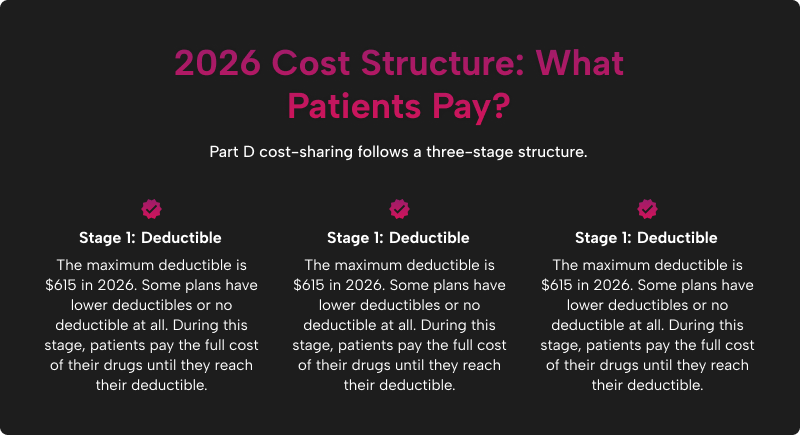
Part D cost-sharing follows a three-stage structure.
- Stage 1: Deductible. The maximum deductible is $615 in 2026. Some plans have lower deductibles or no deductible at all. During this stage, patients pay the full cost of their drugs until they reach their deductible.
- Stage 2: Initial Coverage. After the deductible is met, patients pay 25% coinsurance for covered drugs. This continues until their total out-of-pocket spending reaches $2,100 in 2026. Spending that counts toward this limit includes not only what the patient pays directly but also certain payments made on their behalf, such as through the Extra Help program.
- Stage 3: Catastrophic Coverage. Once a patient hits $2,100 in out-of-pocket costs, they automatically enter catastrophic coverage. From that point on, they pay nothing for covered Part D drugs for the rest of the calendar year.
Premiums and the Late Enrollment Penalty
The 2026 national base beneficiary premium is $38.99. This figure is used to calculate late-enrollment penalties and income-related adjustments. The average monthly premium for a stand-alone Part D plan is about $34.5. However, plan costs vary significantly depending on location and plan type.
The late enrollment penalty can be a shock for patients who delay enrollment. It is calculated as: 1% × $38.99 × the number of full, uncovered months the patient was eligible but did not enroll. This penalty amount is rounded to the nearest $0.10 and permanently added to the monthly premium.
Insulin Cost Cap
Part D plans are required to cap insulin costs at $35 per month per prescription. For a 90-day supply, the cost cannot exceed $105. Insulin is also exempt from the deductible.
Extra Help Program
The Extra Help program (Low-Income Subsidy) was expanded for 2026. Individuals earning less than 150% of the federal poverty level may qualify, paying no more than $5.10 per generic drug and $12.65 per brand-name drug.
What Changed for 2026?
The $2,100 Out-of-Pocket Cap
The most significant change for 2026 is the out-of-pocket spending cap of $2,10. Once a patient’s total out-of-pocket costs for covered drugs reach this amount in a calendar year, they enter catastrophic coverage and pay nothing for the rest of the year.
This represents a substantial shift from prior years. Previously, patients could face unlimited out-of-pocket costs in the catastrophic phase with 5% coinsurance on extremely expensive drugs.
Coinsurance on Higher Tiers
Some plans have shifted from fixed copays to coinsurance for Tier 3 and Tier 4 drugs. Patients now pay a percentage of the drug cost rather than a flat dollar amount for these tiers.
This can increase costs for expensive brand-name drugs but can also lower costs for cheaper ones.
Formulary Changes
Plans update their formularies each year.
UnitedHealthcare announced several formulary changes effective January 2026, including replacing some brand-name drugs with biosimilars and generics.
Providers should check specific plan formularies annually.
Provider Takeaways
Know the Difference Between Part B and Part D Coverage
Some drugs can be covered under either Part B or Part D, depending on how they are administered and why. Determining the correct coverage pathway is essential for claims processing.
Assist with Prior Authorizations
Prior authorizations are common for expensive and specialty drugs. Providers may need to submit supporting documentation demonstrating the drug’s medical necessity. Having this documentation ready can significantly speed up the approval process.
Watch for Step Therapy Requirements
If a patient’s preferred drug requires step therapy, you may need to document that the patient has tried and failed the required alternatives. Keeping clear records of previous treatment failures can be valuable.
Consider Cost When Prescribing
Tier placement directly affects patient costs.
Using lower-tier drugs when clinically appropriate can reduce patients’ out-of-pocket expenses and minimize the need for exception requests.
Document Everything
Exception requests require supporting documentation.
Clearly document the medical rationale for the specific drug, especially when it is not on the formulary or is subject to restrictions.
Conclusion
Medicare Part D covers outpatient prescription drugs through private plans, each with its own formulary and cost structure.
Certain drug categories are excluded by law, and utilization management tools like prior authorization, step therapy, and quantity limits are common.
For 2026, the out-of-pocket spending cap is $2,100, the maximum deductible is $615, and insulin is capped at $35 per month.
Plans are shifting toward coinsurance on higher tiers, which can increase costs for some patients and decrease them for others.
When a medication is not covered, patients can request exceptions.
When prior authorization is required, documentation of medical necessity is critical. When step therapy applies, previous treatment failures must be documented.
Medicare Part D is a complex program, but knowing its structure and rules makes it easier to help patients access the medications they need.
