Accurate coding for stroke, transient ischemic attacks (TIA), and stroke-like symptoms is critical for proper reimbursement, regulatory compliance, and quality reporting. Misclassification can delay payments, increase denials, and even trigger audits under the False Claims Act. For fiscal year 2026, understanding the nuances of ICD-10 coding is more important than ever for neurologists, emergency departments, urgent care clinics, and primary care providers.
Following the official ICD-10 stroke coding guidelines for FY 2026 ensures accurate cerebral infarction coding, proper DRG assignment, and risk-adjusted reimbursement under Medicare and commercial payer policies.
This guide walks you through TIA, ischemic stroke, stroke-like symptoms, documentation requirements, sequencing, and billing considerations, ensuring clarity for both coders and providers.
When to Use G45 vs I63 vs R Codes
One of the most common coding errors is misclassifying stroke-like symptoms as TIA or coding confirmed infarction as a symptom-only condition.
Use:
- G45.x when symptoms resolve within 24 hours and no infarction is confirmed.
- I63.x when imaging confirms cerebral infarction.
- R codes when the diagnosis is not established or workup is pending.
Correct code selection directly impacts DRG assignment, reimbursement, and quality reporting.
ICD-10 Codes for Stroke-Like Symptoms
Correct coding starts with distinguishing between TIA, stroke, and stroke-like symptoms. While these terms may seem similar clinically, they have distinct ICD-10 categories and documentation requirements.
A Transient Ischemic Attack (TIA) is a transient neurological deficit that resolves entirely within 24 hours and shows no infarction on imaging, such as MRI or CT. The ICD-10 category for TIA is G45, and coding should reflect the specific vascular territory whenever possible, such as carotid or vertebrobasilar artery syndromes. The most commonly reported TIA ICD-10 code in outpatient settings is G45.9; however, using more specific G45 subcategories improves coding accuracy and supports payer documentation requirements.
An Acute Ischemic Stroke involves a persistent neurological deficit with confirmed infarction visible on imaging. The correct ICD-10 code falls under I63. Documentation must include the vascular territory affected, laterality (right or left hemisphere), and, if known, etiology (thrombotic, embolic, or lacunar). Symptoms that persist beyond 24 hours are never coded as TIA.
Stroke-like symptoms, on the other hand, describe patients with neurological complaints where neither TIA nor stroke is confirmed. These cases use R codes, such as R29 for general neurological signs, R41 for cognitive symptoms, or R47 for speech and language disturbances. These codes are only appropriate when the workup is inconclusive or an alternative diagnosis explains the symptoms, such as migraine or seizure.
Proper classification under ICD-10 depends on distinguishing between confirmed cerebral infarction, transient ischemic attack (TIA), and non-specific neurological symptoms. Misclassification can directly impact MS-DRG grouping and stroke-related reimbursement.
TIA vs. Stroke vs. Stroke-Like Symptoms
Understanding the difference between TIA, acute ischemic stroke, and stroke-like symptoms is the foundation of accurate coding.
| Condition | Clinical Definition | Primary ICD-10 Category | Key Documentation Requirement |
| TIA | Transient neurological deficit with complete resolution within 24 hours and no infarction on imaging | G45 (Transient cerebral ischemic attacks) | Symptoms resolved completely; no evidence of infarction on MRI/CT |
| Acute Ischemic Stroke | Persistent neurological deficit with confirmed infarction on imaging | I63 (Cerebral infarction) | Radiological evidence of infarction; symptoms persist beyond 24 hours |
| Stroke-Like Symptoms (Unconfirmed) | Neurological symptoms without a confirmed diagnosis of TIA or stroke | R codes (Symptoms/signs) | No definitive diagnosis; workup pending/inconclusive |
Coding Rule:
- Never code TIA (G45) if imaging confirms infarction. Use I63 for confirmed strokes.
- Never code I63 if symptoms resolve within 24 hours with no infarction; in that case, use G45.
ICD-10 Codes for Transient Ischemic Attack (TIA)
TIA coding is based on clinical presentation rather than imaging confirmation. Codes should reflect the vascular territory when documented.
| Code | Description | When to Use |
| G45.0 | Vertebro-basilar artery syndrome | TIA with vertebrobasilar territory symptoms (e.g., diplopia, ataxia, bilateral weakness) |
| G45.1 | Carotid artery syndrome (hemispheric) | TIA with unilateral symptoms suggesting carotid involvement |
| G45.2 | Multiple and bilateral precerebral artery syndromes | TIA affecting multiple vascular territories |
| G45.3 | Amaurosis fugax | Transient monocular vision loss |
| G45.4 | Transient global amnesia | Not a true TIA; vascular etiology unproven |
| G45.8 | Other transient cerebral ischemic attacks | Specific TIA not elsewhere classified |
| G45.9 | Transient cerebral ischemic attack, unspecified | Most common when the vascular territory is not documented |
TIA Coding Guidelines:
- Symptoms must resolve completely within 24 hours.
- Use Z86.73 for follow-up visits without residual deficits.
- Avoid using G45 for follow-up encounters after acute TIA resolution.
Primary ICD-10 Codes for Stroke (Cerebral Infarction)
Acute ischemic stroke requires radiological confirmation of infarction. Accurate cerebral infarction coding under I63 directly affects MS-DRG 061–063 grouping in inpatient settings and influences HCC risk adjustment in Medicare Advantage plans.
| Code Range | Description | Key Documentation Required |
| I63.0-I63.2 | Infarction due to thrombosis | Specify artery (e.g., middle cerebral, anterior cerebral) |
| I63.3-I63.5 | Infarction due to embolism | Document embolic source if known (e.g., cardioembolic) |
| I63.6 | Infarction due to venous thrombosis | Cerebral venous sinus thrombosis |
| I63.8 | Other cerebral infarction | Specific infarction type not elsewhere classified |
| I63.9 | Cerebral infarction, unspecified | Only when documentation lacks specificity |
Additional Stroke Codes:
- I64: Stroke not specified as hemorrhage or infarction (rare, only when imaging unavailable).
- Hemorrhagic Stroke: I60 (subarachnoid), I61 (intracerebral), I62 (other nontraumatic intracranial hemorrhage).
Do not code I63 based solely on symptoms; imaging confirmation is required.
Stroke-Like Symptoms Without Confirmed Diagnosis
When neurological symptoms are present, but a TIA or stroke is unconfirmed, R codes are appropriate:
| Symptom Category | ICD-10 Code Range | Examples |
| Neurological signs | R29.8 | R29.810 (Facial weakness), R29.818 (Other neurological signs) |
| Cognitive symptoms | R41 | R41.0 (Disorientation), R41.89 (Other cognitive symptoms) |
| Speech/language | R47 | R47.01 (Dysphasia), R47.02 (Dysarthria) |
| Altered consciousness | R40 | R40.0-R40.4 (Somnolence, stupor, coma) |
| Dizziness/giddiness | R42 | Vertigo, lightheadedness |
Usage Rule: R codes are valid when:
- Workup is pending or inconclusive
- An alternative diagnosis explains the symptoms
- Symptoms resolve without evidence of a vascular event
Sequencing Rules & Comorbidities
Principal Diagnosis Selection Examples:
| Scenario | Principal Diagnosis | Additional Codes |
| Acute TIA with hypertension | G45.9 | I10 |
| Acute ischemic stroke with atrial fibrillation | I63.x | I48.91 |
| TIA due to carotid stenosis | G45.1 | I65.21 |
| Stroke with diabetes | I63.x | E11.9 |
NIH Stroke Scale (NIHSS) Codes – R29.7 Series:
- R29.70: NIHSS score 0-9
- R29.71: NIHSS score 10-19
- R29.72: NIHSS score 20-30
- R29.73: NIHSS score 31-42
- R29.79: Other NIHSS scores
NIH Stroke Scale (NIHSS) coding plays a critical role in Centers for Medicare & Medicaid Services (CMS) quality reporting measures and supports accurate stroke severity documentation for reimbursement analysis.
Laterality:
- Right-sided symptoms default to the dominant hemisphere unless documented otherwise.
- Left-sided symptoms default to the non-dominant hemisphere unless specified.
Personal History & Sequelae
| Code | Description | When to Use |
| Z86.73 | Personal history of TIA/cerebral infarction without residual deficits | Follow-up visits after complete recovery |
| I69.3xx | Sequelae of cerebral infarction | Persistent deficits (e.g., hemiplegia, aphasia) |
| Z86.71 | History of pulmonary embolism/venous thrombosis | Not for stroke history |
Documentation Requirements for Accurate TIA and Stroke Coding
Accurate documentation is the backbone of both correct coding and reimbursement. Without it, claims are prone to denials, underpayments, or compliance issues. Each type of neurological event—TIA, ischemic stroke, or stroke-like symptoms—has distinct documentation requirements:
TIA Documentation
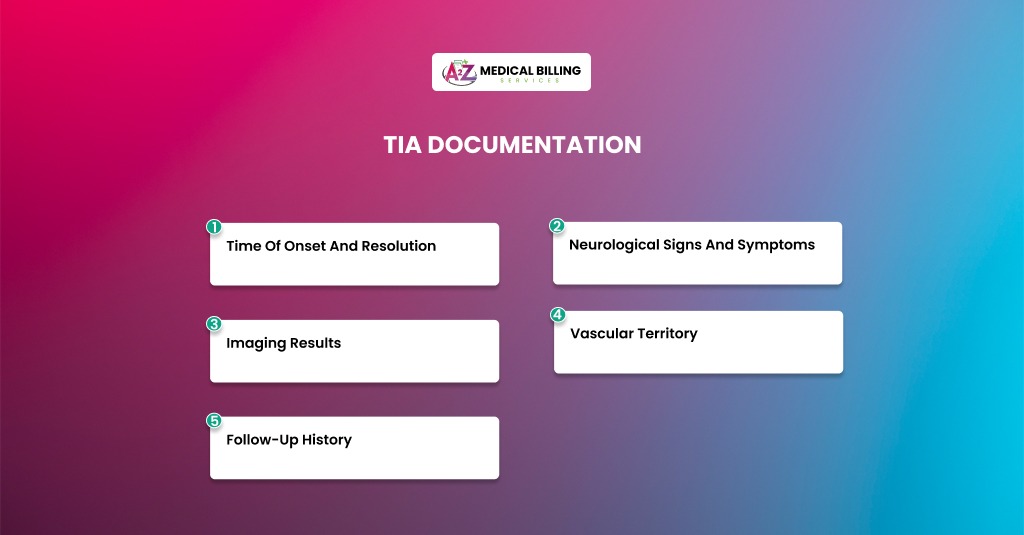
For transient ischemic attacks coded under G45, providers must document:
- Time of onset and resolution: TIA symptoms must resolve completely within 24 hours. Document the exact start and end times of symptoms.
- Neurological signs and symptoms: Specify deficits, such as facial droop, limb weakness, speech disturbance, visual changes, or coordination issues.
- Imaging results: Document that MRI or CT shows no evidence of infarction. While imaging is not required for the diagnosis, it supports documentation and helps avoid miscoding.
- Vascular territory: Indicate whether symptoms are carotid, vertebrobasilar, or unspecified. This allows for more specific G45 codes (G45.0–G45.3) instead of G45.9.
- Follow-up history: For visits after complete resolution, note that there are no residual deficits. Use Z86.73 for the history of TIA.
Acute Ischemic Stroke Documentation
For cerebral infarction coded under I63, documentation must be more detailed:
- Imaging confirmation: MRI (diffusion-weighted imaging) or CT scan showing infarction is mandatory.
- Vascular territory: Document which artery is affected (e.g., middle cerebral, anterior cerebral).
- Laterality: Specify whether symptoms affect the right or left hemisphere; indicate dominance when possible.
- Etiology: Identify thrombotic, embolic, or lacunar origin if known.
- NIH Stroke Scale (NIHSS): Record the NIHSS score for quality reporting, sequence it after the I63 diagnosis.
- Comorbidities: Hypertension, diabetes, atrial fibrillation, or carotid stenosis should be coded concurrently if present.
Stroke-Like Symptoms (R Codes)
For patients with unresolved or inconclusive neurological symptoms:
- Document exact symptoms: dizziness, vertigo, cognitive changes, speech disturbance, or altered consciousness.
- Include the reason that stroke/TIA was ruled out or that the workup is pending.
- Note any alternative diagnosis, such as seizure or migraine.
- Avoid using these codes if a vascular event is later confirmed.
Documentation drives coding accuracy. Always encourage providers to record symptom onset, resolution, vascular territory, laterality, imaging results, and comorbid conditions. Accurate notes reduce denials and ensure proper reimbursement.
DRG and Risk Adjustment Impact of Stroke Coding
Accurate ICD-10 coding for stroke significantly affects hospital reimbursement under MS-DRG systems.
For inpatient admissions:
- I63 codes often group into MS-DRG 061–063 (Ischemic Stroke)
- Comorbidities such as atrial fibrillation, diabetes, or hypertension may qualify as CC/MCC
- Incorrect use of G45 instead of I63 can shift DRG assignment and reduce reimbursement
In Medicare Advantage plans:
- Stroke diagnoses impact Hierarchical Condition Categories (HCC)
- Accurate coding improves risk-adjusted reimbursement
Precise documentation supports appropriate DRG grouping and protects revenue integrity.
Reimbursement Considerations
Reimbursement for TIA, stroke, and stroke-like symptoms depends on coding accuracy, payer rules, and the patient’s clinical setting. Under the Inpatient Prospective Payment System (IPPS), stroke admissions are reimbursed based on MS-DRG assignment.
Key Factors Affecting Reimbursement:
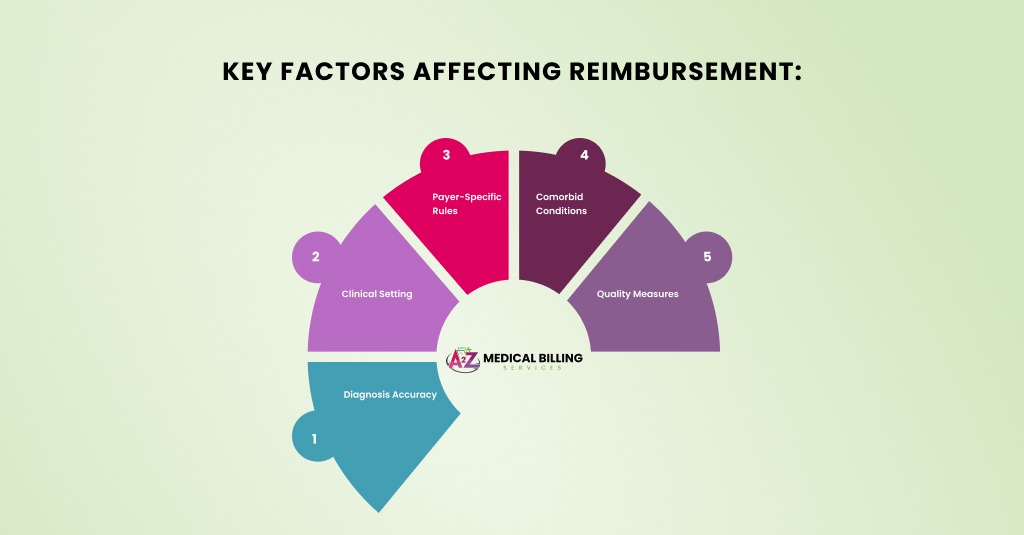
- Diagnosis Accuracy: Coding TIA as I63 or vice versa can lead to claim denials or underpayment. Payers expect ICD-10 codes to match documentation and imaging. In hospital-based billing, incorrect stroke ICD-10 coding can alter MS-DRG assignment, reduce reimbursement rates, and increase audit exposure under Medicare administrative contractor (MAC) review.
- Clinical Setting:
- ED visits: TIA patients are often billed using observation codes with G45 codes.
- Inpatient admission: Acute ischemic strokes with confirmed infarction typically require inpatient admission using I63 codes.
- Payer-Specific Rules: Medicare, Medicaid, and commercial payers have slightly different requirements for coding, modifiers, and observation vs. inpatient status.
- Comorbid Conditions: Reporting coexisting conditions like hypertension, diabetes, or atrial fibrillation can impact risk adjustment in Medicare Advantage plans.
- Quality Measures: NIHSS documentation and correct I63 coding affect CMS Stroke Mortality Measures (MORT-3) and other quality reporting requirements.
Accurate coding and proper sequencing ensure faster claim approval, reduce denials, and maximize reimbursement for both hospital-based and outpatient practices.
Step-by-Step Billing Process for TIA and Stroke
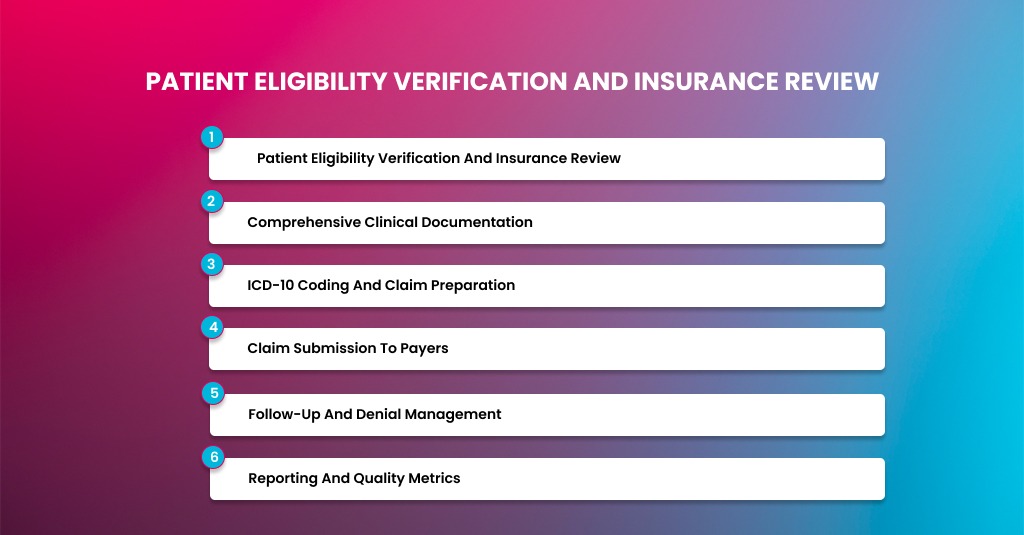
Efficient billing for stroke, TIA, and stroke-like symptoms is more than just submitting claims. The process must ensure accurate coding, proper documentation, payer compliance, and timely reimbursement. A structured workflow helps practices reduce denials, improve accounts receivable, and optimize revenue while maintaining regulatory compliance.
Here’s a step-by-step overview of how the billing process works for these neurological conditions:
1. Patient Eligibility Verification and Insurance Review
Before any services are billed, it’s crucial to confirm patient coverage.
- Verify active insurance, including Medicare, Medicaid, and commercial payers.
- Check whether pre-authorization or observation vs. inpatient admission requirements apply.
- Document any payer-specific rules to avoid rejected claims.
- Ensure the patient’s benefits cover stroke-related evaluations, imaging, and follow-up care.
2. Comprehensive Clinical Documentation
Accurate documentation is the foundation of correct coding and reimbursement.
- Record exact symptom onset, type, and duration (TIA must resolve within 24 hours).
- Specify the vascular territory affected and laterality (right, left, or dominant hemisphere).
- Include imaging results for stroke confirmation (MRI or CT) and relevant comorbidities.
- Document NIHSS scores for acute stroke patients for quality reporting purposes.
3. ICD-10 Coding and Claim Preparation
Correct coding ensures claims are processed smoothly and reimbursed accurately.
- Assign ICD-10 codes based on documentation: G45.x for TIA, I63.x for confirmed stroke, and R codes for unconfirmed stroke-like symptoms.
- Include comorbidities, such as hypertension, diabetes, or atrial fibrillation, for risk adjustment and accurate reimbursement.
- Apply appropriate CPT/E/M codes for the service type and care setting.
- Ensure modifier usage is correct, e.g., -25 for a significant, separately identifiable E/M service.
4. Claim Submission to Payers
Submitting clean claims is critical for avoiding denials or delays.
- Submit electronically whenever possible to speed processing.
- Include all supporting documentation, especially imaging reports for stroke and TIA claims.
- Ensure the claim complies with payer-specific rules, including observation versus inpatient codes.
- Monitor for immediate rejections or errors at the time of submission.
5. Follow-Up and Denial Management
Proactive follow-up ensures claims are paid accurately and promptly.
- Track claims until payment is received and review aging accounts receivable regularly.
- Address denials promptly by identifying whether they are due to coding errors, documentation gaps, or payer requirements.
- Query providers if clarification is needed for more specific coding or missing documentation.
- Maintain detailed reports on denial trends and reimbursement rates to improve future billing accuracy.
6. Reporting and Quality Metrics
Regular reporting helps practices understand revenue performance and maintain compliance.
- Generate collections, AR aging, and payer performance reports.
- Ensure NIHSS scores and stroke coding comply with CMS Stroke Mortality (MORT-3) quality measures.
- Use reporting data to optimize workflows, reduce denials, and improve cash flow.
Common ICD-10 Coding Errors for Stroke and TIA
- Coding TIA (G45) when imaging confirms infarction
- Using I63 without documented radiological confirmation
- Failing to document laterality
- Not coding NIHSS scores
- Omitting comorbid atrial fibrillation
- Using I64 when imaging results are available
- Not coding sequelae (I69) for residual deficits
Avoiding these errors reduces denials and audit risk.
Risk Adjustment and HCC Considerations for Stroke Coding
In Medicare Advantage and value-based care models, stroke diagnoses contribute to Hierarchical Condition Category (HCC) risk adjustment scoring. Accurate reporting of I63 codes and related comorbidities ensures appropriate risk-adjusted reimbursement and prevents revenue loss due to undercoding. Stroke diagnoses contribute to Hierarchical Condition Categories (HCC) under Medicare Advantage risk adjustment models.
Final Thoughts
Stroke and TIA coding requires close attention to detail, precise documentation, and an understanding of payer rules. Key points to remember:
- Distinguish clearly between TIA, acute ischemic stroke, and stroke-like symptoms.
- Use the correct ICD-10 codes: G45 for TIA, I63 for confirmed stroke, and R codes for unconfirmed symptoms.
- Document symptom onset, duration, vascular territory, laterality, imaging findings, NIHSS scores, and comorbidities.
- Follow a structured billing process from eligibility verification to claim follow-up.
- Accurate coding improves reimbursement, reduces denials, supports quality reporting, and ensures regulatory compliance.
By combining meticulous documentation, proper coding, and proactive billing workflows, practices can confidently manage stroke-related claims, optimize revenue, and provide the highest level of care without financial disruption.
Optimize Stroke & TIA Claims with Expert Medical Billing Services
Accurate ICD-10 coding for stroke, TIA, and stroke-like symptoms directly impacts DRG assignment, HCC risk adjustment, and reimbursement outcomes. Even minor documentation or sequencing errors can reduce payment or trigger payer scrutiny.
At A2Z Medical Billing Services, we deliver specialized medical billing services for neurology practices, emergency departments, and hospital-based providers, including:
- Advanced ICD-10 stroke and TIA coding review
- MS-DRG optimization and reimbursement analysis
- HCC risk adjustment validation
- Denial prevention and appeals management
- End-to-end revenue cycle management services
Our certified billing and medical coding experts ensure your stroke-related claims are compliant, properly sequenced, and fully supported by documentation — before submission.
If your organization handles acute stroke or TIA cases, your revenue integrity depends on precision coding and proactive billing oversight.
Partner with A2Z Medical Billing Services to strengthen your stroke revenue cycle today.