

CPT Code 90791 plays an important role in behavioral health billing, but therapists cannot use it simply because they meet a patient for the first time.
The code represents a psychiatric diagnostic evaluation without medical services. The provider performs a comprehensive evaluation to understand the patient’s mental health concerns, establish a diagnostic impression, and develop an appropriate treatment plan.
For therapists and other behavioral health professionals, accurate use of CPT 90791 starts with one basic rule:
Code the service you actually provided and document the clinical work that supports it.
A new patient appointment does not automatically qualify for 90791. The provider must perform a qualifying psychiatric diagnostic evaluation, and the documentation must support medical necessity.
This guide explains how therapists can use CPT 90791, what to document, how billing works, common mistakes, reimbursement considerations, telehealth issue s, and practical steps that can help reduce claim problems.
What Is CPT Code 90791?
CPT 90791 describes a psychiatric diagnostic evaluation without medical services.
The service involves a comprehensive assessment of the patient’s behavioral health needs.
Depending on the patient’s situation, the evaluation may cover:
- The patient’s main reason for seeking treatment and current concerns.
- Presenting symptoms and their impact on daily functioning.
- Relevant psychiatric and treatment history.
- Medical history that affects behavioral health care.
- Current medications and previous medication experiences when clinically relevant.
- Family and social history.
- Substance use history when appropriate.
- Trauma history when clinically relevant and appropriate to assess.
- Mental status findings.
- Psychosocial factors.
- Safety and risk factors when clinically indicated.
- Previous therapy and treatment outcomes.
- Diagnostic considerations.
- Treatment recommendations.
- Initial treatment planning.
The provider uses the information from the evaluation to develop a clinical understanding of the patient’s condition and determine appropriate treatment.
The code does not represent a routine psychotherapy session.
That distinction matters.
A therapist who performs an initial comprehensive diagnostic evaluation may report 90791 when the service meets the applicable requirements. A therapist who provides ongoing individual psychotherapy generally reports an appropriate psychotherapy code, such as 90832, 90834, or 90837, based on the service and applicable time requirements.
Who Can Bill CPT 90791?
The answer depends on the provider’s professional credentials, state law, payer policy, and enrollment status.
Depending on the payer and applicable rules, professionals who may report psychiatric diagnostic evaluation services can include qualified behavioral health providers such as:
- Psychologists.
- Licensed clinical social workers.
- Licensed professional counselors, where the payer and state rules allow.
- Other qualified mental health professionals who meet applicable requirements.
Psychiatrists and other medical professionals may also perform psychiatric diagnostic evaluations, but the applicable code may differ when the provider includes medical services.
Before billing 90791, therapists should verify:
- Their state scope of practice.
- Their professional license.
- Their payer enrollment.
- Their credentialing status.
- Their network participation.
- The payer’s eligible provider list.
- The patient’s behavioral health benefits.
- Any authorization requirements.
A therapist may have the clinical skills to perform an evaluation but still face reimbursement problems if the payer does not recognize the provider type for the service.
When Should a Therapist Use CPT 90791?
A therapist should consider CPT 90791 when the encounter involves a comprehensive psychiatric diagnostic evaluation that meets the code requirements.
For example, a patient contacts a behavioral health practice because of persistent anxiety, sleep problems, difficulty concentrating, and worsening work performance.
During the initial appointment, the therapist:
- Explores the patient’s current symptoms.
- Reviews relevant psychiatric history.
- Discusses previous treatment.
- Assesses psychosocial circumstances.
- Reviews relevant medical information.
- Evaluates functional impairment.
- Performs a mental status assessment.
- Considers potential diagnoses.
- Evaluates risk when clinically indicated.
- Develops an initial treatment plan.
If the service meets the applicable CPT definition and the therapist has the appropriate credentials and payer eligibility, 90791 may represent the encounter.
The key point involves the scope and purpose of the service.
The therapist must perform a diagnostic evaluation rather than simply conduct a standard therapy session.
When Should a Therapist Not Use CPT 90791?
Therapists should not report 90791 just because:
- The patient is new to the practice.
- The patient has never seen that therapist before.
- The appointment lasted a long time.
- The therapist completed a standard intake form.
- The therapist wants to receive a higher reimbursement.
- The payer reimburses 90791 at a higher rate than psychotherapy.
- The therapist updates a treatment plan during a routine therapy session.
The provider should select the code based on the actual service.
For example, suppose a therapist meets a returning patient for a regular psychotherapy session and updates the treatment plan.
That situation does not automatically justify another 90791.
The therapist should report the appropriate psychotherapy service unless the encounter meets the requirements for a new or additional psychiatric diagnostic evaluation and the payer allows the service.
Does CPT 90791 Require a New Patient?
Not necessarily.
Many practices associate 90791 with the first visit, and providers often use it during an initial behavioral health evaluation.
However, the CPT code itself does not simply mean “new patient intake.”
The provider must perform the qualifying psychiatric diagnostic evaluation.
A patient may also require another comprehensive evaluation when the clinical situation changes significantly or when the provider needs to reassess the patient’s condition.
However, practices should not routinely report 90791 at every initial appointment or periodically without clinical justification.
Payers may also apply frequency limits or other coverage policies.
Always verify the payer’s current requirements.
Does CPT 90791 Have a Time Requirement?
CPT 90791 does not specify a fixed time range in the code descriptor.
That means providers should not select the code based solely on the number of minutes spent with the patient.
For example, a 90-minute appointment does not automatically qualify for 90791.
Likewise, a shorter appointment does not automatically disqualify the service if the provider performs a qualifying evaluation and meets the applicable requirements.
The provider should focus on the nature and scope of the service.
The documentation should demonstrate that the provider performed a psychiatric diagnostic evaluation and gathered enough relevant information to support the clinical assessment and treatment plan.
CPT 90791 Documentation Requirements for Therapists
Strong documentation supports accurate billing and helps demonstrate medical necessity.

The exact documentation requirements vary by payer and practice setting, but a comprehensive evaluation may include the following components.
Reason for the Evaluation
Start by explaining why the patient sought behavioral health care.
For example:
The patient reports persistent anxiety and difficulty sleeping following a recent job loss. The symptoms interfere with daily activities and work related functioning.
This information establishes the clinical reason for the evaluation.
Presenting Problems
Document the patient’s main symptoms and concerns.
Depending on the situation, this may include:
- Anxiety.
- Depression.
- Panic symptoms.
- Sleep problems.
- Irritability.
- Difficulty concentrating.
- Trauma related symptoms.
- Grief.
- Relationship problems.
- Behavioral concerns.
- Changes in daily functioning.
Focus on clinically relevant information rather than filling the note with unnecessary details.
Relevant Psychiatric History
Document relevant previous behavioral health treatment.
This may include:
- Previous diagnoses.
- Prior therapy.
- Psychiatric hospitalization.
- Previous treatment response.
- Previous suicide attempts when clinically relevant.
- History of self-harm when clinically relevant.
- Previous behavioral health medications.
The provider should document information that affects the current evaluation.
Medical History
Include relevant medical information when it affects behavioral health assessment or treatment.
For example, a chronic medical condition may contribute to depression or anxiety.
The provider does not need to document unrelated medical details simply to make the note longer.
Social and Family History
The provider may document relevant information about:
- Family relationships.
- Living situation.
- Employment.
- Education.
- Social support.
- Financial stressors.
- Legal issues when clinically relevant.
- Significant life events.
- Cultural factors that affect treatment.
The provider should include information that helps explain the patient’s current condition.
Substance Use History
When clinically appropriate, the therapist should assess and document substance use.
This may include:
- Alcohol use.
- Tobacco or nicotine use.
- Prescription medication misuse.
- Recreational drug use.
- Previous substance use treatment.
The provider should document only clinically relevant information and follow appropriate privacy and confidentiality requirements.
Mental Status Examination
The mental status examination provides information about the patient’s current psychological functioning.
Depending on the clinical situation, the provider may assess:
- Appearance.
- Behavior.
- Speech.
- Mood.
- Affect.
- Thought process.
- Thought content.
- Perception.
- Orientation.
- Attention.
- Memory.
- Insight.
- Judgment.
The provider should document the findings that matter to the patient’s clinical presentation.
Avoid copying the same mental status examination into every note when the patient’s presentation changes.
Risk Assessment
The provider should assess safety risks when clinically indicated.
Depending on the patient, this may include evaluation of:
- Suicidal thoughts.
- Homicidal thoughts.
- Self harm.
- Psychosis.
- Abuse or neglect.
- Other immediate safety concerns.
The provider should document the assessment and the clinical response when risk factors exist.
If the patient presents a safety concern, the record should explain the provider’s clinical decision making and intervention.
Diagnostic Impression
The provider should document the diagnostic impression based on the evaluation.
The provider may identify:
- A confirmed diagnosis.
- A provisional diagnosis.
- Differential diagnostic considerations.
- Conditions that require further evaluation.
The diagnosis should match the clinical findings and support the treatment plan.
Treatment Plan
The treatment plan should explain what happens next.
Depending on the patient’s needs, the plan may include:
- Individual psychotherapy.
- Family therapy.
- Group therapy.
- Referral to psychiatry.
- Medication evaluation.
- Additional assessment.
- Coordination with other providers.
- Safety planning.
- Follow up schedule.
The plan should connect directly to the problems identified during the evaluation.
CPT 90791 and Medical Necessity
Medical necessity plays a major role in behavioral health reimbursement.
A payer may deny a claim when the documentation does not demonstrate why the patient needed the service.
The diagnosis code alone does not automatically prove medical necessity.
For example, listing “anxiety disorder” without documenting symptoms, functional impact, clinical findings, and the reason for the evaluation may not adequately support the claim.
A stronger record connects the patient’s condition to the service.
For example:
The patient reports daily panic episodes that interfere with work attendance and social functioning. The therapist completed a comprehensive psychiatric diagnostic evaluation to assess symptom severity, identify contributing factors, establish a diagnostic impression, and develop an appropriate treatment plan.
This type of documentation gives the payer a clearer understanding of the service.
CPT 90791 vs Psychotherapy Codes
One of the most common billing questions involves choosing between 90791 and psychotherapy codes.
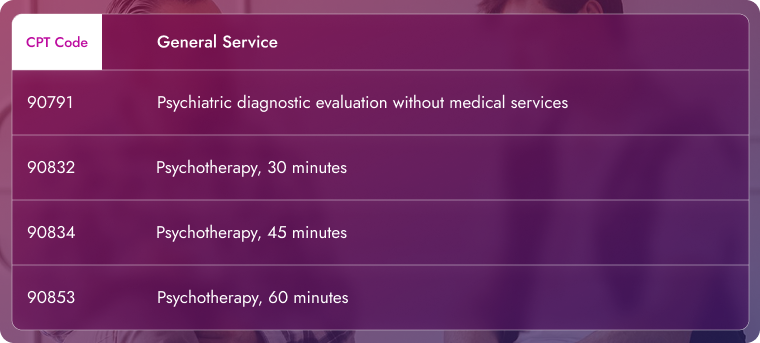
The provider should choose the code that matches the service performed.
Example
A therapist conducts an initial comprehensive diagnostic evaluation, reviews the patient’s history, evaluates symptoms, develops a diagnostic impression, and creates a treatment plan.
Potential code: 90791
At the next appointment, the therapist provides individual psychotherapy focused on anxiety management and cognitive behavioral techniques.
Potential code: 90834 or 90837, depending on the service and applicable time requirements.
The provider should not report 90791 simply because the patient remains “new” to the therapist.
Can a Therapist Bill CPT 90791 and 90837 Together?
In general, providers should not assume that they can report 90791 and 90837 together for the same encounter.
The two codes describe different services.
If a provider performs a diagnostic evaluation and psychotherapy during the same encounter, the provider should review the current CPT guidance and the payer’s billing policy before reporting both.
Some payers may not reimburse both services on the same date.
Others may apply specific restrictions or documentation requirements.
The provider should never report both codes simply because the appointment lasted several hours.
The medical record must support each separately reported service, and the payer must allow the combination.
CPT 90791 Reimbursement
CPT 90791 reimbursement varies widely.
The payment depends on factors such as:
- Insurance company.
- Patient’s specific plan.
- Provider credentials.
- Provider specialty.
- Geographic location.
- Network status.
- Contracted reimbursement rate.
- Place of service.
- Telehealth status.
- Payer policy.
- Medical necessity.
- Authorization requirements.
A practice should not rely on a single reimbursement figure found online.
Instead, billing teams should verify the current payer fee schedule or contracted rate.
For example, a psychologist and a clinical social worker may receive different reimbursement depending on payer contracts and provider classification.
The same provider may also receive different payments from different insurance plans.
CPT 90791 Authorization Requirements
Some payers require prior authorization for behavioral health services.
Others may allow a limited number of visits without authorization.
Requirements can also depend on:
- Diagnosis.
- Provider type.
- Patient plan.
- Place of service.
- Inpatient or outpatient setting.
- Telehealth.
- State Medicaid rules.
Before providing services, the practice should verify:
Is the service covered?
Does the provider participate with the plan?
Does the plan require authorization?
Does the payer limit the frequency of 90791?
Does the plan require a referral?
Document the verification process in accordance with the practice’s policies.
Common CPT 90791 Billing Mistakes
Using 90791 for Every New Patient
A new patient does not automatically qualify for psychiatric diagnostic evaluation.
How to avoid it
Code the actual service provided and ensure that the documentation supports a comprehensive evaluation.
Billing 90791 for Routine Psychotherapy
A regular therapy session does not become a diagnostic evaluation simply because the therapist discusses the patient’s diagnosis.
How to avoid it
Use the appropriate psychotherapy code when the provider performs psychotherapy.
Using a Generic Intake Template
A template can help organize information, but copied documentation can create problems.
How to avoid it
Customize the evaluation to the patient’s actual symptoms, history, clinical findings, diagnosis, and treatment plan.
Failing to Document Medical Necessity
A diagnosis without supporting clinical information may not adequately justify the service.
How to avoid it
Explain the patient’s symptoms, functional impact, clinical findings, and reason for the evaluation.
Ignoring Provider Credentialing
A provider may perform an appropriate service but still face reimbursement problems if the payer does not recognize the provider for 90791.
How to avoid it
Verify payer enrollment and credentialing before submitting claims.
Ignoring Authorization Requirements
A claim may deny when the practice fails to obtain required authorization.
How to avoid it
Verify benefits and authorization requirements before the evaluation.
Billing the Same Service Twice
Some practices accidentally report the same clinical work under multiple codes.
How to avoid it
Review the documentation and ensure each reported code represents a distinct service that the payer allows.
How Therapists Can Improve CPT 90791 Billing
· Accurate billing starts before the claim reaches the payer.
· A quick eligibility and benefit check can prevent many billing surprises.
· Make sure the therapist has the correct credentialing and enrollment status.
· Front desk staff, clinicians, coders, and billers should understand what the code represents.
· Avoid copy and paste documentation that does not reflect the actual evaluation.
· Link Diagnosis to Treatment
· The diagnosis, clinical findings, and treatment plan should make sense together.
· If one payer repeatedly denies 90791 claims, investigate the pattern instead of treating each denial as an isolated issue.
· Review a sample of 90791 claims to identify coding and documentation problems.
· Compare actual payment with contracted rates and expected reimbursement.
Frequently Asked Questions
What is CPT 90791 used for?
CPT 90791 represents a psychiatric diagnostic evaluation without medical services. A qualified provider uses it when performing a comprehensive behavioral health evaluation that meets the applicable CPT requirements.
Can a therapist bill CPT 90791?
A therapist may bill 90791 when the provider’s credentials, state scope of practice, payer policy, and service requirements allow it.
Does CPT 90791 have a time requirement?
No specific time range appears in the CPT descriptor for 90791. Providers should report the code based on the nature of the qualifying diagnostic evaluation rather than appointment length alone.
Can I bill CPT 90791 for an established patient?
Potentially, yes, when the provider performs a qualifying psychiatric diagnostic evaluation and the payer allows the service. The provider should document why the evaluation was clinically necessary.
Can I bill CPT 90791 and 90837 on the same day?
Do not assume that you can. Review current CPT guidance and the payer’s policy. The documentation must support each service, and the payer must allow both services.
Can I bill CPT 90791 through telehealth?
Some payers cover 90791 through telehealth. Requirements vary by payer, state, and program. Verify current rules for place of service, modifiers, provider eligibility, and coverage.
How much does CPT 90791 reimburse?
There is no universal reimbursement amount. Payment depends on the payer, provider, location, contract, and other factors.
Concluding Remarks
CPT Code 90791 can help therapists and behavioral health practices accurately report comprehensive psychiatric diagnostic evaluations, but providers should use the code carefully.
The most important rule remains simple:
Do not bill 90791 because the patient is new. Bill it because the provider performed a qualifying psychiatric diagnostic evaluation and documented the service appropriately.
Strong billing practices start with accurate eligibility verification, clear documentation, correct diagnosis coding, proper provider credentialing, and attention to payer specific requirements.
When your clinical documentation clearly reflects the work you performed, your billing team has a stronger foundation for accurate claims and appropriate reimbursement.
Let A2Z Medical Billing Handle the Therapy Billing
Behavioral health providers already have enough on their plates. Managing patients, documenting care, handling insurance requirements, and chasing unpaid claims can quickly consume valuable time.
A2Z medical billing can support your practice with medical billing and revenue cycle services designed to help reduce administrative pressure and keep claims moving.
From eligibility verification and claim submission to denial management, payment posting, and accounts receivable follow up, your practice can get the billing support it needs while your team focuses on patient care.
Connect Our Therapy Billing Experts Now
