Blue Cross Blue Shield is not a single payer. It is a confederation of over 30 independent companies, each with its own claims address, its own rules for behavioral health, and often its very own third-party administrator dealing with mental well-being claims. Let’s read the A2Z Medical Billing guide on how to bill Blue Cross Blue Shield for mental health providers.
Why Blue Cross Blue Shield Isn’t One Payer
Blue Cross Blue Shield is a brand name used for more than three dozen independent, locally operated insurance companies, all of them separate legal entities with their own provider contracts 00 fee schedules, and claims systems. Billing BCBS correctly begins with knowing who you are really billing; a rule upheld at one plan, say Blue Cross Blue Shield of Illinois, does not carry over to another,r such as the California-based plan (Blue Shield).
This difference is more pronounced in behavioral health than just about any other care, as session limits, prior authorization lists, and carve-out arrangements are determined separately by each company. A practice that has in-network agreements with one BCBS plan is not automatically considered to be the same for a different state’s equivalent of that exact Blue Cross experience.
Two structures add further exceptions. The Federal Employee Program, or BCBS FEP, is a nationally standardized benefit for federal employees that a state plan does not automatically credential a provider to bill.
The BlueCard Program handles out-of-state patients differently: a claim is submitted to the local host plan where care was delivered, which routes it electronically to the patient’s home plan for pricing, so a practice never needs a separate contract with every BCBS company nationwide.
Credentialing and Network Participation Before You Bill
The rendering provider does not have to be a part of that BCBS plan’s network, but if they are not properly credentialed with them on the date of service, then it will still be denied even for a clinically appropriate and correctly coded claim. In-network claims pay at a contracted rate with a known, predictable patient copay, whereas out-of-network behavioral health claims receive slower and less reimbursement and additionally expose the patients to balance billing.
Credentialing data is sourced from CAQH ProView, with a 120-day re-attestation cycle for most BCBS plans. A stale profile can hold up claims even if the underlying contract is active, and a current CAQH profile still does not substitute for enrollment with individual plans. The effective date is a unique assignment based on the needs of each BCBS plan, and thus every rendering clinician will require an enrollment specific to that practice’s group NPI. Skipping that step for a newly hired clinician is one of the most common reasons a new hire’s claims are denied while the rest of the practice’s claims pay normally.
Plan type changes the billing path further. An out-of-network behavioral health benefit will be lower under a BCBS PPO, and an HMO must receive care in-network or through referral, while point-of-service plans lie somewhere in between. The BCBS Medicare Advantage plan essentially adds new coverage and provider-type rules over the top of the claims system for Base Plans, meaning a provider has to meet each respective set of requirements before billing.
Billing Under Supervision: Trainees and the NPI Rule
A claim has to be billed under the NPI of whoever actually rendered the service. The one recognized exception is a formal, documented supervisor-trainee relationship that meets the plan’s specific supervision standard, which several Health Care Service Corporation plans describe as direct and personal.
Billing a trainee’s session under a supervisor’s NPI without that documented relationship misrepresents who delivered the care, and it is exactly the pattern payers look for in behavioral health audits. Blue Cross Blue Shield of Illinois and Oklahoma are both proposing a future HL modifier to mark the services provided by trainees directly on the claim. While it is not a requirement yet and both plans have instructed providers to refrain from appending it before formal notice, bulletins like this often become an enforceable claim edit within 12-24 months.
The Behavioral Health Carve-Out Most Providers Miss
A patient’s BCBS card can list medical coverage clearly while mental health claims process somewhere else entirely. The card sometimes names the administrator directly, usually in small print near the mental health benefit line. Carved-out claims require a separate payer ID, usually need to be credentialed independently of the medical network, and often have an entirely different standard for prior authorization since the administrator establishes its own utilization-management criteria.
Verifying Mental Health Benefits Before the First Session
The standard eligibility check can verify that coverage is active, but does not identify the actual benefit for mental health. In contrast, certain BCBS plans limit therapy sessions covered in a benefit year without state law or the plan governing provisions to protect employees (often at an employer-group level rather than by plan), so that two patients with similar policies covering them may have differing limits simply due to their employment with different companies. Cost-share may also differ from medical benefits on the same policy; certain plans will impose a flat therapy copay regardless of deductible status.
Finally, there is an additional element with telehealth; BCBS plans in many states are required to reimburse those licensed within their borders for parity coverage of telehealth mental health visits or else pay no less than what it would have cost had a visit been done face-to-face (with the exception that if none exists, they can pay some reduced method according to how strongly mandated). Because parity is set at the state level while plan policy is set by the company, both have to be confirmed together rather than assumed from general billing knowledge.
CPT Codes and Modifiers for Mental Health Claims
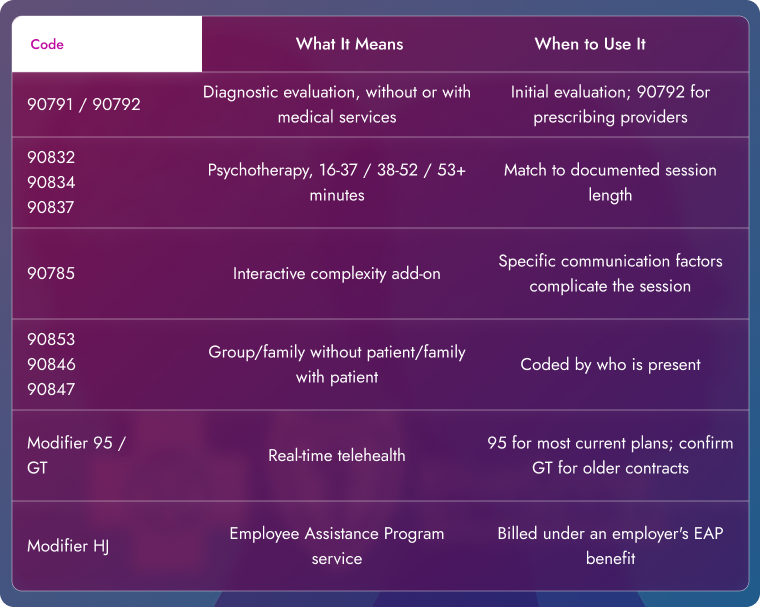
CPT 90791 is for a diagnostic evaluation without medical services; CPT 90792 carries with it the additional expense of prescribing providers. The majority of the plans allow one per episode, and that is why a second 90791 without an identifiable clinical reason often raises red flags.
Psychotherapy codes are time-based: 90832 for 16-37 mins, 90834 for 38-52 mins, and 90637, the final Gantz move code, covers face-to-face in minutes or longer; whoever takes a scheduled slot that the doc has to be matched with face-to-face. The ratio of direct factor hours is not square!
CPT codes 90833, 90836, and 90838 are add-on codes that accompany an E/M code for shared medical management (i.e., psychotherapy), whereas interactive complexity CPT is 90785, only used once or if certain complicating factors such as presence of an interpreter or disruptive interaction are present. Code 90853 is billed as a group code per patient present, whereas for family codes (often coded separately from individual therapy), attendance of the identified patient determines whether it can be treated using that code.
Modifier 95 identifies real-time telehealth and is what most BCBS plans currently require, though some Medicaid managed care and older contracts still use GT. Employee Assistance Program sessions, billed with modifier HJ, are typically covered outside the regular mental health benefit for a limited number of visits set by the employer’s EAP contract, usually between three and ten, after which billing shifts to the standard benefit.
Prior Authorization for Behavioral Health Services
Prior authorization is typically not required for routine outpatient therapy. For treatment continuing beyond an initial authorization, the pre–authorization that follows sessions must be submitted while they remain rather than after running out; a gap presents a time in which plans are not required to pay.
Mental health claims utilize the standard CMS-1500 form, but BCBS-specific rejections occur more often on it at NPI 24J, diagnosis pointer, and place of service code than they do by procedure code. Each BCBS plan also has its own payer ID and claims address, so a claim that was sent to the wrong one simply never makes it; there just isn’t an obvious rejection.
Timely filing limits are usually between 90 days and one year, but each plan has its own independent deadline.
Common BCBS Mental Health Denials and Their Fixes
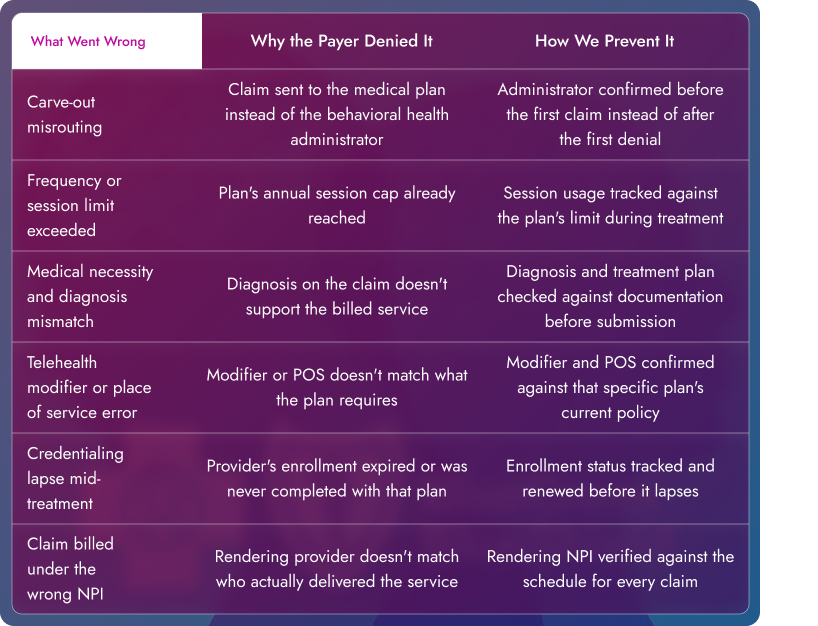
Most BCBS mental health denials repeat the same small set of causes, each tracing back to a point already covered in this guide.
Appeals: What Changes Under a Behavioral Health Carve-Out
When a behavioral health administrator handled the original claim, it usually owns the first-level appeal. Several of the 29 CFR ch. model federal claims procedure rules under ERISA, which name a minimum to which most employer-sponsored BCBS plans conform: filing an internal appeal at least180 days; plan’s decision within30 days for pre-service claim (generally);60 day- post-Service Claim and72 hours )urgent Care). Those are only federal minimums, so the deadline for a specific plan can stretch longer (which is worth checking rather than assuming).
Federal parity law requires a BCBS plan to impose mental health benefit limits no stricter than comparable medical benefits, including numerical limits like visit caps and procedural limits like preauthorization or fail-first requirements. A 2025 enforcement pause is limited to the new documentation requirements added in 2024. The underlying parity statute remains fully enforceable.
You can appeal a denial that is subject to tighter standards than a comparable medical claim on parity grounds. Most states also provide for an independent external review after internal appeals are denied.
How We Help Mental Health Providers Bill BCBS Correctly
- Plan-by-plan verification
Coverage, session limits, and administrator confirmed for that specific BCBS plan before treatment starts.
- Carve-out identification and routing
Behavioral health administrators identified upfront, with claims routed to the correct payer ID the first time.
- Credentialing tracked by plan
Enrollment and CAQH status tracked separately for every BCBS plan a provider bills.
- Denials worked to resolution.
Every denial traced to its actual cause and appealed on that basis, including parity where it applies.
Frequently Asked Questions
Does every BCBS plan use the same claims address?
No. Each independent BCBS company sets its own claims address and payer ID, and a behavioral health carve-out often has a separate address from the medical plan. A practice billing several states needs a maintained list by plan.
How do I know if my patient’s BCBS plan has a behavioral health carve-out?
Look for a different administrator name on the member ID card or get confirmation from benefit services while doing verification of benefits. Carve-out deals can change at renewal, so rerun the analysis as the new benefit year begins.
What’s the difference between 90834 and 90837?
90834 covers 38 to 52 minutes of psychotherapy, and 90837 covers 53 minutes or more. The code must match the actual, documented session length rather than the scheduled appointment slot.
Does BCBS require prior authorization for routine outpatient therapy?
Usually not for standard weekly sessions, but intensive outpatient programs, partial hospitalization, and treatment beyond a plan’s session allowance commonly do. The threshold varies by plan and administrator.
How does the Mental Health Parity Act affect my claims?
It requires limits on mental health benefits no stricter than comparable medical benefits. That statutory requirement stands regardless of the 2024 rule’s current enforcement pause.
What is the BlueCard program?
BlueCard routes a claim for an out-of-state BCBS member through your local host plan to the member’s home plan for pricing, so you still bill and submit locally rather than contacting the home plan directly.
Get a Free Billing Review for Your Mental Health Practice
Whether it’s carve-out routing, credentialing gaps, or denials that keep repeating, A2Z reviews what your current BCBS billing is actually recovering.
