
The 2027 ICD-10-CM code changes took effect on October 1, 2026, and there was no grace period. A claim billed with a deleted or non-billable code after that date is rejected or denied right away. This guide covers what changed and the steps a practice should take before the next billing cycle. It also walks through which ICD-10-CM codes for physicians were affected the most.
What Are the 2027 ICD-10-CM Code Changes?
CMS and the CDC’s National Center for Health Statistics update the ICD-10-CM code set every October. Every year’s ICD-10-CM coding changes follow roughly the same shape: a batch of new codes, a short list of deletions, and a handful of revised descriptions. These 2027 medical coding changes affect any practice that bills ICD-10-CM diagnosis codes, including primary care.
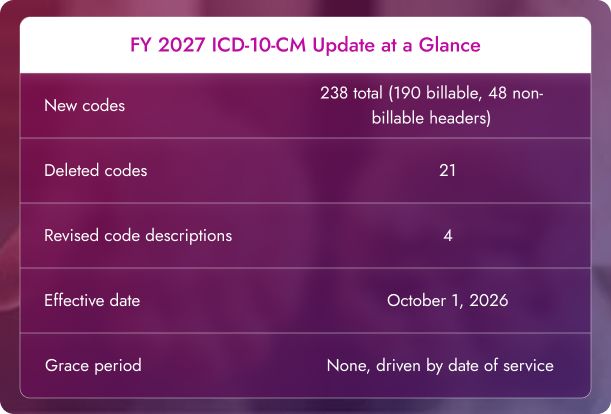
The 2027 ICD-10-CM code changes apply to any encounter or discharge from October 1, 2026 through September 30, 2027. This year’s update added 238 new entries. Of those, 190 are billable codes, and 48 are non-billable header codes that organize the billable codes listed under them. CMS deleted 21 codes outright, and four existing code descriptions were revised.
The official ICD-10-CM 2027 changes list, including the full addendum and the updated code descriptions, is posted on the CMS and CDC NCHS websites. Code selection follows the date of service for outpatient claims and the date of discharge for inpatient claims. There is no transition window.
New ICD-10-CM Codes for 2027 Physicians Should Know
Most of the new ICD-10-CM codes for physicians narrow down a condition that already had a code, asking for detail the old code could not capture.
The additions below are the ones most likely to affect a general or specialty practice.
- Plantar fasciitis laterality. A new subcategory, M67.A, splits plantar fasciitis into right foot (M67.A01), left foot (M67.A02), and unspecified foot (M67.A09).
- Dilated cardiomyopathy. The single code I42.0 becomes three codes: unspecified (I42.00), familial or genetic (I42.01), and other specified (I42.09). I42.0 alone is no longer billable.
- New arrhythmia codes. Brugada syndrome gets its own code, I49.81, and catecholaminergic polymorphic ventricular tachycardia gets I47.22.
- Post-bariatric surgery hypoglycemia. New codes E89.830 and E89.838 replace a general postprocedural code for this condition.
- Low body mass index. Z68.18 covers a BMI of 18.4 or below, and Z68.19 covers a BMI between 18.5 and 19.9.
- C. difficile history. A new history code, Z86.17, documents a past Clostridioides difficile infection.
- Inherited cancer syndromes. Lynch syndrome (QA1.71) and a BRCA1-related familial cancer syndrome (QA1.790) get dedicated codes for the first time.
- Military and environmental exposure. New codes under Z77 cover documented exposure to Agent Orange, burn pits, and blast overpressure.
- Hepatic fibrosis staging. K74.0A covers moderate fibrosis, stage F2.
- Odontogenic sinusitis. This condition now has its own code, J34.83.
Most of the 2027 ICD-10 codes covered here build on conditions a physician already documents every day.
ICD-10-CM Deleted Codes for 2027
Most practices will only notice a handful of the 21 deletions, depending on their specialty and the diagnoses they bill most often. Along with the straight deletions, CMS also moved some existing codes from billable status to header-only status. The clearest example is dilated cardiomyopathy. I42.0 was a commonly used, standalone billable code. Under the FY 2027 update, it becomes a header with three billable codes underneath it.
Billing I42.0 alone after October 1, 2026 gets the same result as billing a deleted code: the claim is rejected. Cardiology and primary care practices that document this condition often are the ones most likely to feel it. A deleted or demoted code stays in an EHR favorites list or on a paper superbill until someone removes it.
Checking the ICD-10-CM deleted codes list against a practice’s most frequently billed diagnoses is the fastest way to catch this before it turns into a backlog of denials.
How to Prepare Your Practice Before the Next Billing Cycle
These ICD-10-CM updates for physicians are worth folding into annual compliance training.
- Pull a diagnosis frequency report. Run a report of the diagnosis codes billed most often over the last twelve months and check each one against the FY 2027 deletion list. This single step catches most of the risk for a typical practice.
- Update EHR favorites and superbills. Replace any deleted or demoted code with its more specific replacement in every template, favorites list, and paper superbill the practice uses.
- Review the dilated cardiomyopathy change closely. Any provider who documents cardiomyopathy regularly needs to know that I42.0 alone is no longer billable, and should pick between unspecified, familial or genetic, and other specified going forward.
- Train providers on the new specificity requirements. Laterality, such as which foot for plantar fasciitis, needs to be documented and coded correctly starting with the first visit after October 1.
- Confirm clearinghouse and payer readiness. Ask billing software vendors and major payers whether their systems have loaded the FY 2027 code set and can process claims using it.
- Review the final CMS coding guidelines. The official guidelines sometimes post close to the effective date, so check for updates before treating any earlier summary as final.
- Set a short internal deadline. Giving the practice a target date in September, ahead of the October 1 cutoff, leaves time to fix any template that was missed on the first pass.
What Happens If a Practice Bills an Old Code
There is no grace period for the 2027 ICD-10-CM code changes. Submitting a deleted or non-billable code for a date of service on or after October 1, 2026 gets the claim rejected or denied, no matter how small the change seems. Denials tied to a coding update tend to arrive in a cluster, since the same mistake repeats across every provider using the same outdated superbill or favorites list.
Fixing the error at the source stops the backlog from growing. Resubmitting one claim at a time without fixing the template just repeats the same denial on the next batch of claims. Catching the problem early, during the first week of October, usually leaves enough time to correct the template and clear the claims before they pile up.
How A2Z Helps Practices Stay Current on 2027 ICD-10-CM Updates
- Annual code set review. Every ICD-10-CM update is checked against a practice’s billing history before it takes effect.
- Superbill and EHR updates. Deleted and revised codes replaced across templates and favorites lists before the effective date.
- Denial tracking by cause. Claims denied for an outdated code traced back to the source so the error does not repeat.
- Provider education support. Plain language summaries of what changed, built for the specialties a practice actually bills.
Frequently Asked Questions
When did the 2027 ICD-10-CM code changes take effect?
The 2027 ICD-10-CM code changes took effect on October 1, 2026, and apply through September 30, 2027.
How many new ICD-10-CM codes were added for 2027?
CMS added 238 new entries for FY 2027. Of those, 190 are billable codes, and 48 are non-billable headers used to organize the billable codes listed under them.
What happens if a claim uses an ICD-10-CM deleted code?
A claim billed with an ICD-10-CM deleted code for a date of service on or after October 1, 2026 is rejected or denied. There is no grace period.
Is dilated cardiomyopathy still billed with I42.0?
No. I42.0 is no longer billable on its own. Claims now need one of three new codes: I42.00 for unspecified, I42.01 for familial or genetic, or I42.09 for other specified types.
Are there new ICD-10 coding guidelines for 2027?
Yes. CMS releases updated ICD-10-CM coding guidelines alongside the new code set each year, and practices should review them before training providers on the 2027 changes.
Where can a practice find the official FY 2027 ICD-10-CM files?
CMS and the CDC’s National Center for Health Statistics post the full FY 2027 code set and guidelines on their websites. A practice should treat these as the primary source for training and check any outside summary against them.
Conclusion
The 2027 ICD-10-CM code changes are already in effect, and the practices that prepared ahead of October 1 are the ones least likely to see a spike in denials this month. Checking frequently billed codes against the deletion list, updating superbills, and training providers on the new specificity requirements cover most of what this update asks for.
