
CPT code 90837 is the code for individual psychotherapy lasting 53 minutes or more. It pays more than 90834, so payers look at it more closely. If your note does not show the time, a 60-minute session can end up downcoded or denied.
This guide shows how to bill 90837 correctly in 2026. It covers the time rule, the Medicare rate, who can bill, and telehealth modifiers. You will also learn what your note needs and how to fix the most common denials. It is part of our mental health billing and coding guide, which covers the other psychotherapy codes. Read the key points below, then jump to the section you need.
Key Takeaways
- 53-minute rule: the session must run 53 minutes or more of face-to-face psychotherapy.
- 2026 Medicare rate: approximately $167.00, national non-facility average.
- Who can bill: psychologists, LCSWs, LPCs, LMFTs, and prescribers, within state scope.
- Top denial cause: missing or thin time documentation.
What Is CPT Code 90837?
CPT 90837 is for psychotherapy that lasts 60 minutes with one patient. This code applies when the session is at least 53 minutes long. It’s meant for individual therapy sessions that focus on behavioral or emotional issues using talk and interaction as the main method.
Not everything done during a session counts as psychotherapy. Things like teaching how to groom, watching a person do tasks, or doing recreation therapy do not count. If most of the time is spent on any of those, then 90837 is not the code.
CPT 90837 is grouped under “Individual Psychotherapy “ along with codes 90832 and 90834. For family sessions, use 90847. For group sessions, use 90853
90837 Time Requirements: The 53-Minute Rule
You can bill 90837 only when you spend 53 minutes or more in psychotherapy with the patient.
Individual Psychotherapy Time Ranges
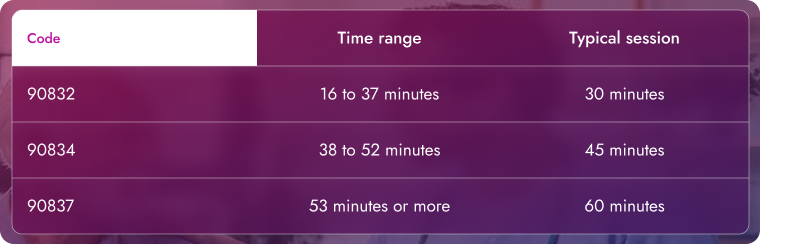
Here is a quick example. A session from 2:00 to 2:52 is 52 minutes and bills as 90834. A session from 2:00 to 2:53 is 53 minutes and bills as 90837. Under 16 minutes is not billable as psychotherapy. Our guide to timed vs untimed CPT codes explains how time-based codes work.
What counts toward the 53 minutes, and what does not
Only direct contact with patients counts toward your hour total. Time spent scheduling, talking about insurance, waiting in the lobby, or writing notes does not count. The clock starts when therapy starts and stops when therapy ends.
Sessions over 60 minutes
Bill 90837 for an extended session. CPT eliminated prolonged services (codes 99354 and 99355) effective January 1, 2023; however, many popular pages continue to suggest these codes. Those claims will be rejected. Check your payer’s policy before you bill a second unit.
Who Can Bill CPT 90837?
Any provider whose state license and payer contract cover individual psychotherapy can bill 90837. The usual providers are:
- Clinical psychologists (PhD or PsyD)
- Licensed clinical social workers (LCSW)
- Licensed professional counselors and mental health counselors (LPC, LMHC)
- Licensed marriage and family therapists (LMFT)
- Psychiatrists
- Psychiatric nurse practitioners and physician assistants
Associates and interns usually bill under a supervising clinician. The rules come from each payer and state board, so confirm them before you submit. Our guide to psychotherapy codes for psychologists covers psychologist billing in more detail.
Medicare billing for MFTs and mental health counselors
MFTs and mental health counselors can bill Medicare directly since January 1, 2024. Medicare pays them 75% of what it pays a clinical psychologist. Enrollment goes through PECOS or a paper CMS-855, as CMS explains.
Enroll and credential before you see a patient. Our CAQH credentialing post covers commercial payers.
CPT 90837 Reimbursement Rates in 2026
The Medicare national non-facility rate for 90837 is approximately $167.00 in 2026.
Approximate 2026 Medicare Rate for 90837 by Provider Type
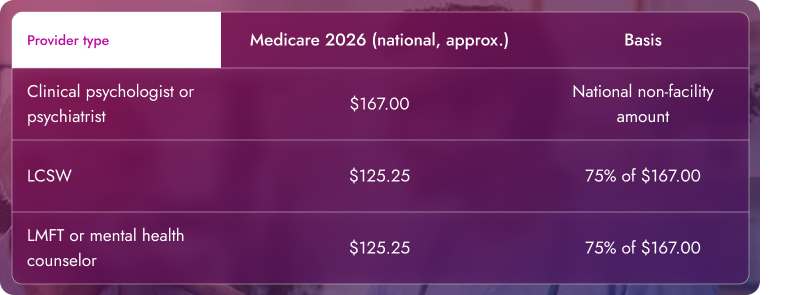
The math is $167.00 × 0.75 = $125.25. Re-check the figure on the CMS Physician Fee Schedule Look-Up Tool for your locality before you rely on it.
Why your actual payment differs
Four things change what you collect:
- Locality: the GPCI raises or lowers the national rate for your area.
- Setting: facility rates are lower than non-facility rates.
- Coinsurance: Medicare patients owe 20% of the allowed amount after the deductible.
- Contracts: commercial payers pay by contract.
90837 vs 90834 pay difference
The national non-facility rate for 90834 is approximately $113.90. That puts 90837 about $53.10, or 47%, higher per session.
90837 vs 90838: Standalone vs Add-On
Bill 90837 when psychotherapy is the only service. Bill 90838 when a prescriber adds 53 minutes or more of therapy to an E/M visit on the same day.
Which Code to Bill
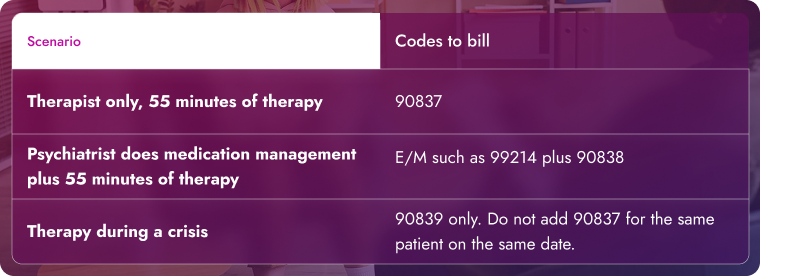
Never bill 90837 and 90838 together. Some payers want modifier 25 on the E/M, so check yours. Add 90785 when you document a specific communication barrier.
Documentation Requirements for 90837
Your note has to prove the time and the need. Every 90837 note needs:
- Start and stop time, or total time with start time
- Diagnosis and medical necessity
- Therapy modality, such as CBT, DBT, EMDR, or psychodynamic
- Interventions used in the session
- Patient response
- Plan and next steps
- Signature and credentials
Sample note that supports 90837
The diagnosis code below is an example only. A diagnosis does not guarantee coverage.
Supported note: “Session on 10/12/2026, 2:02 pm to 3:00 pm (58 minutes), in person. Dx F41.1. The patient reported that the patient had three panic attacks this week compared to five the week before. The patient used Cognitive Behavioral Therapy by reviewing the thought record, challenging the thought “I am going to lose my job,” and practicing breathing for five minutes. The patient’s rating of anxiety was eight before CBT. Dropped to four afterward. Plan: Weekly CBT sessions, creating thought records for 3 separate events, and reviewing the exposure list at the next session. J. Rivera, LCSW.”
Weak note: “Patient seen for therapy. Anxiety discussed. Continue plan. J. Rivera, LCSW.”
The weak note has no times, no intervention, and no response. A payer cannot confirm 53 minutes, so it will likely downcode to 90834 or deny.
Billing 90837 for Telehealth
Bill video sessions with modifier 95 and POS 10 for a patient at home or POS 02 for other locations. Some payers still want modifier GT. Use POS 11 for in-office visits. The note must have the detail as an office visit plus the patient’s location and consent. Audio-only sessions use modifier 93 where the payer allows them. Medicare allows audio-only in limited cases, so check 90837 on the CMS telehealth list.
The in-person visit requirement for Medicare mental health telehealth does not apply through December 31, 2027. CMS has also proposed a 1.68% cut to the 2027 conversion factor for most clinicians. That would lower Medicare payment for 90837 unless the final rule changes it. Read our 2027 Medicare physician fee schedule article.
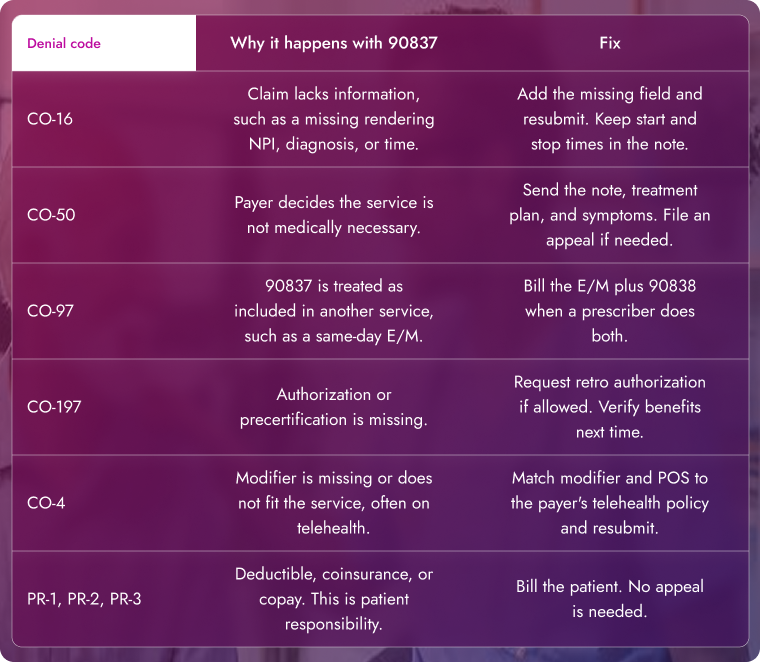
Common 90837 Denials and How to Fix Them
Most 90837 denials come from thin documentation, bundling, or a telehealth setup error.
90837 Denial Codes and Fixes
Does 90837 Need Prior Authorization?
Most payers do not require authorization for 90837. Some plans flag high 90837 use for review. Check the benefits before the session. Ask about authorization visit limits and telehealth rules. Our insurance verification guide walks through it.
CPT Code 90837 Billing Checklist
Use this list for each session:
- Eligibility and benefits verified
- Authorization checked
- Start and stop time recorded
- Session ran 53 minutes or more
- Diagnosis, modality, and patient response in the note
- Correct modifier and POS for telehealth
- No 90839, E/M, or 90838 conflict on the same date
- Note signed with credentials
Frequently Asked Questions
How many minutes is CPT code 90837?
CPT code 90837 can be used when you spend at least 53 minutes with a patient during a face-to-face psychotherapy session.
What is the 2026 Medicare reimbursement rate for 90837?
The National Non-Facility Rate is expected to be $167.00. The payment amount can vary based on where you’re located, the type of setting, and the type of provider. Use the CMS Physician Fee Schedule Look-Up Tool to find your amount.
Can an LMFT or LPC bill 90837 to Medicare?
Yes. MFTs and mental health counselors can enroll and bill Medicare since January 1, 2024. They are paid 75% of what Medicare pays a clinical psychologist, which is approximately $125.25 nationally.
Can I bill 90837 for a 50-minute session?
No. A 50-minute session falls within the 38 to 52-minute range of code 90834. You can only bill the actual number of minutes you spent with your patient.
How do I bill a therapy session longer than 90 minutes?
Most payers will bill for one unit of 90837 regardless of the length of the session. On January 1, 2023, the codes 99354 and 99355 were deleted and can no longer be used.
Can 90837 be billed with an E/M code?
Not as 90837. A prescriber who has an E/M visit and provides psychotherapy can bill the E/M with the add-on code 90838 when the time spent by the prescriber is equal to or greater than 53 minutes.
What modifier do I use for 90837 telehealth?
To indicate a video-based telehealth visit, you should include modifier 95 when using POS 10 or POS 02. Some payers require that you use modifier GT; other payers allow you to use modifier 93 if the service was delivered via telephone.
Why was my 90837 claim downcoded to 90834?
The most common reason for being denied is a lack of start and end times, or the notes you submit do not indicate that you provided 53 minutes of therapy. Correct your documentation, and submit an appeal with an accurate time log.
Does Medicare cover 90837 every week?
You may have weekly sessions covered if your record shows that the service is medically necessary. Different MACs and plans establish their own rules regarding how often you will be allowed to receive services.
Get Your 90837 Claims Paid
Our mental health billing services department looks over time records, checks how modifiers are used, and reviews payer rules before sending claims. For a look at how we manage billing for mental health practices, please check our mental health billing and coding guide.
