
That thirteen-digit ICN number is easily the most underrated piece of data in your whole revenue cycle.
Nobody talks about it much because it doesn’t feel exciting; it’s just a number the payer slaps on your claim after they receive it.
But once you understand what it contains and how to read it, a lot of the friction that used to eat up your billing team’s afternoons just disappears.
What Is an ICN Number?
ICN stands for Internal Control Number.
Medicare (and quite a few commercial payers) assigns one to every single claim the moment it lands in their system, whether you submitted it electronically or mailed it in on paper.
Think of it less as a billing code and more as a tracking number, the same idea as the one your Amazon package gets, except this one follows your claim through submission, review, payment, denial, correction, or appeal.
Here’s the part people miss: your practice’s own internal claim number, the one your EHR generates when you create the claim, means absolutely nothing to the payer’s system. It’s for your records only. The ICN is the number the payer actually recognizes, and it’s the only reference that lets a rep instantly locate the exact claim you’re calling about instead of guessing based on a patient name that might match five different people in their database.
Breaking Down the 13 Digits
Medicare’s ICN isn’t a random string. Every digit means something, and once you know the pattern, you can actually read useful information straight off the number itself without opening a portal.
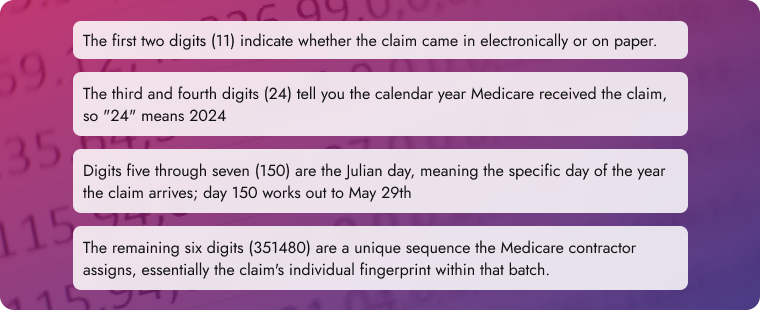
That’s Medicare’s standard format specifically. It doesn’t hold across every payer. Aetna also uses a 13-digit format, but Meritain uses only 7 digits, and UnitedHealthcare’s ICN typically runs 10. The concept stays the same everywhere, a unique claim identifier, but don’t assume you can apply the Medicare decoding trick to a commercial EOB and expect it to line up.
Not the Same Thing: ICN, CCN, DCN, and TCN
This is where billing teams genuinely get tripped up: these four acronyms are used almost interchangeably in casual conversation, but they’re not actually the same thing.
TCN, or Transaction Control Number, is the term most state Medicaid programs use in place of ICN. Functionally, it does the same job, tracking a claim from submission to payment. Still, the format varies widely by state, ranging from 13 to 17 digits, and some states even embed the provider’s NPI directly into the number. If your practice bills across multiple state Medicaid programs, keep a cheat sheet of which state calls it what, because assuming uniformity here is a fast way to confuse your own team.
CCN, or Claim Control Number, is basically just Medicare’s other name for the ICN. The two terms are used interchangeably within Medicare’s own systems, so if a rep says CCN instead of ICN, you’re talking about the same number.
DCN, or Document Control Number, is different. It’s more of a pre-submission or supporting-document identifier, something a clearinghouse assigns before the payer’s system converts it into a permanent ICN, or something tied to a records request or attachment rather than the claim itself. If you’re chasing down a medical records request tied to a claim, that reference number might be a DCN, not the ICN you’d use to check payment status.
Where to Actually Find the ICN
Knowing what an ICN is doesn’t help much if you can’t locate it when you need it. A few places to check, in order of how often you’ll actually use them:
Your remittance advice is the first stop. On a Medicare Summary Notice or a standard remittance, the ICN sits right next to the beneficiary’s name and Medicare ID, on the same line. If you’re staring at an 835 electronic remittance file instead of a printed page, the ICN lives in the CLP07 segment, sometimes labeled the “Payer Claim Control Number.”
Payer portals are the second stop, and honestly, probably the most convenient one day to day. Novitasphere and other MAC-specific dashboards display the ICN right alongside claim status, payment details, and any adjustment codes, searchable by patient or date of service.
If neither of those has it yet, the claim may not have been fully processed. Calling the payer directly and providing the patient’s member ID, date of service, and billed amount will usually prompt a rep to read the ICN back to you over the phone.
Why This Little Number Moves the Needle in 2026
It’s tempting to file this under “administrative trivia,” but there are real dollars at stake in getting ICN handling right, especially as claim volume and denial complexity keep climbing.
Voided and corrected claims flat out require it. If a claim needs to be replaced because of a coding error or voided because it should never have been paid in the first place, Medicare compares the resubmission to the original ICN to ensure the correction ties back to the correct claim. Submit a replacement without referencing the correct ICN, and you’re not fixing anything; you’re just creating a new problem for someone to untangle later.
It dramatically shortens every phone call and every portal search. A rep who has your ICN can pull your exact claim in seconds. A rep working off a patient name and a rough date range is sifting through a pile, and that pile gets bigger every year as claim denial rates climb. Denial rates on ACA marketplace plans alone have ranged from 2 percent to nearly half of submitted claims, depending on the insurer, according to KFF’s tracking of in-network denials, so the faster you can pinpoint a specific claim, the faster you get paid.
It also builds your audit trail. Every touch a claim gets, initial submission, denial, appeal, correction, stays linked to that same ICN thread. If a payer ever comes back questioning a billing pattern on your account, having a clean, ICN-referenced history of every claim’s lifecycle is exactly the kind of documentation that makes an audit go smoothly rather than dragging on for months.
The Mistakes That Cost Time (And Sometimes Money)
Treating your practice’s internal claim number as though the payer will recognize it is probably the single most common mix-up, and it’s an easy habit to fall into, especially for newer billing staff. Your internal number organizes your own files. It means nothing on the payer’s end.
Confusing a DCN with an ICN comes up constantly, too, particularly when a claim gets flagged for a records request. That pre-submission reference number isn’t interchangeable with the number you’ll need for a status check once the claim has actually been adjudicated.
Assuming every payer’s ICN format matches Medicare’s thirteen-digit, date-encoded structure is another one. Try decoding a UnitedHealthcare ten-digit ICN using Medicare’s Julian day method and you’ll just end up with nonsense. Each payer builds its own system, and while the underlying purpose is universal, the format absolutely is not.
And finally, losing track of the ICN entirely on a claim that needs correcting. Without it, resubmitting a corrected or voided claim becomes far harder, sometimes requiring a phone call just to retrieve information you could have pulled from your own remittance file in 30 seconds if it had been logged properly the first time.
Bottom Line
The ICN isn’t glamorous, but it’s one of those unglamorous details that determines how smoothly (or painfully) your denial management and claim correction process actually runs. Learn to read Medicare’s 13 digits, know the difference between an ICN, a CCN, a DCN, and a TCN, and build the habit of logging every ICN the moment it appears on a remittance. That one habit alone shaves real time off every follow-up call your team makes.
Chasing down ICNs across dozens of payer portals eats up hours your staff could spend on actual denial resolution. A2Z Medical Billing services tracks and organizes claim identifiers as part of our full revenue cycle service, so your team isn’t stuck hunting for a thirteen-digit number every time a claim needs a second look.
Get in touch for a free review of your current claim-tracking workflow.
Frequently Asked Questions
Is the ICN the same thing as a claim number?
In practice, yes, that’s exactly how most people use the term. The ICN is the number the payer assigns once a claim officially enters its processing system, and it serves as the claim’s unique tracking ID from that point forward. Some payers label it a claim number, a reference number, or a claim control number on your EOB or ERA instead of writing out “ICN,” but they’re all pointing to the same underlying identifier.
Can I look up an ICN before a claim has finished processing?
Not always, and this trips people up when they check a portal too soon. Until Medicare or a commercial payer has actually received and logged the claim into their system, there’s no ICN to display yet. If you’re checking status and the ICN field is blank, that alone can be a useful signal that the claim hasn’t fully arrived on the payer’s end, which is worth confirming before assuming it’s lost.
Does every insurance company use a 13-digit ICN, as Medicare does?
No, and this is one of the more common misunderstandings. Medicare’s format runs 13 digits with specific meaning built into each segment, but Aetna, Meritain, UnitedHealthcare, and other commercial payers each maintain their own format and length. The purpose is consistent across the board, uniquely identifying a claim, but the actual digit count and structure vary payer to payer.
What’s the difference between an ICN and a DCN?
The ICN identifies a claim once it’s been received and entered into the payer’s processing system. A DCN, or Document Control Number, is more often tied to supporting documentation, attachments, or a pre-submission tracking stage handled by a clearinghouse. They’re related but not interchangeable, and using a DCN when a payer rep asks for an ICN can send your call in the wrong direction entirely.
Why do state Medicaid programs use TCN instead of ICN?
It largely comes down to terminology choices made independently by each state’s Medicaid program rather than any functional difference. TCN (Transaction Control Number) does the same job as Medicare’s ICN. Still, the format can differ significantly from state to state, with some states embedding the provider’s NPI directly into the number, and the length ranging from 13 to 17 digits. If your practice bills Medicaid in more than one state, checking each state’s specific billing manual for its TCN format saves a lot of confusion down the line.
What should I do if I lost track of the ICN for a claim I now need to correct?
Start with your remittance advice or ERA file from when the claim was originally paid or denied, since the ICN should be printed or embedded there. If you can’t locate it that way, most payer portals let you search by patient information and date of service to pull it back up. As a last resort, calling the payer directly with the patient’s member ID, date of service, and billed amount will usually get a representative to retrieve and confirm the ICN for you over the phone.
